



 Chat with AI
Exam 11: Public Goods and Common Resources

Exam 1: Ten Principles of Economics455 Questions
Exam 2: Thinking Like an Economist645 Questions
Exam 3: Interdependence and the Gains From Trade550 Questions
Exam 4: The Market Forces of Supply and Demand693 Questions
Exam 5: Elasticity and Its Application625 Questions
Exam 6: Supply, Demand, and Government Policies671 Questions
Exam 7: Consumers, Producers, and the Efficiency of Markets547 Questions
Exam 8: Application: The Costs of Taxation507 Questions
Exam 9: Application: International Trade521 Questions
Exam 10: Externalities543 Questions
Exam 11: Public Goods and Common Resources453 Questions
Exam 12: The Design of the Tax System563 Questions
Exam 13: The Costs of Production649 Questions
Exam 14: Firms in Competitive Markets608 Questions
Exam 15: Monopoly662 Questions
Exam 16: Monopolistic Competition649 Questions
Exam 17: Oligopoly522 Questions
Exam 18: The Markets for the Factors of Production592 Questions
Exam 19: Earnings and Discrimination511 Questions
Exam 20: Income Inequality and Poverty478 Questions
Exam 21: The Theory of Consumer Choice568 Questions
Exam 22: Frontiers in Microeconomics461 Questions
Select questions type


In a cost-benefit analysis, the value of a human life is sometimes calculated on the basis of
(Multiple Choice)
4.7/5  (91)
(91) If we can conclude that human life has a finite value, cost-benefit analysis can lead to solutions in which human life is worth less than the cost of a potential project.
(True/False)
4.8/5 (74)
(74) Why do wild salmon populations face the threat of extinction while goldfish populations are in no such danger?
(Essay)
4.9/5 (76)
(76) Studies that compare the wages of more risky and less risky occupations estimate the value of a human life to be about
(Multiple Choice)
4.9/5 (84)
(84) Figure 11-1  -Refer to Figure 11-1. Once good x is provided, policymakers need to be concerned about how much of it is used. Good x is an example of the type of good represented by Box
 (Multiple Choice)
4.7/5 (91)
(91) Common resources and public goods have in common that they are not excludable and they are not rival in consumption.
(True/False)
4.9/5 (72)
(72) Private markets usually provide lighthouses because ship captains have the incentive to navigate using the lighthouse and therefore will pay for the service.
(True/False)
4.8/5 (71)
(71) Table 11-5
A small island off the coast of Cape Cod contains two restaurants and two retail stores. Tourists need to take a ferry boat to reach the island, but with a recent slowdown in the economy, tourists are less willing to pay for the boat ride to visit the island. The owners of the restaurants and stores on the island - Restaurants 1 and 2, and Stores A and B - think that if tourists could ride the ferry for free, they would be happy to visit the island, eat and shop. The business owners are considering contributing to a pool of money that will be used to pay for roundtrip ferry service each day. The table represents their willingness to pay, that is, the maximum amount that each business owner is willing to contribute, per day, to pay for each ferry trip.  -Refer to Table 11-5. Suppose the cost to run the ferry for each roundtrip is $750 per day and the 4 business owners have agreed to split the costs of the ferry trips equally. Which business owner(s) would be opposed to having any ferry trips?
 (Multiple Choice)
4.8/5 (73)
(73) Which of the following is not a reason why government agencies subsidize basic research?
(Multiple Choice)
4.8/5 (78)
(78) Table 11-6
Consider the city of Widgetapolis with only four residents, John, James, Mary, and Lydia. The four residents are trying to determine how many hours to spend in cleaning up the public lake. The table below shows each resident's willingness to pay for each hour of cleaning. 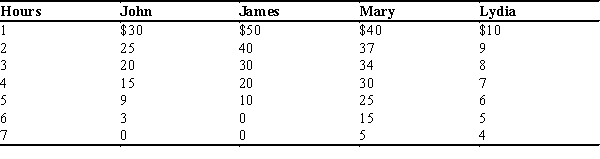
-Refer to Table 11-6. Suppose the cost to clean the lake is $32 per hour and that the residents have agreed to split the cost of cleaning the lake equally. It would maximize Lydia's surplus if 6 hours of cleaning is done.
-Refer to Table 11-6. Suppose the cost to clean the lake is $32 per hour and that the residents have agreed to split the cost of cleaning the lake equally. It would maximize Lydia's surplus if 6 hours of cleaning is done. (True/False)
4.8/5 (95)
(95) People cannot be prevented from using a good if the good is
(Multiple Choice)
4.9/5 (84)
(84) Which of the following types of goods are rival in consumption?
(Multiple Choice)
4.9/5 (91)
(91) Consider a good for which the number of people who benefit from the good is large and the exclusion of any one those people is impossible. In this case, the market for this good will likely
(Multiple Choice)
4.9/5 (74)
(74) The overuse of a common resource relative to its economically efficient use is called
(Multiple Choice)
4.9/5 (75)
(75) Each of the following explains why cost-benefit analysis is difficult except
(Multiple Choice)
4.9/5 (83)
(83) What particular characteristic do public goods and common resources have in common?
(Essay)
4.9/5 (77)
(77) A neighborhood voted to develop a vacant lot into a vegetable garden. All of the neighbors worked the land and sowed the seeds. A few neighbors picked and ate the produce before the other neighbors had a chance. Which of the following could solve this example of the Tragedy of the Commons?
(Multiple Choice)
4.8/5 (69)
(69) 
Filters
- Essay(0)
- Multiple Choice(0)
- Short Answer(0)
- True False(0)
- Matching(0)