



 Chat with AI
Exam 11: Corporations-An Introduction

Exam 1: Taxation-Its Role in Decision Making8 Questions
Exam 2: Fundamentals of Tax Planning6 Questions
Exam 3: Liability for Tax, Income Determination, and Administration of the Income Tax System5 Questions
Exam 4: Income From Employment7 Questions
Exam 5: Income From Business7 Questions
Exam 6: The Acquisition, Use, and Disposal of Depreciable Property6 Questions
Exam 7: Income From Property6 Questions
Exam 8: Gains and Losses on the Disposition of Capital Property-Capital Gains7 Questions
Exam 9: Other Income, Other Deductions, and Special Rules for Completing Net Income for Tax Purposes6 Questions
Exam 10: Individuals: Determination of Taxable Income and Taxes Payable10 Questions
Exam 11: Corporations-An Introduction9 Questions
Exam 12: Organization, Capital Structures, and Income Distributions of Corporations9 Questions
Exam 13: The Canadian-Controlled Private Corporation9 Questions
Exam 14: Multiple Corporations and Their Reorganization7 Questions
Exam 15: Partnerships8 Questions
Exam 16: Limited Partnerships and Joint Ventures8 Questions
Exam 17: Trusts6 Questions
Exam 18: Business Acquisitions and Divestitures-Assets Versus Shares6 Questions
Exam 19: Business Acquisitions and Divestitures-Tax-Deferred Sales6 Questions
Exam 20: Domestic and International Business Expansion4 Questions
Exam 21: Tax Aspects of Corporate Financing7 Questions
Exam 22: Gsthst Overview5 Questions
Exam 23: Business Valuations7 Questions
Select questions type


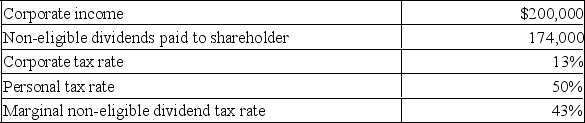
The Canadian tax system practices integration between corporations and individuals. Using the data in Table 1 and assumed rates, illustrate and explain the concept of integration.
Table 1

Free
(Essay)
4.9/5  (82)
(82) Correct Answer: Verified
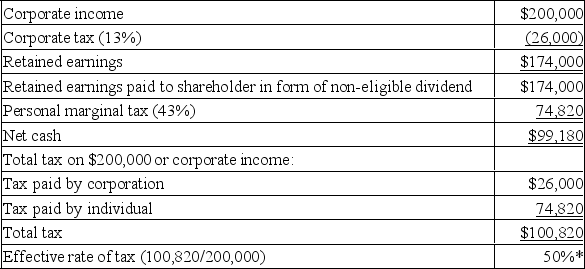 *Rounded The concept of integration illustrated here shows that as income flows through a corporation and ultimately to an individual, the total tax paid on that income is relatively equivalent to the amount that the individual would have paid had he/she received the income directly, rather than through a corporation. Thus, double taxation is avoided. [However, this example is based on set tax rates which may differ in varying circumstances, and double taxation may occur in some scenarios.]
Which of the following scenarios is not allowed?
Free
(Multiple Choice)
4.8/5 (89)
(89) Correct Answer:Verified
VerifiedB
When shares are transferred from one group of shareholders to another and there is a change in control, which of the following applies?
Free
(Multiple Choice)
4.8/5 (82)
(82) Correct Answer:Verified
VerifiedD
Which of the following statements accurately describes the tax treatment of Canadian corporations?
(Multiple Choice)
5.0/5 (86)
(86) Using general terms, explain how a change in control of a corporation can affect the net-capital losses and the non-capital losses.
(Essay)
4.8/5 (72)
(72) Coffee Co. began operations in 20x0 and recognized $37,000 in business income and $1,000 in taxable capital gains that year. In 20x1, the company incurred a business loss of $25,000, a taxable capital gain of $2,000, and an allowable capital loss of $5,000. Business income for 20x2 was $50,000, taxable capital gains were $4,000, and the company received $10,000 in dividends from a taxable Canadian corporation. Coffee Co. utilizes any unused losses in the earliest years possible, Which of the following taxable incomes are correct after all carry-over adjustments have been made?
(Multiple Choice)
4.9/5 (79)
(79) Johnson Co. is a CCPC with active business income of $350,000 in 20xx. The company engages in retail and wholesale activities. Capital gains recognized by the company in 20xx totaled $84,000.
Johnson Co. will utilize a net capital loss carry-over of $28,000 on its 20xx tax return.
Required:
Applying tax rates and amounts for 2019, calculate the following for Johnson Co. for 20xx:
a) Net Income for Tax Purposes
b) Taxable Income
c) Federal Tax
(Essay)
4.7/5 (74)
(74) Bride and Groom Co. is a Canadian controlled private corporation with active business income of $750,000 in 20x9. Dividends were received during 20x9 from a taxable Canadian corporation in the amount of $80,000. The company recognized a $50,000 capital gain during 20x9. The company's year-end is December 31st.
Additional information is as follows:
Net capital loss carry-over from 20x8 is $30,000.
Non capital loss carry-over from 20x8 is $70,000.
Required:
Calculate the following for the company for the 20x9 tax year:
A) Net income for tax purposes
B) Taxable income
C) Part I Federal tax
(Use tax rates and amounts applicable for 2019 for each of the above.)
(Essay)
5.0/5 (80)
(80) Steven Co. is a public Canadian corporation which was established five years ago. The company's head office is located in Saskatchewan. In 2018, a small branch was established in Manitoba.
In 2019, the company's books included the following:
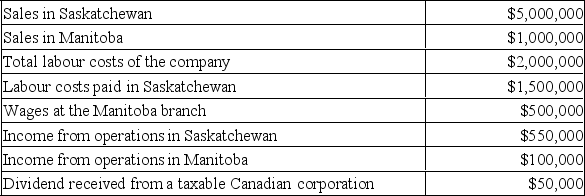 Required:
A) Calculate the company's net income for tax purposes for 2019.
B) Calculate the company's taxable income, both federal and provincial. (Round all amounts to two decimal places.)
C) Calculate Steven Co.'s Part I federal tax liability. (Round all numbers to zero decimal points.)
(Use tax rates and amounts applicable for 2019 for each of the above.)
Required:
A) Calculate the company's net income for tax purposes for 2019.
B) Calculate the company's taxable income, both federal and provincial. (Round all amounts to two decimal places.)
C) Calculate Steven Co.'s Part I federal tax liability. (Round all numbers to zero decimal points.)
(Use tax rates and amounts applicable for 2019 for each of the above.) (Essay)
4.7/5 (81)
(81) 
Filters
- Essay(0)
- Multiple Choice(0)
- Short Answer(0)
- True False(0)
- Matching(0)