



 Chat with AI
Exam 12: Organization, Capital Structures, and Income Distributions of Corporations

Exam 1: Taxation-Its Role in Decision Making8 Questions
Exam 2: Fundamentals of Tax Planning6 Questions
Exam 3: Liability for Tax, Income Determination, and Administration of the Income Tax System5 Questions
Exam 4: Income From Employment7 Questions
Exam 5: Income From Business7 Questions
Exam 6: The Acquisition, Use, and Disposal of Depreciable Property6 Questions
Exam 7: Income From Property6 Questions
Exam 8: Gains and Losses on the Disposition of Capital Property-Capital Gains7 Questions
Exam 9: Other Income, Other Deductions, and Special Rules for Completing Net Income for Tax Purposes6 Questions
Exam 10: Individuals: Determination of Taxable Income and Taxes Payable10 Questions
Exam 11: Corporations-An Introduction9 Questions
Exam 12: Organization, Capital Structures, and Income Distributions of Corporations9 Questions
Exam 13: The Canadian-Controlled Private Corporation9 Questions
Exam 14: Multiple Corporations and Their Reorganization7 Questions
Exam 15: Partnerships8 Questions
Exam 16: Limited Partnerships and Joint Ventures8 Questions
Exam 17: Trusts6 Questions
Exam 18: Business Acquisitions and Divestitures-Assets Versus Shares6 Questions
Exam 19: Business Acquisitions and Divestitures-Tax-Deferred Sales6 Questions
Exam 20: Domestic and International Business Expansion4 Questions
Exam 21: Tax Aspects of Corporate Financing7 Questions
Exam 22: Gsthst Overview5 Questions
Exam 23: Business Valuations7 Questions
Select questions type


Which of the following scenarios would be appropriate for a section 85 rollover?

Free
(Multiple Choice)
4.7/5  (81)
(81) Correct Answer: Verified
C
Janko Corp. has transferred the following three assets to Jumbo Corp., a Canadian controlled private corporation, under section 85 of the Income Tax Act.
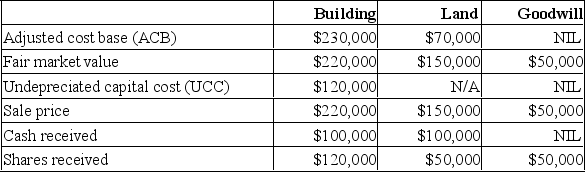 Required:
Determine the following amounts:
A) The minimum amount that Janko may elect to transfer each asset in the rollover based on the information provided
B) Janko's income or loss for tax purposes as a result of the rollover
C) The ACB of the shares received by Janko following the rollover
D) The PUC of the shares received by Janko following the rollover
Required:
Determine the following amounts:
A) The minimum amount that Janko may elect to transfer each asset in the rollover based on the information provided
B) Janko's income or loss for tax purposes as a result of the rollover
C) The ACB of the shares received by Janko following the rollover
D) The PUC of the shares received by Janko following the rolloverFree
(Essay)
4.8/5 (88)
(88) Correct Answer:Verified
Verified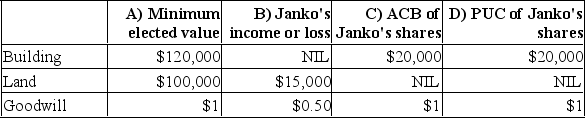
Which of the following statements is TRUE regarding the disposal of shares by a shareholder?
Free
(Multiple Choice)
4.9/5 (83)
(83) Correct Answer:Verified
VerifiedD
Green Co. transferred a small piece of land to one of its shareholders as a dividend in kind. The land originally cost $50,000 and had a fair market value of $175,000 at the time of the transfer. The corporation will realize ________, and the shareholder will realize ________.
(Multiple Choice)
4.9/5 (86)
(86) Anthony is the sole shareholder of Glass Co. He would like to lend $500,000 to his company by way of a shareholder loan. He is not sure whether to issue an interest free loan or a loan with an interest rate of 10%. Anthony does not pay himself a salary, but rather issues all after-tax profits to himself in the form of a dividend.
Required:
A) Calculate the total combined tax liability for Anthony and Glass Co. under both alternatives (an interest free loan and a loan with 10% interest). (Assume that CRA's prescribed rate of interest is 2%, Anthony's personal tax rate is 50%, his marginal tax rate on dividends is 43%, and Glass Co. has income of $200,000, subject to a 13% tax rate.)
B) Has double taxation occurred in either scenario?
(Essay)
4.8/5 (68)
(68) Ben is incorporating his proprietorship and transferring all of the assets to the new company, which he will continue to operate. His long-term assets consist of:

 The transfer will also include the company's inventory and accounts receivables. The inventory originally cost $25,000 and has a fair market value of $30,000. The accounts receivable have a fair market value of $10,000 and a tax value of $12,000.
Ben wishes to minimize the tax effect of this business decision. He will receive the maximum note receivable possible and the remainder of the transfer in preferred shares.
Required:
A) What is the elected value for each of the assets transferred under section 85?
B) What is the value of the note receivable that Ben will receive from those assets which benefit from section 85? (Show the amounts for each asset, and the total for all.)
C) What is the value of the preferred shares that Ben must receive in order to defer any income inclusions at this point in time?
D) Identify which assets would not benefit from section 85.
E) If Ben elects to transfer the accounts receivable using a section 22 election, what is the amount of Ben's business loss that must be included in the corporation's income?
The transfer will also include the company's inventory and accounts receivables. The inventory originally cost $25,000 and has a fair market value of $30,000. The accounts receivable have a fair market value of $10,000 and a tax value of $12,000.
Ben wishes to minimize the tax effect of this business decision. He will receive the maximum note receivable possible and the remainder of the transfer in preferred shares.
Required:
A) What is the elected value for each of the assets transferred under section 85?
B) What is the value of the note receivable that Ben will receive from those assets which benefit from section 85? (Show the amounts for each asset, and the total for all.)
C) What is the value of the preferred shares that Ben must receive in order to defer any income inclusions at this point in time?
D) Identify which assets would not benefit from section 85.
E) If Ben elects to transfer the accounts receivable using a section 22 election, what is the amount of Ben's business loss that must be included in the corporation's income? (Essay)
4.8/5 (75)
(75) There are significant differences in the tax treatment of shareholder debt and shareholder equity from the perspective of both the CCPC and the shareholders.
Required:
List one tax consequences for each of the following:
1) Return on investment - shareholder debt
2) Loss on investment - shareholder debt
3) Return of capital - shareholder debt
4) Return on investment - shareholder equity
5) Loss on investment - shareholder equity
6) Return of capital - shareholder equity
(Essay)
4.9/5 (63)
(63) Corporation A is a Canadian controlled private corporation and Corporation B is a public Canadian corporation. Both corporations have a paid-up capital balance of $25,000. Which of these statements is TRUE, provided the proper legal steps are
(Multiple Choice)
5.0/5 (77)
(77) Tony Brown sold 5000 of his shares back to ABC Co. for $25,000 during the current fiscal year. He purchased these shares from Carrie White three years ago for $15,000. Carrie had originally purchased the shares from the corporate treasury for $10,000. Which of the following tax consequences will Tony recognize?
(Multiple Choice)
4.7/5 (78)
(78) 
Filters
- Essay(0)
- Multiple Choice(0)
- Short Answer(0)
- True False(0)
- Matching(0)