



 Chat with AI
Exam 9: Other Income, Other Deductions, and Special Rules for Completing Net Income for Tax Purposes

Exam 1: Taxation-Its Role in Decision Making8 Questions
Exam 2: Fundamentals of Tax Planning6 Questions
Exam 3: Liability for Tax, Income Determination, and Administration of the Income Tax System5 Questions
Exam 4: Income From Employment7 Questions
Exam 5: Income From Business7 Questions
Exam 6: The Acquisition, Use, and Disposal of Depreciable Property6 Questions
Exam 7: Income From Property6 Questions
Exam 8: Gains and Losses on the Disposition of Capital Property-Capital Gains7 Questions
Exam 9: Other Income, Other Deductions, and Special Rules for Completing Net Income for Tax Purposes6 Questions
Exam 10: Individuals: Determination of Taxable Income and Taxes Payable10 Questions
Exam 11: Corporations-An Introduction9 Questions
Exam 12: Organization, Capital Structures, and Income Distributions of Corporations9 Questions
Exam 13: The Canadian-Controlled Private Corporation9 Questions
Exam 14: Multiple Corporations and Their Reorganization7 Questions
Exam 15: Partnerships8 Questions
Exam 16: Limited Partnerships and Joint Ventures8 Questions
Exam 17: Trusts6 Questions
Exam 18: Business Acquisitions and Divestitures-Assets Versus Shares6 Questions
Exam 19: Business Acquisitions and Divestitures-Tax-Deferred Sales6 Questions
Exam 20: Domestic and International Business Expansion4 Questions
Exam 21: Tax Aspects of Corporate Financing7 Questions
Exam 22: Gsthst Overview5 Questions
Exam 23: Business Valuations7 Questions
Select questions type


Which of the following is FALSE regarding Tax Free Savings Accounts (TFSAs)?

Free
(Multiple Choice)
4.7/5  (86)
(86) Correct Answer: Verified
B
Car Co. is selling its land and building to Truck Co. for $340,000 (Land $200,000; Building $140,000). These values have not been officially appraised, and Truck Co. thinks that the land is only worth $150,000 and the building is worth $190,000. (Car Co. originally paid $100,000 for the land and constructed the building for $150,000. The UCC on the building is currently $130,000.) Which of the following statements is TRUE based on these facts?
Free
(Multiple Choice)
4.9/5 (80)
(80) Correct Answer:Verified
VerifiedC
Which of the following examples of income received from private corporations would not be excluded from tax on split income for adult family members?
Free
(Multiple Choice)
4.9/5 (79)
(79) Correct Answer:Verified
VerifiedB
Identify whether the following sources of income and expenditures are included for the calculation of net income for tax purposes.
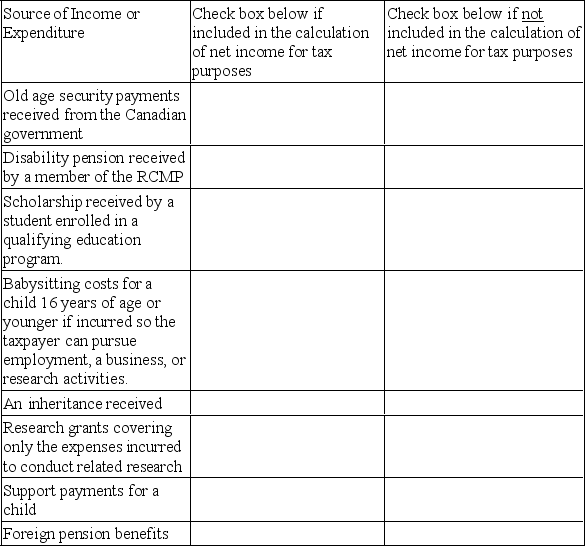
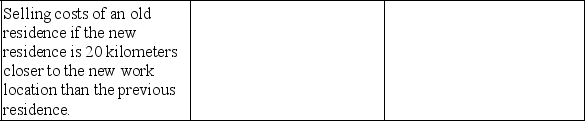
(Essay)
4.9/5 (88)
(88) Agatha earned $35,000 at her job during January 1st - October 10th of 20x4. She accepted a new position with the company in a town 1312 kilometres away and began the new job on November 1st, 20x4, earning a gross salary of $4000 per month.
Agatha's moving expenses included:
$7,000 for a moving van
$300 for meals en route for Agatha and her 4 year-old daughter on the four-day drive
$700 for accommodations en route
$3000 ($150 per day) for 20 nights of temporary lodging in the new location until her apartment was available
$550 in gas receipts
She was not reimbursed for the move.
Agatha also received the following in 20x4:
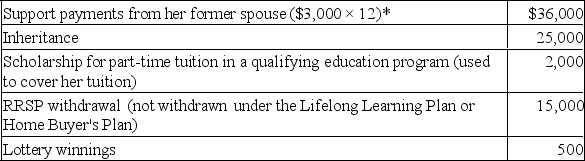 *The support payments are in accordance with Agatha's divorce agreement, which calls for monthly support payments of $1,500 for Agatha and $1,500 for her daughter.
Additional information:
Assumed mileage rates:
 Required:
Determine Agatha's minimum net income for tax purposes for 20x4 in accordance with Section 3 of the Income Tax Act. Show all calculations for her moving expenses and identify any amounts to be carried-forward.
*The support payments are in accordance with Agatha's divorce agreement, which calls for monthly support payments of $1,500 for Agatha and $1,500 for her daughter.
Additional information:
Assumed mileage rates:
Required:
Determine Agatha's minimum net income for tax purposes for 20x4 in accordance with Section 3 of the Income Tax Act. Show all calculations for her moving expenses and identify any amounts to be carried-forward. (Essay)
4.9/5 (90)
(90) Steve gifted shares in a public corporation to his fifteen-year-old son, Simon. The ACB of the shares was $10,000. During the year, Simon received $500 in dividends from the shares. Simon then sold the shares for $12,000. Which of the following is true for Steve and Simon?
(Multiple Choice)
5.0/5 (97)
(97) 
Filters
- Essay(0)
- Multiple Choice(0)
- Short Answer(0)
- True False(0)
- Matching(0)