



 Chat with AI
Exam 7: Income From Property

Exam 1: Taxation-Its Role in Decision Making8 Questions
Exam 2: Fundamentals of Tax Planning6 Questions
Exam 3: Liability for Tax, Income Determination, and Administration of the Income Tax System5 Questions
Exam 4: Income From Employment7 Questions
Exam 5: Income From Business7 Questions
Exam 6: The Acquisition, Use, and Disposal of Depreciable Property6 Questions
Exam 7: Income From Property6 Questions
Exam 8: Gains and Losses on the Disposition of Capital Property-Capital Gains7 Questions
Exam 9: Other Income, Other Deductions, and Special Rules for Completing Net Income for Tax Purposes6 Questions
Exam 10: Individuals: Determination of Taxable Income and Taxes Payable10 Questions
Exam 11: Corporations-An Introduction9 Questions
Exam 12: Organization, Capital Structures, and Income Distributions of Corporations9 Questions
Exam 13: The Canadian-Controlled Private Corporation9 Questions
Exam 14: Multiple Corporations and Their Reorganization7 Questions
Exam 15: Partnerships8 Questions
Exam 16: Limited Partnerships and Joint Ventures8 Questions
Exam 17: Trusts6 Questions
Exam 18: Business Acquisitions and Divestitures-Assets Versus Shares6 Questions
Exam 19: Business Acquisitions and Divestitures-Tax-Deferred Sales6 Questions
Exam 20: Domestic and International Business Expansion4 Questions
Exam 21: Tax Aspects of Corporate Financing7 Questions
Exam 22: Gsthst Overview5 Questions
Exam 23: Business Valuations7 Questions
Select questions type


Stella Flier has received an inheritance of $100,000. She is trying to decide what to do with this money and has come to you for some advice. She has an excellent credit rating and no outstanding debts. She would like to buy a $225,000 house and invest $100,000 in bonds as a safety net.
Required:
How could Stella minimize her tax liability, assuming only the facts given?

Free
(Essay)
4.7/5  (79)
(79) Correct Answer: Verified
Stella could use the $100,000 for a down payment on her house and borrow $125,000 for the remainder. She could then borrow $100,000 to purchase the bonds. The interest on the investment loan would be deductible against any income earned on the bonds. If Stella were to borrow the full amount required for her house while buying the bonds with her inheritance, she would not have any allowable deductions for tax purposes. (This solution is exclusive of factors such as interest rates, etc., all of which should be given careful consideration.)
Martha Shine has provided you with the following information for 20xx:
She owns rental properties originally valued at $275,000. (Property 1: land $70,000, building $55,000) (Property 2: land $90,000, building $60,000)
The buildings are Class 1 (4%) properties.
-Net rental income before CCA in 20xx was $11,000.
-The UCC on building 1 at the beginning of 20xx was $50,000.
-The UCC on building 2 at the beginning of 20xx was $40,000.
-Property 2 was sold in 20xx for $250,000 (land $200,000, building $50,000)
She owns shares in ABC Inc. (a CCPC) valued at $50,000.
-She received $5,000 in non-eligible dividends on the shares in 20xx.
Martha purchased a 5-year GIC two years ago for $30,000.
-Interest earned in 20xx was $1,000.
Martha worked full-time as a baker in 20xx, earning a gross salary of $45,000.
Martha is in a 45% tax bracket.
Required:
Calculate Martha's net income for tax purposes in 20xx in accordance with Section 3 of the Income Tax Act. Martha will take the maximum CCA allowed this year on her rental properties. (Assume the tax year is 2019.)
Free
(Essay)
4.8/5 (71)
(71) Correct Answer:Verified
Verified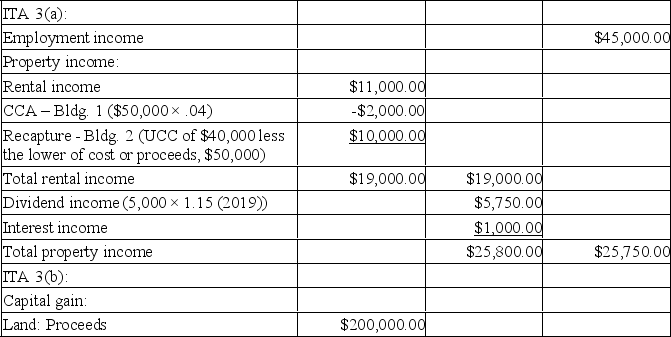

Jim Smith owns a rental property which had a UCC of $85,000 at the beginning of 20x0. After all allowable expenses other than CCA, Jim's total rental income was $1,000 in 20x0 and $10,000 in 20x1. Jim always deducts the maximum CCA allowed. What is the UCC for his rental property at the end of 20x1? (The property is a Class 1 building amortized at 4%.)
Free
(Multiple Choice)
4.8/5 (87)
(87) Correct Answer:Verified
VerifiedB
Amanda received a $300,000 inheritance on May 1st, 20x2. With the proceeds, she purchased the following investments:
1) Two rental properties: Property A has a value of $85,000, of which $40,000 is allocated to the building. Property B has a value of $110,000, of which $60,000 is allocated to the building. The properties earned a total of $9,750 in rental income before CCA. Both buildings are Class 1 - 4% assets, and the maximum allowable CCA will be claimed each year. The capital growth of the two properties combined is expected to be 5%.
2) A bond: Valued at $50,000 with 10% annual interest paid at maturity
3) Portfolio shares: Worth $10,000 - Eligible dividends in the amount of $700 were paid to Amanda before the end of the year. The capital growth of the shares is expected to be 3%.
The remainder of the money was applied to her mortgage.
Amanda is in a personal marginal tax bracket of 45%. Her marginal tax rate for eligible dividends is 30% and her marginal tax rate for capital gains is 23%.
Required:
A) Calculate Amanda's minimum property income for 20x2.
B) Calculate the annual pre-tax return (as a percentage) for each of the three investments.
C) Calculate the after-tax yield (as a percentage) for each of the three investments based on the information provided.
D) Briefly explain the tax benefit that Amanda could have realized had she used her inheritance to pay off her mortgage and then borrowed funds to make the above investments. (Assume the tax year is 2019.)
(Essay)
4.9/5 (83)
(83) On March 1, 20x1, Notes Inc. purchased a two-year guaranteed investment certificate (GIC) for $15,000. The interest compounds annually at 8% and will be received at the end of the full term. Notes Inc. has a marginal tax rate of 30%, which will increase to 34% for 20x2 and 20x3. Notes Inc. uses the calendar year as its fiscal year. (These tax rates are used here for illustration purposes only.)
Angela Major also invested $15,000 in a GIC with an 8% annual return, on March 1, 20x1, with interest to be paid at the end of each annual period. Angela's marginal tax rate is 40%.
(Assume there are no leap years in this time period.)
Required:
Calculate the after-tax interest income for each year for Notes Inc. and for Angela. (Round all numbers.)
(Essay)
4.9/5 (81)
(81) A public corporation earns $500,000 in pre-tax profits and pays out all of its after-tax earnings in dividends. The corporate tax rate is 27.5% and the sole shareholder is in a 50% tax bracket. The dividend gross-up rate is 1.38 and the total dividend tax credit (federal and provincial) is 27.5%.
Required:
A) Calculate the tax liability for (1) the corporation and (2) the shareholder.
B) Briefly explain how this tax structure illustrates the theory of integration.
(Essay)
5.0/5 (83)
(83) 
Filters
- Essay(0)
- Multiple Choice(0)
- Short Answer(0)
- True False(0)
- Matching(0)