



 Chat with AI
Exam 23: Business Valuations

Exam 1: Taxation-Its Role in Decision Making8 Questions
Exam 2: Fundamentals of Tax Planning6 Questions
Exam 3: Liability for Tax, Income Determination, and Administration of the Income Tax System5 Questions
Exam 4: Income From Employment7 Questions
Exam 5: Income From Business7 Questions
Exam 6: The Acquisition, Use, and Disposal of Depreciable Property6 Questions
Exam 7: Income From Property6 Questions
Exam 8: Gains and Losses on the Disposition of Capital Property-Capital Gains7 Questions
Exam 9: Other Income, Other Deductions, and Special Rules for Completing Net Income for Tax Purposes6 Questions
Exam 10: Individuals: Determination of Taxable Income and Taxes Payable10 Questions
Exam 11: Corporations-An Introduction9 Questions
Exam 12: Organization, Capital Structures, and Income Distributions of Corporations9 Questions
Exam 13: The Canadian-Controlled Private Corporation9 Questions
Exam 14: Multiple Corporations and Their Reorganization7 Questions
Exam 15: Partnerships8 Questions
Exam 16: Limited Partnerships and Joint Ventures8 Questions
Exam 17: Trusts6 Questions
Exam 18: Business Acquisitions and Divestitures-Assets Versus Shares6 Questions
Exam 19: Business Acquisitions and Divestitures-Tax-Deferred Sales6 Questions
Exam 20: Domestic and International Business Expansion4 Questions
Exam 21: Tax Aspects of Corporate Financing7 Questions
Exam 22: Gsthst Overview5 Questions
Exam 23: Business Valuations7 Questions
Select questions type


Graeme owns a profitable small CCPC, ABC Co. that he started five years ago, which generated $75,000 in pre-tax profits this year. He is considering selling the company to a potential buyer, Steve, and the two are trying to determine an appropriate value. Graeme believes the profits will increase steadily in the future, while Steve is a bit more cautious in his predictions as he is aware of a strong competitor coming to town. Graeme believes that a capitalization rate of 20% is reasonable, while Steve believes that 40% would be more realistic for this type of sale. Graeme would like to use the after-tax profits from this year in the valuation. Steve would like to see the pre-tax profits reduced by 10% to reflect a potential decline in revenues. The corporate tax rate is 13%.
Required:
Calculate the difference in the two valuations that Graeme and Steve are considering for the sale of ABC Co. using the earnings method.

Free
(Essay)
4.8/5  (64)
(64) Correct Answer: Verified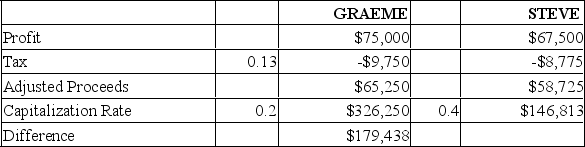
The Food Hut Inc. is for sale, and the sole shareholder, Andy, is trying to determine the value of the company. The business has annual pre-tax financial profits of $55,000. The following items will be omitted in arriving at the business value as they will not pertain to the prospective buyer's objectives: donations of $2,000, personal travel of $1,500, and part-time wages to Andy's son, Phil, of $8,000.
The store is run from a small building which has a fair market value of $105,000 (land = $45,000 and building = $60,000). The property was originally purchased for $75,000 (land = $40,000 and building = $35,000). The UCC on the building is $20,000. There is no mortgage remaining on the property.
Businesses similar to The Food Hut Inc. are generating a 15% rate of return.
Andy is selling the operations of the business using the earnings method, and the small store and land will be sold using the asset approach.
The corporate tax rate is 13% for active business income, and 50 2/3% on specified investment business income.
Required:
Calculate the total value of the sale of The Food Hut Inc. Show all calculations.
Free
(Essay)
4.7/5 (85)
(85) Correct Answer:Verified
Verified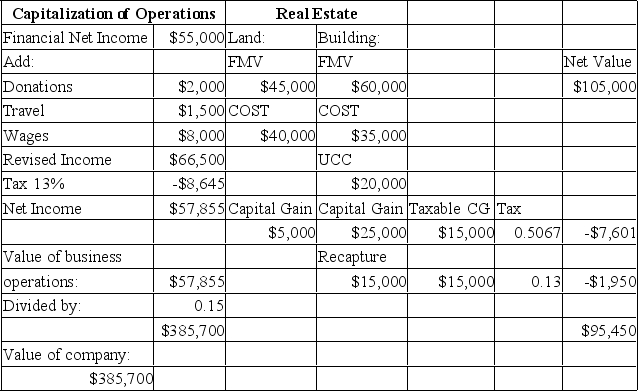

Business Co. is a CCPC with annual profits of $120,000. The corporate tax rate is 13%.
Required:
Calculate 1) the business value and 2) the earnings multiple if the capitalization rate is:
a) 30%
b) 20%
c) 10%
Free
(Essay)
4.9/5 (76)
(76) Correct Answer:Verified
Verified
The contingent business value method determines the valuation of a business based on which of the following:
(Multiple Choice)
4.8/5 (90)
(90) The value of a going-concern business is influenced primarily by its
(Multiple Choice)
4.8/5 (78)
(78) Based on the premise of the capitalization of earning method, if a business for sale is low risk with good growth potential, the value will be based on which of the following?
(Multiple Choice)
4.9/5 (82)
(82) Small Co. is for sale. The company has recognized $50,000 in profits every year since it began three years ago. The industry has a capitalization rate of 25%. What is the value of Small Co.?
(Multiple Choice)
4.9/5 (82)
(82) 
Filters
- Essay(0)
- Multiple Choice(0)
- Short Answer(0)
- True False(0)
- Matching(0)