



 Chat with AI
Exam 9: Joint Product and By-Product Costing

Exam 1: The Role of Accounting Information in Ethical Management Decision Making100 Questions
Exam 2: Cost Concepts, Behaviour, and Estimation129 Questions
Exam 3: Cost-Volume-Profit Analysis147 Questions
Exam 4: Relevant Information for Decision Making135 Questions
Exam 5: Job Costing133 Questions
Exam 6: Process Costing114 Questions
Exam 7: Activity-Based Costing and Management132 Questions
Exam 8: Measuring and Assigning Support Department Costs115 Questions
Exam 9: Joint Product and By-Product Costing121 Questions
Exam 10: Static and Flexible Budgets128 Questions
Exam 11: Standard Costs and Variance Analysis128 Questions
Exam 12: Strategic Investment Decisions37 Questions
Exam 13: Pricing Decisions109 Questions
Exam 14: Strategic Management of Costs111 Questions
Exam 15: Measuring and Assigning Costs for Income Statements88 Questions
Exam 16: Performance Evaluation and Compensation39 Questions
Select questions type


Managers who want to avoid arbitrary joint cost allocations should use the physical output method.
(True/False)
5.0/5  (79)
(79) Under the constant gross margin NRV method:
I. Only the joint costs are deducted from revenue to determine the gross margin
II. The gross margin percentage is allocated to all main products
III. The allocation is calculated by subtracting the gross margin percentage and separable costs from revenue
(Multiple Choice)
4.9/5 (81)
(81) HGT Corporation produces four products from a common production process. Selected data from HGT's accounting system for the four products appears below:  Joint costs for the accounting period totalled $5,000. Each product line has a different product manager who is evaluated based on product line profitability. Therefore each manager is motivated to reduce his / her total product line costs as much as possible. The managers have been given information about potential joint cost allocations using the following three methods: physical output, sales at split-off point, and net realizable value. The managers are comparing the joint cost allocations under each method so that they can give the accountant input about their preferred method(s).
Which product line(s) would receive the least amount of joint cost under the net realizable value method?
Joint costs for the accounting period totalled $5,000. Each product line has a different product manager who is evaluated based on product line profitability. Therefore each manager is motivated to reduce his / her total product line costs as much as possible. The managers have been given information about potential joint cost allocations using the following three methods: physical output, sales at split-off point, and net realizable value. The managers are comparing the joint cost allocations under each method so that they can give the accountant input about their preferred method(s).
Which product line(s) would receive the least amount of joint cost under the net realizable value method? (Multiple Choice)
4.9/5 (72)
(72) HGT Corporation produces four products from a common production process. Selected data from HGT's accounting system for the four products appears below:  Joint costs for the accounting period totalled $5,000. Each product line has a different product manager who is evaluated based on product line profitability. Therefore each manager is motivated to reduce his / her total product line costs as much as possible. The managers have been given information about potential joint cost allocations using the following three methods: physical output, sales at split-off point, and net realizable value. The managers are comparing the joint cost allocations under each method so that they can give the accountant input about their preferred method(s).
Which product line would receive the least amount of joint cost under the physical output method?
Joint costs for the accounting period totalled $5,000. Each product line has a different product manager who is evaluated based on product line profitability. Therefore each manager is motivated to reduce his / her total product line costs as much as possible. The managers have been given information about potential joint cost allocations using the following three methods: physical output, sales at split-off point, and net realizable value. The managers are comparing the joint cost allocations under each method so that they can give the accountant input about their preferred method(s).
Which product line would receive the least amount of joint cost under the physical output method? (Multiple Choice)
4.9/5 (71)
(71) HGT Corporation produces four products from a common production process. Selected data from HGT's accounting system for the four products appears below:  Joint costs for the accounting period totalled $5,000. Each product line has a different product manager who is evaluated based on product line profitability. Therefore each manager is motivated to reduce his / her total product line costs as much as possible. The managers have been given information about potential joint cost allocations using the following three methods: physical output, sales at split-off point, and net realizable value. The managers are comparing the joint cost allocations under each method so that they can give the accountant input about their preferred method(s).
If HGT allocates joint costs using the sales value at split-off point method, the total joint cost allocated to full-body pillows (rounded to the nearest dollar) will be:
Joint costs for the accounting period totalled $5,000. Each product line has a different product manager who is evaluated based on product line profitability. Therefore each manager is motivated to reduce his / her total product line costs as much as possible. The managers have been given information about potential joint cost allocations using the following three methods: physical output, sales at split-off point, and net realizable value. The managers are comparing the joint cost allocations under each method so that they can give the accountant input about their preferred method(s).
If HGT allocates joint costs using the sales value at split-off point method, the total joint cost allocated to full-body pillows (rounded to the nearest dollar) will be: (Multiple Choice)
4.8/5 (83)
(83) Johnson Manufacturing Company buys Fluron for $0.80 per litre. At the end of processing in Department 1, Fluron splits off into products Alphon, Cryon, and Runon. Alphon is sold at the split-off point, with no further processing. Cryon and Runon require further processing before they can be sold. Cryon is processed in Department 2 and Runon is processed in Department 3. Following is a summary of costs and other related data for the year ended June 30, 20x5: 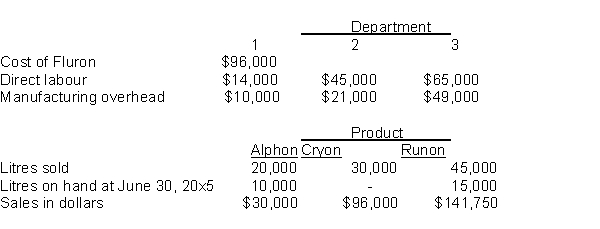 There were no inventories on hand at July 1, 20x4, and there was no Fluron on hand at June 30, 20x5. All litres on hand at June 30, 20x5 were complete as to processing. Johnson uses the net realizable value method of allocating joint costs.
The cost of Cryon sold for the year ended June 30, 20x5, is:
There were no inventories on hand at July 1, 20x4, and there was no Fluron on hand at June 30, 20x5. All litres on hand at June 30, 20x5 were complete as to processing. Johnson uses the net realizable value method of allocating joint costs.
The cost of Cryon sold for the year ended June 30, 20x5, is: (Multiple Choice)
4.8/5 (63)
(63) In which of the following industries would you be least likely to find a joint production process?
(Multiple Choice)
4.9/5 (86)
(86) Which of the following are sub-categories of joint products?
(Multiple Choice)
4.9/5 (82)
(82) Balley, Inc. produces three milk products (all are main products) from a joint process costing $200,000. Data from the current period's operation follow: Units Unit Sales Price Separable Total Revenue After Produced at Split-Off Costs Further Processing Regular 5,000 \ 5 \ 10,000 \ 40,000 Fat-free 15,000 7 16,000 120,000 2\% 30,000 8 5,000 250,000
Which product(s) should be processed beyond the split-off point?
(Multiple Choice)
4.7/5 (72)
(72) If the incremental revenues for a joint product that has been processed further exceed the incremental costs, the general decision is to:
(Multiple Choice)
4.8/5 (77)
(77) A joint input costing $500 results in four distinct products at the point of split-off. Relevant data follows: Sales Value Separable Sales Value After Product at Split-Off Cost Further Processing J \ 200 \ 100 \ 400 K 300 200 600 L 100 50 140 M 20 10 40
Which of the four products should not be further processed?
(Multiple Choice)
4.8/5 (86)
(86) The sales value at split-off point method of joint cost allocation is most appropriate when:
(Multiple Choice)
4.7/5 (65)
(65) A main product is typically differentiated from other joint products by its:
(Multiple Choice)
4.7/5 (89)
(89) Heston, Inc. produces 2 main products and a by-product. During the current month it had no beginning inventories. During the current month it incurred $185,000 of joint costs, which are allocated to main products using the physical output method. Additional information follows: Units Units Unit Sales Product Produced Sold Price Able (main) 8,000 6,000 \ 15 Baker (main) 12,000 8,000 22 Delta (by-product) 5,000 4,500 2 If Heston subtracts the NRV of by-product sales from joint costs at the time of by-product production, what is the total cost of goods sold for the current month?
(Multiple Choice)
4.8/5 (86)
(86) Separable costs generally must be allocated to joint products because they are difficult to trace directly.
(True/False)
4.8/5 (85)
(85) Major Foods, Inc. produces a cereal from oat grain. The company buys unprocessed oats for $400 per ton. It costs $60 per ton to send the oats through a processor, which produces 1,900 kilograms of pure oats and 100 kilograms of oat shells. The oat shells are ground and packaged at a cost of $100 per hundred kilograms. They are sold to a poultry feed company for $3 per kilogram. The pure oats are cooked and packaged into 4-kilogram containers at a cost of $350. The packaged oats are sold for $2 per 4-kilogram container.
If Major uses the net realizable value method, the gross profit from the oat shells is:
(Multiple Choice)
4.9/5 (79)
(79) Jagger, Inc. production begins in Department A with 1,000 kilograms of material, of which 40% goes to Department B, 50% to Department C, and the rest evaporates. From Department C, 72% goes to Department D, 24% to Department E, and the remainder is scrapped. There are no intermediate markets. By-product sales are treated as miscellaneous income. The following occurred during the month: Department Costs Sales Product Type A \ 20,000 --- B 5,000 \ 10,000 By-product C 30,000 -- D 20,000 60,000 Main-1 E 10,000 30,000 Main-2 If Jagger uses the physical output method, the total cost of Main-1 is:
(Multiple Choice)
4.9/5 (93)
(93) Which joint cost allocation methods are preferred because they are based on a product's ability to pay for its allocated cost?
I. Constant gross margin NRV
II. Physical output
III. Net realizable value
(Multiple Choice)
4.7/5 (83)
(83) Joint costs are allocated to individual products primarily to meet requirements for:
(Multiple Choice)
4.8/5 (85)
(85) A joint input costing $500 results in four distinct products at the point of split-off. Relevant data follows: Sales Value Separable Sales Value After Product at Split-Off Cost Further Processina \ 200 \ 100 \ 400 300 200 600 100 50 140 20 10 40 Assume that after the split-off point one unit of J can be processed directly into one unit of K, and then processed further as shown for product K. For the purpose of making this decision, what is the opportunity cost to be assigned to a unit of J?
(Multiple Choice)
4.9/5 (87)
(87) 
Filters
- Essay(0)
- Multiple Choice(0)
- Short Answer(0)
- True False(0)
- Matching(0)