



 Chat with AI
Exam 9: Joint Product and By-Product Costing

Exam 1: The Role of Accounting Information in Ethical Management Decision Making100 Questions
Exam 2: Cost Concepts, Behaviour, and Estimation129 Questions
Exam 3: Cost-Volume-Profit Analysis147 Questions
Exam 4: Relevant Information for Decision Making135 Questions
Exam 5: Job Costing133 Questions
Exam 6: Process Costing114 Questions
Exam 7: Activity-Based Costing and Management132 Questions
Exam 8: Measuring and Assigning Support Department Costs115 Questions
Exam 9: Joint Product and By-Product Costing121 Questions
Exam 10: Static and Flexible Budgets128 Questions
Exam 11: Standard Costs and Variance Analysis128 Questions
Exam 12: Strategic Investment Decisions37 Questions
Exam 13: Pricing Decisions109 Questions
Exam 14: Strategic Management of Costs111 Questions
Exam 15: Measuring and Assigning Costs for Income Statements88 Questions
Exam 16: Performance Evaluation and Compensation39 Questions
Select questions type


When separable costs are deducted from the selling price that can be achieved after further processing, the result is called the:
(Multiple Choice)
4.9/5  (83)
(83) J-M Company uses a joint process costing $15,000 to produce three main products. The company had no beginning inventory. Its current period operation data follow: Units Sales Value Separable Sales Value After Units Product Produced at Split-Off Costs Further Processing Sold S 500 \ 5,000 \ 500 \ 7,000 400 T 450 6,000 650 9,000 300 R 300 9,000 700 10,000 250 If J-M sells products at the split-off point and uses the relative sales value at split-off point method to allocate joint costs, what is the carrying value of ending inventory for product T? Note: the sales values above are based on units produced.
(Multiple Choice)
4.8/5 (90)
(90) RKH Corporation produces three joint products. During a recent accounting period, joint costs totalled $365 and RKH had no beginning inventories. Additional data appear below: Volume (kilograms) 150 50 300 Sales value at the split-off point \ 375 \ 155 \ 600 Sales value after further processing \ 450 \ 200 \ 900 Separable costs \ 50 \ 35 \ 100 Using the constant gross margin NRV method, the joint costs allocated to M1 will be:
(Multiple Choice)
4.9/5 (85)
(85) J-M Company uses a joint process costing $15,000 to produce three main products. The company had no beginning inventory. Its current period operation data follow: Units Sales Value Separable Sales Value After Units Product Produced at Split-Off Costs Further Processing Sold S 500 \ 5,000 \ 500 \ 7,000 400 T 450 6,000 650 9,000 300 R 300 9,000 700 10,000 250 If J-M uses the physical output method to allocate joint costs and performs further processing after the split-off point, what is the gross profit for product S? Note: the sales values above are based on units produced.
(Multiple Choice)
4.8/5 (78)
(78) Costs incurred after the split-off point are referred to as split-off costs.
(True/False)
4.8/5 (85)
(85) Balley, Inc. produces three milk products (all are main products) from a joint process costing $200,000. Data from the current period's operation follow: Units Unit Sales Price Separable Total Revenue After Produced at Split-Off Costs Further Processing Regular 5,000 \ 5 \ 10,000 \ 40,000 Fat-free 15,000 7 16,000 120,000 2\% 30,000 8 5,000 250,000
If Balley allocates joint costs using the physical output method instead of the net realizable value method, income will be:
(Multiple Choice)
4.9/5 (80)
(80) The Great Foods Company processes milk into skim milk and butter. This year 70,000 litres of milk will be processed, costing $40,000. If processed to the split-off point, this will yield 40,000 litres of skim milk and 10,000 kilograms of butter. Skim milk is sold to distributors for $1 per litre and butter is sold for $0.75 per kilogram. Great Foods has the option of processing the two products further. Skim milk can be processed into canned, sweetened and condensed skim milk and sold for $0.80 per can. One litre of skim milk makes 2 cans of condensed milk. To process 40,000 litres of skim milk it will cost $18,000. Butter can be processed into cake frosting and sold in containers for $2 each. One kilogram of butter goes into each container of frosting. The cost of processing 10,000 kilograms of butter into frosting costs $15,000.
What is the per-unit joint cost allocated to condensed milk and frosting if the net realizable value method is used?
(Multiple Choice)
4.7/5 (79)
(79) RKH Corporation produces three joint products. During a recent accounting period, joint costs totalled $365 and RKH had no beginning inventories. Additional data appear below: Volume (kilograms) 150 50 300 Sales value at the split-off point \ 375 \ 155 \ 600 Sales value after further processing \ 450 \ 200 \ 900 Separable costs \ 50 \ 35 \ 100 Which of the following methods will result in the smallest joint cost allocation to M3?
(Multiple Choice)
4.7/5 (80)
(80) Johnson Manufacturing Company buys Fluron for $0.80 per litre. At the end of processing in Department 1, Fluron splits off into products Alphon, Cryon, and Runon. Alphon is sold at the split-off point, with no further processing. Cryon and Runon require further processing before they can be sold. Cryon is processed in Department 2 and Runon is processed in Department 3. Following is a summary of costs and other related data for the year ended June 30, 20x5: 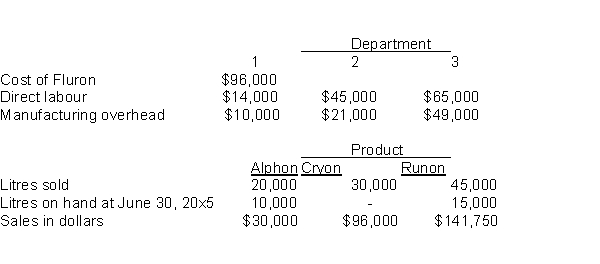 There were no inventories on hand at July 1, 20x4, and there was no Fluron on hand at June 30, 20x5. All litres on hand at June 30, 20x5 were complete as to processing. Johnson uses the net realizable value method of allocating joint costs.
The joint costs for the year ended June 30, 20x5, to be allocated are:
There were no inventories on hand at July 1, 20x4, and there was no Fluron on hand at June 30, 20x5. All litres on hand at June 30, 20x5 were complete as to processing. Johnson uses the net realizable value method of allocating joint costs.
The joint costs for the year ended June 30, 20x5, to be allocated are: (Multiple Choice)
4.9/5 (78)
(78) Only companies in manufacturing industries produce joint products.
(True/False)
4.8/5 (78)
(78) The constant gross margin NRV method of allocating joint costs results in all joint products having equal gross margins (in dollars).
(True/False)
4.9/5 (71)
(71) HGT Corporation produces four products from a common production process. Selected data from HGT's accounting system for the four products appears below: 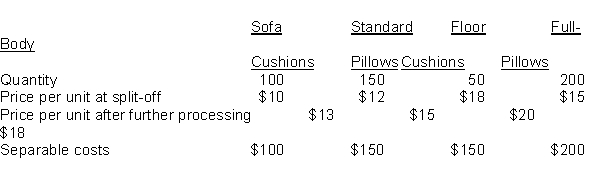 Joint costs for the accounting period totalled $5,000. Each product line has a different product manager who is evaluated based on product line profitability. Therefore each manager is motivated to reduce his / her total product line costs as much as possible. The managers have been given information about potential joint cost allocations using the following three methods: physical output, sales at split-off point, and net realizable value. The managers are comparing the joint cost allocations under each method so that they can give the accountant input about their preferred method(s).
If HGT allocates joint costs using net realizable value method, the total joint cost allocated to floor cushions will be:
Joint costs for the accounting period totalled $5,000. Each product line has a different product manager who is evaluated based on product line profitability. Therefore each manager is motivated to reduce his / her total product line costs as much as possible. The managers have been given information about potential joint cost allocations using the following three methods: physical output, sales at split-off point, and net realizable value. The managers are comparing the joint cost allocations under each method so that they can give the accountant input about their preferred method(s).
If HGT allocates joint costs using net realizable value method, the total joint cost allocated to floor cushions will be: (Multiple Choice)
4.9/5 (87)
(87) Jordan, Inc. produces 2 products from a joint process costing $24,000. The results from the most recent period follow: Sales Value Separable Sales Value After Product Tons at Split-Off Costs Further Processing Alpha-1 800 \ 10,000 \ 12,000 \ 24,000 Alpha-2 400 8,000 4,000 20,000 Waste 200 -- --- --
If Jordan uses the sales value at split-off point method, the joint costs allocated to Alpha-2 would be:
(Multiple Choice)
4.8/5 (69)
(69) Recyclers, Inc. reprocesses paper and obtains 2 main products, a by-product and a waste. By-product revenues are treated as a reduction in joint costs. During the period 1,000 tons were processed at a cost of $12,000 for materials and processing, resulting in the following: Sales Value Separable Sales Value After Product Tons at Split-Off Costs Further Processing Main-1 200 \ 4,000 \ 2,000 \ 10,000 Main-2 400 5,000 6,000 12,000 By-product 300 2,000 -0- 2,000 Waste 100 -0- -0- -0-
If the firm allocates joint costs to the main products using the net realizable value, how much will be allocated to Main-1?
(Multiple Choice)
4.8/5 (93)
(93) When joint production processes include a sales mix, the sales mix should be incorporated into the allocation method.
(True/False)
4.8/5 (78)
(78) Managers normally differentiate main products from by-products based on their weight.
(True/False)
4.8/5 (92)
(92) 
Filters
- Essay(0)
- Multiple Choice(0)
- Short Answer(0)
- True False(0)
- Matching(0)