



 Chat with AI
Exam 12: Trade Blocs and Trade Blocks

Exam 1: International Economics Is Different60 Questions
Exam 2: The Basic Theory Using Demand and Supply60 Questions
Exam 3: Why Everybody Trades: Comparative Advantage59 Questions
Exam 4: Trade: Factor Availability and Factor Proportions Are Key48 Questions
Exam 5: Who Gains and Who Loses From Trade60 Questions
Exam 6: Scale Economies, Imperfect Competition, and Trade59 Questions
Exam 7: Growth and Trade Part II: Trade Policy60 Questions
Exam 8: Analysis of a Tariff60 Questions
Exam 9: Nontariff Barriers to Imports60 Questions
Exam 10: Arguments for and Against Protection60 Questions
Exam 11: Pushing Exports52 Questions
Exam 12: Trade Blocs and Trade Blocks60 Questions
Exam 13: Trade and the Environment60 Questions
Exam 14: Trade Policies for Developing Countries60 Questions
Exam 15: Multinationals and Migration: International Factor Movements60 Questions
Exam 16: Payments Among Nations60 Questions
Exam 17: The Foreign Exchange Market56 Questions
Exam 18: Forward Exchange and International Financial Investment60 Questions
Exam 19: What Determines Exchange Rates44 Questions
Exam 20: Government Policies Toward the Foreign Exchange Market56 Questions
Exam 21: International Lending and Financial Crises60 Questions
Exam 22: How Does the Open Macroeconomy Work59 Questions
Exam 23: Internal and External Balance With Fixed Exchange Rates59 Questions
Exam 24: Floating Exchange Rates and Internal Balance60 Questions
Exam 25: National and Global Choices: Floating Rates and the Alternatives60 Questions
Select questions type


The figure given below shows the U.S. market for imported wine. For simplicity, we consider export supply curves to be flat. Chilean wine is available for $480 per barrel and French wine is available for $420 per barrel. 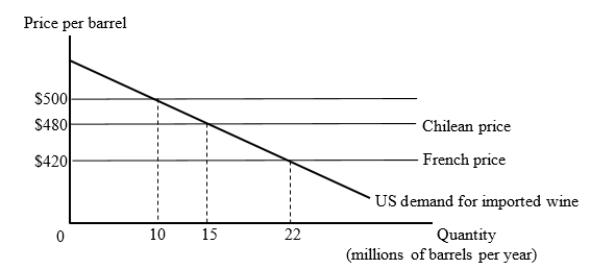 Suppose that the United States imposes a tariff of $80 per barrel on imported wine. How many barrels of wine will the United States import and who will they import from?
 (Multiple Choice)
4.9/5  (74)
(74) Which of the following is NOT among the features that are phased in gradually during the integration of new members in the European Union?
(Multiple Choice)
4.8/5 (80)
(80) Which of the following identifies an important reason why empirical studies find that joining the EC in 1973 may have imposed a substantial net cost on Britain?
(Multiple Choice)
4.8/5 (93)
(93) Which of the following is on a path toward full economic unity?
(Multiple Choice)
4.8/5 (66)
(66) An economic failure of an embargo is said to have occurred if:
(Multiple Choice)
4.7/5 (90)
(90) The figure given below shows the U.S. market for imported wine. For simplicity, we consider export supply curves to be flat. Chilean wine is available for $480 per barrel and French wine is available for $420 per barrel. 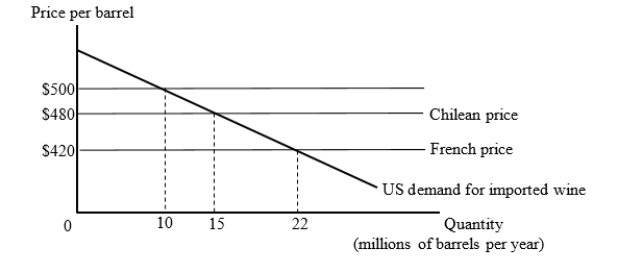 Suppose the United States has a tariff of $80 per barrel on imported wine. Then, the United States joins a trade bloc with Chile. What is the net effect on the U.S. well-being of joining the trade bloc?
 (Multiple Choice)
4.8/5 (85)
(85) "Countries usually experience substantial economic gains from joining trade blocs." Do you agree or disagree with this statement? Why? In your answer, include discussion of the roles of trade creation and trade diversion. Also include discussion of other gains that can arise in a country that chooses to join a trade bloc?
(Essay)
4.9/5 (67)
(67) The figure given below shows the U.S. market for imported wine. For simplicity, we consider export supply curves to be flat. Chilean wine is available for $480 per barrel and French wine is available for $420 per barrel. 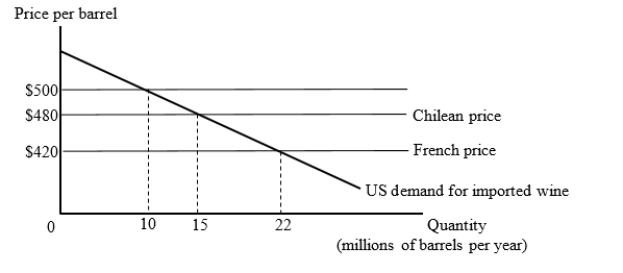 Under free trade, how many barrels of wine will the United States import and who will they import from?
 (Multiple Choice)
4.8/5 (72)
(72) Formation of trade blocs can be considered beneficial because it:
(Multiple Choice)
5.0/5 (81)
(81) In a customs union, members remove all trade barriers among themselves and adopt a common set of external barriers.
(True/False)
4.9/5 (74)
(74) Which of the following statements about a trade bloc is accurate?
(Multiple Choice)
4.8/5 (76)
(76) The figure given below shows the U.S. market for imported wine. For simplicity, we consider export supply curves to be flat. Chilean wine is available for $480 per barrel and French wine is available for $420 per barrel. 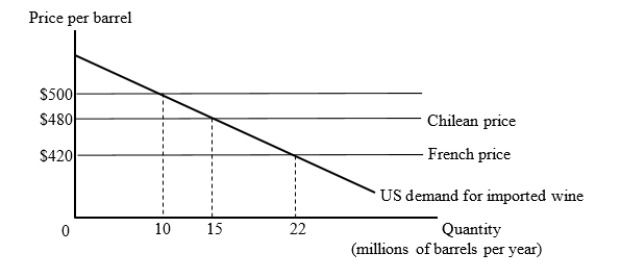 Suppose the United States has a tariff of $80 per barrel on imported wine. Then, the U.S. joins a free trade area with Chile. What will be the change in the consumer surplus after the U.S. enters into a free trade agreement with Chile?
 (Multiple Choice)
4.8/5 (87)
(87) The WTO does not permit any deviation from the MFN principle, even for the developing countries.
(True/False)
4.9/5 (74)
(74) Members of a free trade area not only remove barriers among themselves but also engage in free trade with the non-member countries.
(True/False)
5.0/5 (76)
(76) If the target country of an embargo has a very inelastic demand for imports, the embargo is more likely to be successful in an economic sense.
(True/False)
4.9/5 (68)
(68) Suppose that the constant marginal cost of producing an automobile is $11,000 in Canada, $8,000 in the United States, and $12,000 in Japan.
a.Under free trade, would Canada produce its own cars or import them? If it imports, which country will it import from?
b.If the Canadian government imposes a 100% tariff on all auto imports, would it produce its own automobiles or import them? If it imports, which country will it import from?
c.Canada has a tariff of 100% on imported autos.Then Canada decides to join a customs union with the United States (with a uniform external tariff of 100%).After the customs union is formed, what will the domestic price of automobiles be in Canada?
d.If Canada decides to join this customs union with the United States, will there be trade creation, trade diversion, or both? Explain.
(Essay)
4.9/5 (77)
(77) Which of the following features does a free trade area necessarily have?
(Multiple Choice)
4.9/5 (76)
(76) 
Filters
- Essay(0)
- Multiple Choice(0)
- Short Answer(0)
- True False(0)
- Matching(0)