



 Chat with AI
Exam 12: Trade Blocs and Trade Blocks

Exam 1: International Economics Is Different60 Questions
Exam 2: The Basic Theory Using Demand and Supply60 Questions
Exam 3: Why Everybody Trades: Comparative Advantage59 Questions
Exam 4: Trade: Factor Availability and Factor Proportions Are Key48 Questions
Exam 5: Who Gains and Who Loses From Trade60 Questions
Exam 6: Scale Economies, Imperfect Competition, and Trade59 Questions
Exam 7: Growth and Trade Part II: Trade Policy60 Questions
Exam 8: Analysis of a Tariff60 Questions
Exam 9: Nontariff Barriers to Imports60 Questions
Exam 10: Arguments for and Against Protection60 Questions
Exam 11: Pushing Exports52 Questions
Exam 12: Trade Blocs and Trade Blocks60 Questions
Exam 13: Trade and the Environment60 Questions
Exam 14: Trade Policies for Developing Countries60 Questions
Exam 15: Multinationals and Migration: International Factor Movements60 Questions
Exam 16: Payments Among Nations60 Questions
Exam 17: The Foreign Exchange Market56 Questions
Exam 18: Forward Exchange and International Financial Investment60 Questions
Exam 19: What Determines Exchange Rates44 Questions
Exam 20: Government Policies Toward the Foreign Exchange Market56 Questions
Exam 21: International Lending and Financial Crises60 Questions
Exam 22: How Does the Open Macroeconomy Work59 Questions
Exam 23: Internal and External Balance With Fixed Exchange Rates59 Questions
Exam 24: Floating Exchange Rates and Internal Balance60 Questions
Exam 25: National and Global Choices: Floating Rates and the Alternatives60 Questions
Select questions type


The Southern Common Market (MERCOSUR) is actually a _____.

Free
(Multiple Choice)
4.8/5  (77)
(77) Correct Answer: Verified
B
Which of the following is true of trade embargoes?
Free
(Multiple Choice)
4.8/5 (86)
(86) Correct Answer:Verified
VerifiedB
The NAFTA is an example of a(n):
Free
(Multiple Choice)
4.7/5 (78)
(78) Correct Answer:Verified
VerifiedA
When a few countries join a trade bloc, it not only expands the market for their firms but also creates a larger market for the countries outside the bloc.
(True/False)
4.8/5 (84)
(84) As of 2011, which of the following Balkan states was closest to qualifying for EU membership?
(Multiple Choice)
4.7/5 (82)
(82) The figure given below shows the U.S. market for imported wine. For simplicity, we consider export supply curves to be flat. Chilean wine is available for $480 per barrel and French wine is available for $420 per barrel. 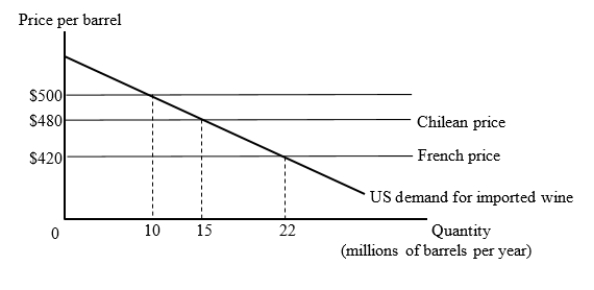 Suppose the United States has a tariff of $80 per barrel on imported wine. Then, the U.S. joins a free trade area with Chile. How many barrels of wine will the United States import after joining the free trade area?
 (Multiple Choice)
4.9/5 (71)
(71) The figure given below shows the U.S. market for imported wine. For simplicity, we consider export supply curves to be flat. Chilean wine is available for $480 per barrel and French wine is available for $420 per barrel. 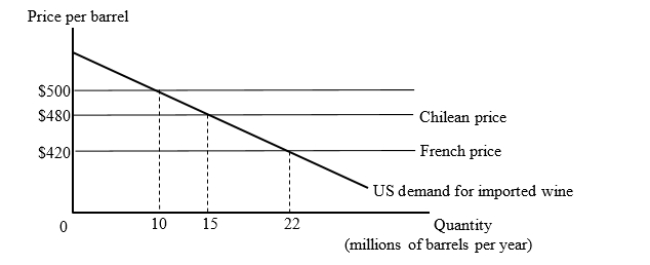 Suppose the United States has a tariff of $80 per barrel on imported wine. Then, the U.S. joins a free trade area with Chile. How much will the U.S. government tariff revenue change (as a result of joining the free trade area)?
 (Multiple Choice)
4.8/5 (78)
(78) The gains from trade creation is likely to be larger for a country if:
(Multiple Choice)
4.9/5 (74)
(74) The figure given below shows the U.S. market for imported wine. For simplicity, we consider export supply curves to be flat. Chilean wine is available for $480 per barrel and French wine is available for $420 per barrel. 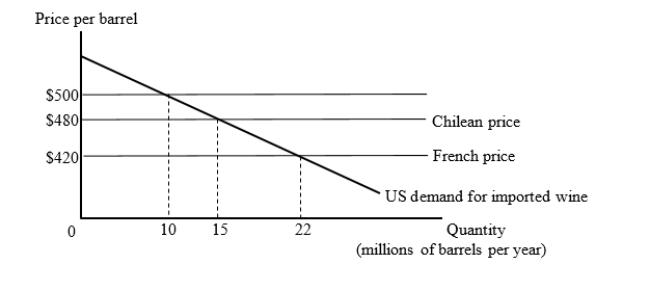 Suppose the United States has a tariff of $80 per barrel on imported wine. Then, the United States joins a trade bloc with Chile. Calculate the loss suffered by the U.S. arising from the shift of trade from low-cost exporters to higher-cost bloc-partner exporter.
 (Multiple Choice)
4.7/5 (78)
(78) It has been observed that trade within MERCOSUR trade has increased most rapidly in protected capital-intensive products like automobiles, machinery and electronic goods in which the member countries enjoy global comparative advantage.
(True/False)
4.7/5 (71)
(71) The formation of a trade bloc necessarily improves well-being worldwide because it is a step toward free trade.
(True/False)
4.8/5 (65)
(65) A trade bloc allows member countries to import from other member countries freely, but imposes trade barriers against imports from countries outside the bloc.
(True/False)
4.7/5 (73)
(73) The figures given below illustrate a situation of a trade embargo. In Figure (a) Dd and Sd are the domestic demand and supply curves of the embargoing countries. The import price is P0 and the target country imports the amount Q0 before the embargo is imposed. 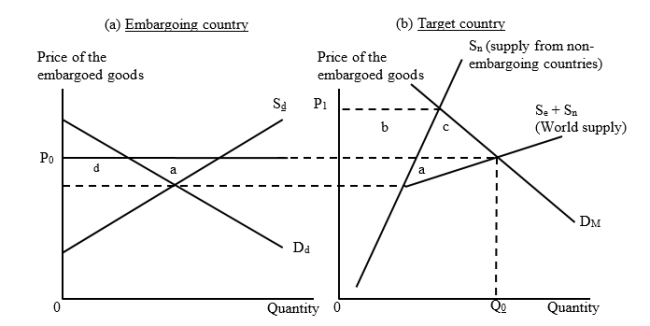 As a result of this embargo, the exporting countries not participating in the embargo gain area _____.
 (Multiple Choice)
4.7/5 (76)
(76) Gains from joining a trade bloc will be higher if the import demands of the member countries are relatively elastic.
(True/False)
4.8/5 (69)
(69) H. Ross Perot's famous claim in 1992 that NAFTA would cause a "great sucking sound" referred to:
(Multiple Choice)
4.9/5 (87)
(87) Which of the following correctly identifies the impact of the formation of NAFTA on Mexico?
(Multiple Choice)
4.9/5 (74)
(74) Suppose Chile joins a trade bloc formed by Argentina, Brazil, Paraguay, and Uruguay. Before joining the trade bloc, the Chilean government has a tariff of 30 percent on imported meat, and Chile's imports of 40,000 tons of meat came exclusively from the United States. The U.S. sold meat at a price of $2,000 per ton in the international market. After joining the trade bloc, Chile switched to importing meat from the other member countries at a price of $2,100 per ton. Its import increased to 50,000 tons. Calculate the amount of trade creation and trade diversion as a result of this change. For this product, did Chile gain economic well-being from joining the trade bloc? If so, then how much? If not, then by how much would Chilean imports of meat have to increase for Chile to benefit from joining the trade bloc?
(Essay)
5.0/5 (69)
(69) Explain the basic requirements a country needs to fulfill to become a member of the European Union and the process of integration of new members.
(Essay)
4.9/5 (78)
(78) 
Filters
- Essay(0)
- Multiple Choice(0)
- Short Answer(0)
- True False(0)
- Matching(0)