



 Chat with AI
Exam 7: Growth and Trade Part II: Trade Policy


Suppose a capital-abundant country experiences a significant increase in its capital stock. This change in endowments is most likely to lead to:

 (76)
 Verified
D
Suppose country X partially specializes in the production of only two goods, food and clothing. At the initial free trade equilibrium, the country produced 40 units of food and 20 units of clothing. At the same time10 units of food were exported and 10 units of clothing were imported by country X. Now suppose a technological innovation in country X leads to a balanced growth while leaving the relative prices of food and clothing unchanged in the international market. Production of food in country X rises to 50 units and that of clothing rises to 25 units. If consumption of food rises to 42 units, the consumption of clothing:
(87) VerifiedA
Explain carefully, with a diagram, the crucial conditions for immiserizing growth to occur. In particular, discuss the effect of the size of the country, the volume of foreign trade, the type of growth the country experiences, and foreign demand for the exports of the country.
(81) VerifiedImmiserizing growth can occur when a country's growth is biased toward the production of the good which the country exports. If the country is large enough, the additional supply of this good will cause the international price of this good to decline relative to the prices of other goods. This effect will be more pronounced the more inelastic is the foreign demand for this good. Further, the country will stand to lose more from the worsening of the terms of trade the more this country exports the good.. If the loss from the worsening of the terms of trade exceeds the gain from being able to produce more, the country experiences immiserizing growth-reduction in the well-being of the country in spite of the growth in production. 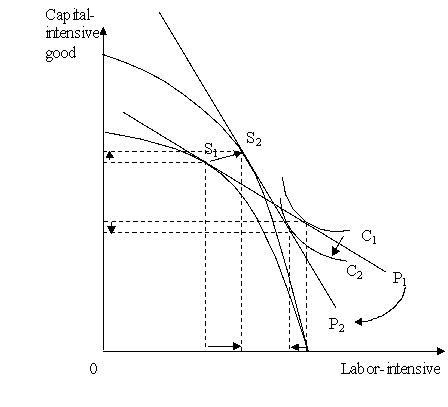 In the figure given above we see that a country is experiencing expansion in its capital endowment. Its production point shifts from S1 to S2. Considering this to be a large country, its willingness to trade influences the international price ratio (terms of trade) and makes the price line steeper from P1 to P2. Here the country experiences immiserizing growth. Its economic well-being declines as the consumption point shifts to a lower community indifference curve, from C1 to C2.
The figure given below shows a shift in the production-possibility curve of a country from AB to AC. Here, S1 and C1 are the initial production and consumption points respectively. S2 and C2, on the other hand, are the final production and consumption points respectively. Which of the following is illustrated by this figure? 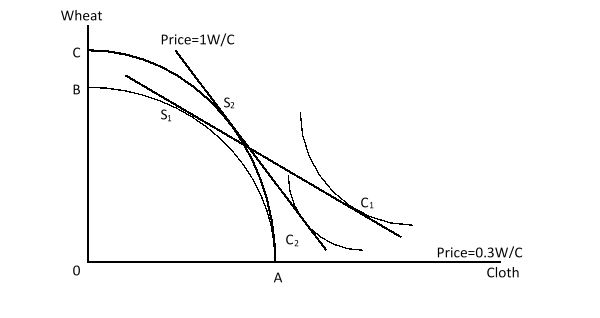
(65) Which of the following conditions is NOT necessary for immiserizing growth to arise in a country?
(89) In the figure given below, we see an expansion of the production-possibility curve (from PPC1 to PPC2). The two goods produced are wheat and cloth, which are land-intensive and labor-intensive respectively. The outward shift of the production-possibility curve shows: 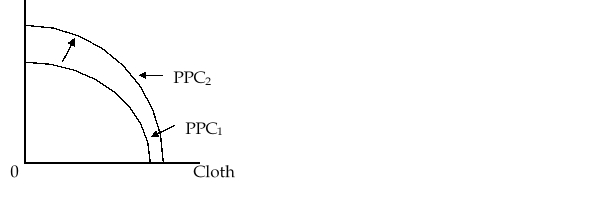
(86) Economic growth with an increased willingness to engage in international trade will always improve the economic well-being of a large country.
(95) Suppose a small country experiences economic growth which leads to an increased willingness to trade. The country's terms of trade will _____ because the prices of its exports will _____ relative to the price that it has to pay for its imports.
(81) The rapid accumulation of capital and worker skills in the United States in the 1800's:
(73) According to the Rybczynski theorem, in a two-good world, with constant product prices, growth in a country's endowment of any one input results in an increase in the production of the good which does not use this input intensively.
(79) Immiserizing growth is the situation in which the expansion of a country's exporting industry results in an increase in the world price of the exported good and an increase in the economic welfare of the country.
(71) Discuss how openness to trade can influence economic growth in a country.
(77) Assume a country produces only wine and guns. Both wine and gun production use land and labor as their only inputs. Wine production is relatively land-intensive while gun production is relatively labor-intensive. According to the Rybczynski theorem, a significant rise in immigration is most likely to lead to:
(79) Suppose country A produces two goods, good X and good Y. Production of good X involves an intensive use of highly skilled workers. However, good Y is a relatively capital-intensive good. If the country experiences a wave of immigration of highly skilled workers, investment in physical capital remaining unchanged, the Rybczynski theorem will predict that:
(74) Suppose a labor-abundant country, exporting a labor-intensive good, experiences a significant increase in its capital stock. This change in endowments can:
(96) Assume that a large capital-abundant country trades only two goods with the rest of the world, medical equipment and corn. Medical equipment is relatively capital-intensive. An increase in the country's endowment of capital will cause the price of medical equipment relative to the price of corn to:
(72) Assume a country that produces only cloth and paddy. Cloth production requires significant amounts of labor and capital, but relatively less land. Assume that paddy production requires relatively less labor and capital, but relatively large amounts of fertile arable land. If there is an increase in the country's endowments of capital and labor, the Rybczynski theorem would predict that:
(90) 
Filters
- Essay(0)
- Multiple Choice(0)
- Short Answer(0)
- True False(0)
- Matching(0)