



 Chat with AI
Exam 12: Trade Blocs and Trade Blocks

Exam 1: International Economics Is Different60 Questions
Exam 2: The Basic Theory Using Demand and Supply60 Questions
Exam 3: Why Everybody Trades: Comparative Advantage59 Questions
Exam 4: Trade: Factor Availability and Factor Proportions Are Key48 Questions
Exam 5: Who Gains and Who Loses From Trade60 Questions
Exam 6: Scale Economies, Imperfect Competition, and Trade59 Questions
Exam 7: Growth and Trade Part II: Trade Policy60 Questions
Exam 8: Analysis of a Tariff60 Questions
Exam 9: Nontariff Barriers to Imports60 Questions
Exam 10: Arguments for and Against Protection60 Questions
Exam 11: Pushing Exports52 Questions
Exam 12: Trade Blocs and Trade Blocks60 Questions
Exam 13: Trade and the Environment60 Questions
Exam 14: Trade Policies for Developing Countries60 Questions
Exam 15: Multinationals and Migration: International Factor Movements60 Questions
Exam 16: Payments Among Nations60 Questions
Exam 17: The Foreign Exchange Market56 Questions
Exam 18: Forward Exchange and International Financial Investment60 Questions
Exam 19: What Determines Exchange Rates44 Questions
Exam 20: Government Policies Toward the Foreign Exchange Market56 Questions
Exam 21: International Lending and Financial Crises60 Questions
Exam 22: How Does the Open Macroeconomy Work59 Questions
Exam 23: Internal and External Balance With Fixed Exchange Rates59 Questions
Exam 24: Floating Exchange Rates and Internal Balance60 Questions
Exam 25: National and Global Choices: Floating Rates and the Alternatives60 Questions
Select questions type


The figure given below shows the U.S. market for imported wine. For simplicity, we consider export supply curves to be flat. Chilean wine is available for $480 per barrel and French wine is available for $420 per barrel. 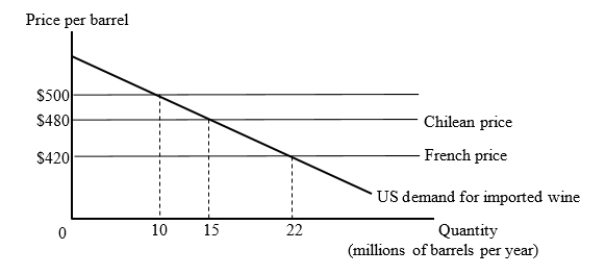 Suppose the United States has a tariff of $80 per barrel on imported wine. Then, the U.S. joins a free trade area with Chile. At what price per barrel will the imported wines be purchased by the U.S. consumers?
 (Multiple Choice)
4.9/5  (82)
(82) The figures given below illustrate a situation of a trade embargo. In Figure (a) Dd and Sd are the domestic demand and supply curves of the embargoing countries. The import price is P0 and the target country imports the amount Q0 before the embargo is imposed. 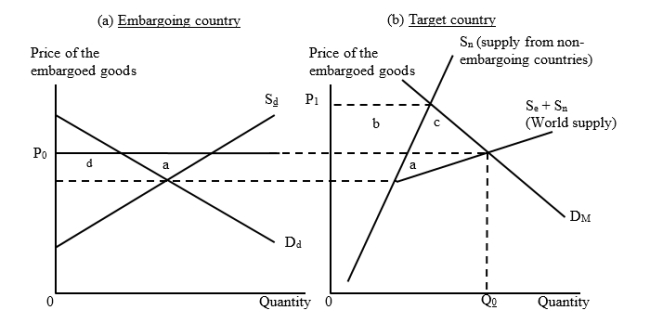 As a result of this embargo, the world as a whole loses area _____.
 (Multiple Choice)
4.8/5 (78)
(78) Which of the following allows member countries to import from other member countries freely, but imposes trade barriers against imports from outside countries?
(Multiple Choice)
4.8/5 (78)
(78) Turkey joined the EU in 2008 after implementing the necessary political and economic policy changes.
(True/False)
4.9/5 (81)
(81) What is an economic embargo? While the embargo is in effect, does it benefit or hurt the embargoing countries? The country on which the embargo is being imposed? What conditions lend themselves toward a successful embargo?
(Essay)
4.8/5 (80)
(80) The figures given below illustrate a situation of a trade embargo. In Figure (a) Dd and Sd are the domestic demand and supply curves of the embargoing countries. The import price is P0 and the target country imports the amount Q0 before the embargo is imposed. 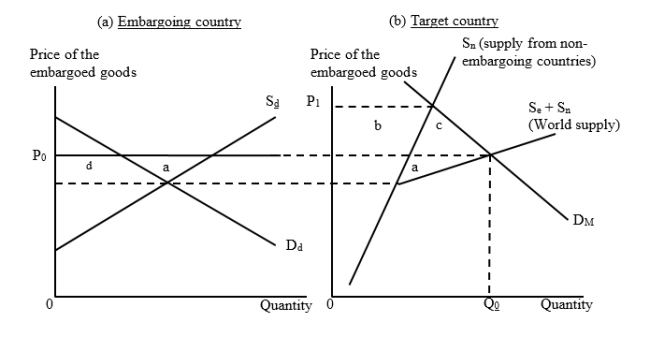 The embargo initiator(s) lose area _____ while the target country loses _____.
 (Multiple Choice)
4.9/5 (89)
(89) A political failure of a trade embargo is most likely to occur if:
(Multiple Choice)
4.8/5 (88)
(88) Which of the following states that any trade concession given to any foreign country must be given to all other countries having the same status?
(Multiple Choice)
4.9/5 (81)
(81) The figure given below shows the U.S. market for imported wine. For simplicity, we consider export supply curves to be flat. Chilean wine is available for $480 per barrel and French wine is available for $420 per barrel. 
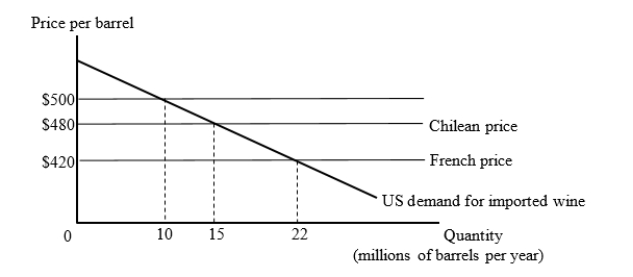


 Suppose the United States has a tariff of $80 per barrel on imported wine. Then, the U.S. joins a free trade area with Chile. Calculate the gain arising from an increase in net volume of trade after the U.S. joins the free trade area.
 (Multiple Choice)
4.8/5 (76)
(76) The net loss from trade diversion for a country is likely to be smaller if:
(Multiple Choice)
4.8/5 (81)
(81) The gains from joining a trade bloc are tied to trade diversion and the losses are tied to trade creation.
(True/False)
4.9/5 (83)
(83) NAFTA has not only eliminated all tariffs and nontariff barriers to trade within the member countries but also allows free human migration across the countries.
(True/False)
4.8/5 (76)
(76) The Single European Act that came into effect in 1992 removed restrictions on people working in other member countries but retained restrictions on the flows of financial investments across the member countries.
(True/False)
4.9/5 (65)
(65) _____ determine(s) which products have been produced within a free-trade area and which products have been produced outside the area and therefore are subject to trade barriers.
(Multiple Choice)
4.8/5 (80)
(80) After the formation of the NAFTA, Mexico became a more attractive country for business investments of foreign firms.
(True/False)
4.9/5 (80)
(80) 
Filters
- Essay(0)
- Multiple Choice(0)
- Short Answer(0)
- True False(0)
- Matching(0)