



 Chat with AI
Exam 10: Monopolistic Competition and Oligopoly

Exam 1: Introducing the Economic Way of Thinking251 Questions
Exam 2: Production Possibilities, Opportunity Cost, and Economic Growth202 Questions
Exam 3: Market Demand and Supply412 Questions
Exam 4: Markets in Action253 Questions
Exam 5: Price Elasticity of Demand and Supply280 Questions
Exam 6: Consumer Choice Theory272 Questions
Exam 7: Production Costs243 Questions
Exam 8: Perfect Competition237 Questions
Exam 9: Monopoly168 Questions
Exam 10: Monopolistic Competition and Oligopoly187 Questions
Exam 11: Labor Markets202 Questions
Exam 12: Income Distribution, Poverty, and Discrimination130 Questions
Exam 13: Antitrust and Regulation203 Questions
Exam 14: Environmental Economics106 Questions
Exam 15: International Trade and Finance241 Questions
Exam 16: Economies in Transition108 Questions
Exam 17: Growth and the117 Questions
Select questions type


Oligopolies with kinked demand curves change their prices quickly and frequently.
(True/False)
4.7/5  (68)
(68) Game theory is an especially useful model for analysis in the following types of markets:
(Multiple Choice)
4.9/5 (75)
(75) A monopolistically competitive market is characterized by:
(Multiple Choice)
4.8/5 (86)
(86) A(n) ____ can be used to demonstrate why a competitive oligopoly tends to result in a low-price strategy that does not maximize mutual profits.
(Multiple Choice)
4.8/5 (80)
(80) When oligopolists take into account their competitors' behavior, this situation is called:
(Multiple Choice)
4.8/5 (89)
(89) The demand curve in monopolistic competition slopes downward because of:
(Multiple Choice)
4.9/5 (79)
(79) Cartel pricing refers to the output and price choice of a cartel. This choice most closely resembles that of a:
(Multiple Choice)
4.9/5 (75)
(75) A "kinked" demand curve reflects a tendency on the part of an oligopolist to:
(Multiple Choice)
4.9/5 (69)
(69) Exhibit 10-2 A monopolistic competitive firm 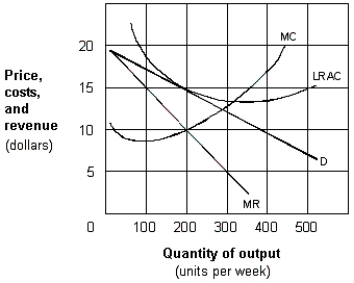 -As represented in Exhibit 10-2, the maximum long-run economic profit earned by this monopolistic competitive firm is:
 (Multiple Choice)
4.9/5 (101)
(101) In an oligopoly, the outcome is uncertain because price and output decisions depend on the response of rivals.
(True/False)
4.7/5 (88)
(88) In the long run, marginal cost must equal marginal revenue for a monopolistic competitive firm, but not at the minimum point of the long-run average cost curve.
(True/False)
4.8/5 (91)
(91) Some economists argue that monopolistically competitive markets are inefficient because:
(Multiple Choice)
4.8/5 (67)
(67) Which of the following most closely approximates the conditions of a monopolistically competitive market?
(Multiple Choice)
4.8/5 (76)
(76) Pricing and output determination under an oligopoly is more complicated than pricing and output determinations in other industries. The primary reason for the complication is the:
(Multiple Choice)
4.8/5 (78)
(78) In long-run equilibrium, output is expanded to the minimum long-run average total cost by:
(Multiple Choice)
4.8/5 (87)
(87) A monopolistically competitive firm, like a perfectly competitive firm, is a price taker.
(True/False)
4.8/5 (82)
(82) 
Filters
- Essay(0)
- Multiple Choice(0)
- Short Answer(0)
- True False(0)
- Matching(0)