



 Chat with AI
Exam 10: Monopolistic Competition and Oligopoly

Exam 1: Introducing the Economic Way of Thinking251 Questions
Exam 2: Production Possibilities, Opportunity Cost, and Economic Growth202 Questions
Exam 3: Market Demand and Supply412 Questions
Exam 4: Markets in Action253 Questions
Exam 5: Price Elasticity of Demand and Supply280 Questions
Exam 6: Consumer Choice Theory272 Questions
Exam 7: Production Costs243 Questions
Exam 8: Perfect Competition237 Questions
Exam 9: Monopoly168 Questions
Exam 10: Monopolistic Competition and Oligopoly187 Questions
Exam 11: Labor Markets202 Questions
Exam 12: Income Distribution, Poverty, and Discrimination130 Questions
Exam 13: Antitrust and Regulation203 Questions
Exam 14: Environmental Economics106 Questions
Exam 15: International Trade and Finance241 Questions
Exam 16: Economies in Transition108 Questions
Exam 17: Growth and the117 Questions
Select questions type


Exhibit 10-7 Two-Firm Payoff Matrix 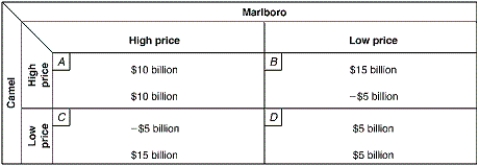 -Suppose costs are identical for the two firms in Exhibit 10-7. If both firms assume the other will compete and charge a lower price, equilibrium will be established by:
 (Multiple Choice)
4.9/5  (92)
(92) A group of firms that collude to limit competition is called a(n):
(Multiple Choice)
4.8/5 (88)
(88) Exhibit 10-6 Two-Firm Payoff Matrix 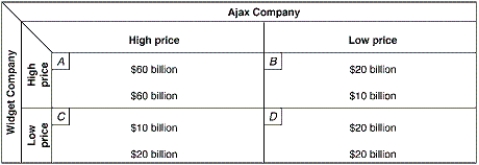 -Suppose costs are identical for the two firms in Exhibit 10-6. If both firms assume the other will compete and charge a lower price, equilibrium will be established by:
 (Multiple Choice)
4.8/5 (85)
(85) Exhibit 10-1 A monopolistic competitive firm  -As presented in Exhibit 10-1, the short-run profit per unit of output for the monopolistic competitive firm is:
 (Multiple Choice)
4.9/5 (65)
(65) Exhibit 10-1 A monopolistic competitive firm
-In the long run, the demand curve for the monopolistic competitive firm shown in Exhibit 10-1:
-In the long run, the demand curve for the monopolistic competitive firm shown in Exhibit 10-1: (Multiple Choice)
4.8/5 (70)
(70) Entry of new firms will occur in a monopolistic competitive industry until:
(Multiple Choice)
4.8/5 (73)
(73) Which of the following is the best example of an oligopoly?
(Multiple Choice)
4.7/5 (85)
(85) Under which one of the following market structures are sellers most likely to consider the reaction of rival sellers when they set the price of their product?
(Multiple Choice)
4.8/5 (80)
(80) Which of the following is not a characteristic of the monopolistic competition market structure?
(Multiple Choice)
4.9/5 (85)
(85) A monopolistic competitive firm in the long run sets price equal to the minimum point on the long-run average cost curve.
(True/False)
4.8/5 (80)
(80) According to the kinked demand theory, when one firm raises its price, other firms will:
(Multiple Choice)
4.9/5 (74)
(74) A profit-maximizing monopolistically competitive firm will expand output to the point where:
(Multiple Choice)
4.8/5 (82)
(82) Exhibit 10-5 Two-Firm Payoff Matrix 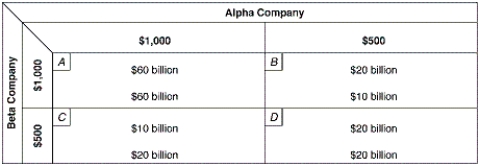 -Assume costs are identical for the two firms in Exhibit 10-5. If both firms were allowed to form a cartel and agree on their prices, equilibrium would be established by:
 (Multiple Choice)
4.9/5 (90)
(90) Exhibit 10-1 A monopolistic competitive firm
-In the long run, which of the following is true for the firm shown in Exhibit 10-1?
-In the long run, which of the following is true for the firm shown in Exhibit 10-1? (Multiple Choice)
5.0/5 (76)
(76) Exhibit 10-4 Kinked demand curves 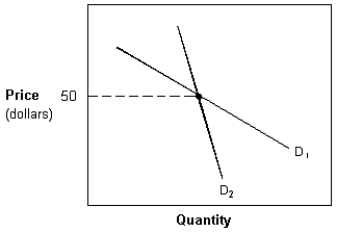 -In Exhibit 10-4, the exhibit represents a kinked-demand oligopoly model. Suppose the current price is $50. If one firm in the oligopoly now attempts to raise price, all firms will:
 (Multiple Choice)
4.9/5 (78)
(78) In the long run, the economic profits of Hoot's Chicken 'n' Ribs, a monopolistic competitor, are:
(Multiple Choice)
4.9/5 (93)
(93) Product differentiation makes the demand for a monopolistically competitive firm's product:
(Multiple Choice)
4.8/5 (77)
(77) If a monopolistically competitive firm can earn a profit, it will increase production until:
(Multiple Choice)
4.8/5 (82)
(82) 
Filters
- Essay(0)
- Multiple Choice(0)
- Short Answer(0)
- True False(0)
- Matching(0)