



 Chat with AI
Exam 10: Monopolistic Competition and Oligopoly

Exam 1: Introducing the Economic Way of Thinking251 Questions
Exam 2: Production Possibilities, Opportunity Cost, and Economic Growth202 Questions
Exam 3: Market Demand and Supply412 Questions
Exam 4: Markets in Action253 Questions
Exam 5: Price Elasticity of Demand and Supply280 Questions
Exam 6: Consumer Choice Theory272 Questions
Exam 7: Production Costs243 Questions
Exam 8: Perfect Competition237 Questions
Exam 9: Monopoly168 Questions
Exam 10: Monopolistic Competition and Oligopoly187 Questions
Exam 11: Labor Markets202 Questions
Exam 12: Income Distribution, Poverty, and Discrimination130 Questions
Exam 13: Antitrust and Regulation203 Questions
Exam 14: Environmental Economics106 Questions
Exam 15: International Trade and Finance241 Questions
Exam 16: Economies in Transition108 Questions
Exam 17: Growth and the117 Questions
Select questions type


Exhibit 10-4 Kinked demand curves 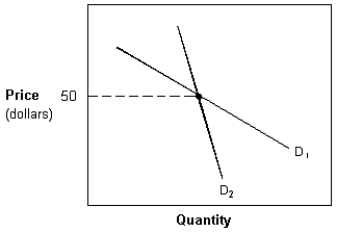 -In Exhibit 10-4, in a kinked-demand oligopoly model, D1 represents the:
 (Multiple Choice)
4.8/5  (79)
(79) Perfect competition and monopolistic competition are similar because under both market structures,
(Multiple Choice)
4.9/5 (76)
(76) The theory of monopolistic competition predicts that in long-run equilibrium a monopolistically competitive firm will:
(Multiple Choice)
4.8/5 (83)
(83) Compared to the perfectly competitive outcome, monopolistically competitive markets will result in:
(Multiple Choice)
4.7/5 (67)
(67) Exhibit 10-7 Two-Firm Payoff Matrix 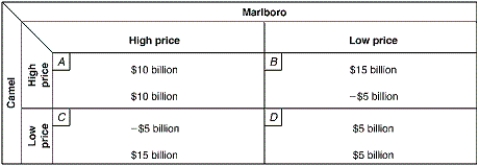 -Assume costs are identical for the two firms in Exhibit 10-7. If both firms were allowed to form a cartel and agree on their prices, equilibrium would be established by:
 (Multiple Choice)
4.8/5 (89)
(89) Which of the following is a characteristic of the monopolistic competition market structure?
(Multiple Choice)
4.9/5 (72)
(72) 
Filters
- Essay(0)
- Multiple Choice(0)
- Short Answer(0)
- True False(0)
- Matching(0)