



 Chat with AI
Exam 15: International Trade and Finance

Exam 1: Introducing the Economic Way of Thinking251 Questions
Exam 2: Production Possibilities, Opportunity Cost, and Economic Growth202 Questions
Exam 3: Market Demand and Supply412 Questions
Exam 4: Markets in Action253 Questions
Exam 5: Price Elasticity of Demand and Supply280 Questions
Exam 6: Consumer Choice Theory272 Questions
Exam 7: Production Costs243 Questions
Exam 8: Perfect Competition237 Questions
Exam 9: Monopoly168 Questions
Exam 10: Monopolistic Competition and Oligopoly187 Questions
Exam 11: Labor Markets202 Questions
Exam 12: Income Distribution, Poverty, and Discrimination130 Questions
Exam 13: Antitrust and Regulation203 Questions
Exam 14: Environmental Economics106 Questions
Exam 15: International Trade and Finance241 Questions
Exam 16: Economies in Transition108 Questions
Exam 17: Growth and the117 Questions
Select questions type


Exhibit 15-2 Production possibilities curves for U.S. and Mexico 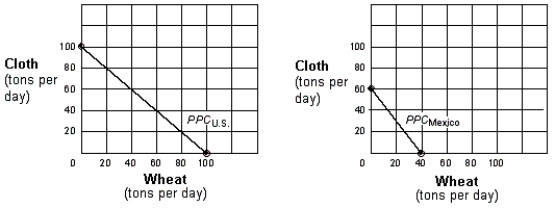 -As shown in Exhibit 15-2, in Mexico, producing 1 additional ton of wheat costs:
 (Multiple Choice)
4.9/5  (87)
(87) If a nation follows a policy of being self-sufficient, its:
(Multiple Choice)
4.8/5 (72)
(72) According to the infant industry argument, a new domestic industry needs protection because it has higher costs than established foreign competitors.
(True/False)
4.8/5 (80)
(80) The primary benefits derived from tariffs usually accrue to the:
(Multiple Choice)
4.9/5 (78)
(78) Borrowing from foreign banks by U.S. firms represents a capital inflow.
(True/False)
4.9/5 (82)
(82) Exhibit 15-1 Production possibilities curves 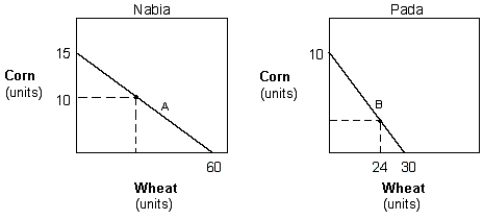 -In Exhibit 15-1, the production possibilities curves of wheat and corn for Nabia and Pada are presented. Suppose Pada produces at point B on its PPC. How much corn is the country able to produce?
 (Multiple Choice)
4.9/5 (87)
(87) A country that has a lower opportunity cost of producing a good:
(Multiple Choice)
4.8/5 (86)
(86) The argument that foreign trade should be restricted to protect domestic employment and output is based on the idea that:
(Multiple Choice)
4.9/5 (84)
(84) Exhibit 15-4 Coffee and tea output (pounds per hour) Country Coffee T ea Brazil 10 5 China 8 8
-As shown in Exhibit 15-4, compared to Brazil, China has a comparative advantage in the production of:
(Multiple Choice)
4.8/5 (88)
(88) If there is bilateral currency trade between Japan and the U.S., then as the supply of U.S. dollars on the world foreign exchange market ________, the price of a dollar in terms of Japanese yen will ________.
(Multiple Choice)
4.9/5 (89)
(89) Suppose a quota on foreign-made automobiles is proposed in Congress. Which of the following groups is most likely to oppose the bill?
(Multiple Choice)
4.8/5 (75)
(75) A country has a comparative advantage in producing a good when it has the lowest opportunity cost of producing that good.
(True/False)
4.8/5 (88)
(88) Suppose the exchange rate changes so that more Japanese yen are required to buy a dollar. We could conclude that:
(Multiple Choice)
4.8/5 (76)
(76) If foreign exchange rates are determined by the interaction of supply and demand forces for the various currencies, then the exchange rate is:
(Multiple Choice)
5.0/5 (73)
(73) 
Filters
- Essay(0)
- Multiple Choice(0)
- Short Answer(0)
- True False(0)
- Matching(0)