



 Chat with AI
Exam 15: International Trade and Finance

Exam 1: Introducing the Economic Way of Thinking251 Questions
Exam 2: Production Possibilities, Opportunity Cost, and Economic Growth202 Questions
Exam 3: Market Demand and Supply412 Questions
Exam 4: Markets in Action253 Questions
Exam 5: Price Elasticity of Demand and Supply280 Questions
Exam 6: Consumer Choice Theory272 Questions
Exam 7: Production Costs243 Questions
Exam 8: Perfect Competition237 Questions
Exam 9: Monopoly168 Questions
Exam 10: Monopolistic Competition and Oligopoly187 Questions
Exam 11: Labor Markets202 Questions
Exam 12: Income Distribution, Poverty, and Discrimination130 Questions
Exam 13: Antitrust and Regulation203 Questions
Exam 14: Environmental Economics106 Questions
Exam 15: International Trade and Finance241 Questions
Exam 16: Economies in Transition108 Questions
Exam 17: Growth and the117 Questions
Select questions type


The account which records a nation's foreign economic transactions is called the:
(Multiple Choice)
4.7/5  (84)
(84) Opening trade between nations enables each nation's consumption possibilities to go beyond the confines of its own production possibilities curve.
(True/False)
4.8/5 (73)
(73) If Japan gives up ten bushels of rice to produce one bicycle, while the United States gives up five bushels of rice to produce one bicycle, then:
(Multiple Choice)
4.9/5 (76)
(76) A basic problem with the infant-industry argument is that:
(Multiple Choice)
4.7/5 (83)
(83) Under a fixed exchange rate system, a government is at risk of running out of foreign currency reserves when the country's imports exceed its exports.
(True/False)
4.8/5 (87)
(87) Exhibit 15-5 International currency markets 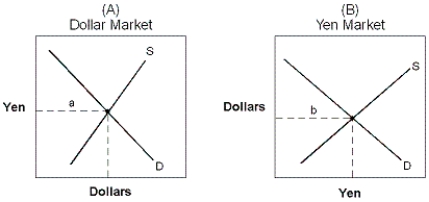 -Exhibit 15-5 displays the international currency market for yen in terms of dollars and dollars in terms of yen. The supply curve in graph 15-5(A) is determined by:
 (Multiple Choice)
4.9/5 (80)
(80) An increase in the equilibrium price of Japanese yen per dollar could be caused by a(n):
(Multiple Choice)
4.8/5 (77)
(77) An itemized account of a nation's foreign economic transactions is its:
(Multiple Choice)
5.0/5 (87)
(87) When countries specialize, total world output increases, and, therefore, the potential for greater total world consumption also increases.
(True/False)
4.8/5 (69)
(69) A tariff has the effect of granting ____ a larger share of the domestic market.
(Multiple Choice)
5.0/5 (79)
(79) Assume the United States can use a given amount of its resources to produce either 20 airplanes or 8 automobiles and Japan can employ the same amount of its resources to produce either 20 airplanes or 10 automobiles. The U.S. should specialize in:
(Multiple Choice)
4.9/5 (78)
(78) Protective tariffs help a nation reach which of the following goals?
(Multiple Choice)
4.9/5 (80)
(80) A decrease in the supply of dollars to holders of Mexican pesos would cause the:
(Multiple Choice)
4.9/5 (74)
(74) If a country's goods exports are less than its goods imports, then it experiences a:
(Multiple Choice)
4.8/5 (70)
(70) Which of the following would be expected if the tariff on foreign-produced shoes were decreased?
(Multiple Choice)
4.9/5 (73)
(73) Trade restrictions imposed in the name of national security have been recommended by protectionists in order to:
(Multiple Choice)
4.9/5 (78)
(78) 
Filters
- Essay(0)
- Multiple Choice(0)
- Short Answer(0)
- True False(0)
- Matching(0)