



 Chat with AI
Exam 15: International Trade and Finance

Exam 1: Introducing the Economic Way of Thinking251 Questions
Exam 2: Production Possibilities, Opportunity Cost, and Economic Growth202 Questions
Exam 3: Market Demand and Supply412 Questions
Exam 4: Markets in Action253 Questions
Exam 5: Price Elasticity of Demand and Supply280 Questions
Exam 6: Consumer Choice Theory272 Questions
Exam 7: Production Costs243 Questions
Exam 8: Perfect Competition237 Questions
Exam 9: Monopoly168 Questions
Exam 10: Monopolistic Competition and Oligopoly187 Questions
Exam 11: Labor Markets202 Questions
Exam 12: Income Distribution, Poverty, and Discrimination130 Questions
Exam 13: Antitrust and Regulation203 Questions
Exam 14: Environmental Economics106 Questions
Exam 15: International Trade and Finance241 Questions
Exam 16: Economies in Transition108 Questions
Exam 17: Growth and the117 Questions
Select questions type


Exhibit 15-4 Coffee and tea output (pounds per hour) Country Coffee T ea Brazil 10 5 China 8 8
-As shown in Exhibit 15-4, the opportunity cost to Brazil of producing one pound of coffee is:
(Multiple Choice)
4.7/5  (71)
(71) A restriction on the quantity of a good that can be imported into a country is a(n):
(Multiple Choice)
4.9/5 (91)
(91) The argument that import restrictions save jobs and promote prosperity fails to recognize that:
(Multiple Choice)
4.9/5 (88)
(88) Exhibit 15-1 Production possibilities curves 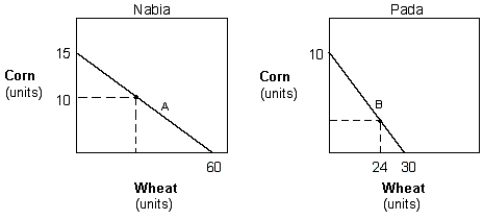 -In Exhibit 15-1, the production possibilities curves of wheat and corn for Nabia and Pada are presented. Suppose Nabia produces at point A on its PPC. How many units of wheat is the country able to produce?
 (Multiple Choice)
5.0/5 (77)
(77) Which of the following would not be counted in the U.S. BOP current account?
(Multiple Choice)
4.8/5 (80)
(80) Exhibit 15-1 Production possibilities curves
-In Exhibit 15-1, the production possibilities curves of wheat and corn for Nabia and Pada are presented. In Pada the cost of producing one more unit of wheat is equal to:
-In Exhibit 15-1, the production possibilities curves of wheat and corn for Nabia and Pada are presented. In Pada the cost of producing one more unit of wheat is equal to: (Multiple Choice)
4.7/5 (80)
(80) Suppose that the Zubians can produce 1000 pounds of flour per hours, or catch 500 pounds of fish per hour. In contrast, the Zirconians can produce 1800 pounds of flour per hour, or catch 300 pounds of fish per hours. What is the comparative advantage of the Zubians?
(Multiple Choice)
4.9/5 (70)
(70) Exhibit 15-1 Production possibilities curves
-In Exhibit 15-1, the production possibilities curves of wheat and corn for Nabia and Pada are presented. In Nabia the cost of producing one more unit of wheat is equal to:
-In Exhibit 15-1, the production possibilities curves of wheat and corn for Nabia and Pada are presented. In Nabia the cost of producing one more unit of wheat is equal to: (Multiple Choice)
4.8/5 (65)
(65) Suppose you are traveling from the United States to Djibouti on vacation. You would be better off on your vacation if:
(Multiple Choice)
4.8/5 (89)
(89) If the U.S. dollar appreciates relative to the British pound, then we pay fewer dollars for a pound.
(True/False)
4.8/5 (74)
(74) The U.S. supply curve of dollars is upward-sloping because a:
(Multiple Choice)
4.9/5 (79)
(79) If a country has a lower opportunity cost of producing oranges, then this is:
(Multiple Choice)
4.7/5 (92)
(92) If Dana can paint his house faster than Luke, a professional house painter, then:
(Multiple Choice)
4.8/5 (78)
(78) 
Filters
- Essay(0)
- Multiple Choice(0)
- Short Answer(0)
- True False(0)
- Matching(0)