



 Chat with AI
Exam 15: International Trade and Finance

Exam 1: Introducing the Economic Way of Thinking251 Questions
Exam 2: Production Possibilities, Opportunity Cost, and Economic Growth202 Questions
Exam 3: Market Demand and Supply412 Questions
Exam 4: Markets in Action253 Questions
Exam 5: Price Elasticity of Demand and Supply280 Questions
Exam 6: Consumer Choice Theory272 Questions
Exam 7: Production Costs243 Questions
Exam 8: Perfect Competition237 Questions
Exam 9: Monopoly168 Questions
Exam 10: Monopolistic Competition and Oligopoly187 Questions
Exam 11: Labor Markets202 Questions
Exam 12: Income Distribution, Poverty, and Discrimination130 Questions
Exam 13: Antitrust and Regulation203 Questions
Exam 14: Environmental Economics106 Questions
Exam 15: International Trade and Finance241 Questions
Exam 16: Economies in Transition108 Questions
Exam 17: Growth and the117 Questions
Select questions type


If one U.S. dollar can be exchanged for 5 Swiss francs, then 1 franc can be exchanged for:
(Multiple Choice)
4.8/5  (70)
(70) If the current account and capital account are both in surplus, the official reserve account does not have to be in deficit.
(True/False)
4.7/5 (86)
(86) Suppose that Spain has a comparative advantage in hats and Portugal has a comparative advantage in doormats. Under a system of free trade, each country specializes and then trades with the other. If the price starts at four hats per doormat, and then increases to five hats per doormat, then:
(Multiple Choice)
4.7/5 (81)
(81) An increase in the price level in Japan relative to the price level in the United States will shift the demand curve for dollars leftward and the dollar depreciates or becomes weaker.
(True/False)
4.8/5 (73)
(73) In the U.S. balance of payments, purchases of foreign assets by U.S. residents are tabulated as a:
(Multiple Choice)
4.8/5 (80)
(80) Suppose a U.S.-made machine costs $500 and the exchange rate is 100 yen = $1. A Japanese citizen purchasing this machine would pay:
(Multiple Choice)
4.7/5 (85)
(85) The main explanation for why the cheap foreign labor argument is a poor reason for restricting international trade is that:
(Multiple Choice)
4.8/5 (81)
(81) The main problem with using the infant industries argument to justify protecting an industry from foreign competition is that:
(Multiple Choice)
4.7/5 (82)
(82) One big difference between tariffs and quotas is that tariffs:
(Multiple Choice)
4.8/5 (89)
(89) An increase in a nation's trade deficit occurs when that nation's exports rise and/or its imports fall.
(True/False)
4.8/5 (86)
(86) Absolute advantage occurs when one nation can produce a good ____ its trading partners.
(Multiple Choice)
4.9/5 (88)
(88) If the Japanese price level falls relative to the price level in the United States, then:
(Multiple Choice)
4.9/5 (98)
(98) Exhibit 15-7 Foreign exchange market for U.S. dollars and British pounds 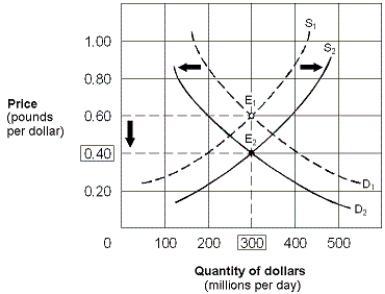 -Exhibit 15-7 shows a situation in which:
 (Multiple Choice)
4.9/5 (89)
(89) Which of the following provides the foundation of the case for free trade?
(Multiple Choice)
4.8/5 (87)
(87) Exhibit 15-2 Production possibilities curves for U.S. and Mexico 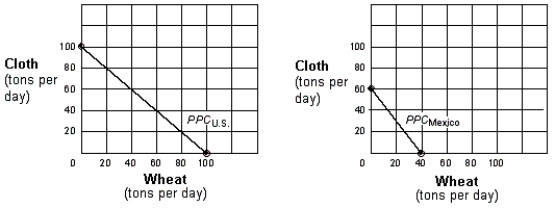 -As shown in Exhibit 15-2, the United States has a comparative advantage over Mexico in:
 (Multiple Choice)
4.9/5 (89)
(89) 
Filters
- Essay(0)
- Multiple Choice(0)
- Short Answer(0)
- True False(0)
- Matching(0)