



 Chat with AI
Exam 13: Accounting for Merchandise Inventory

Exam 1: Introduction to Accounting50 Questions
Exam 2: Analyzing Transactions: the Accounting Equation57 Questions
Exam 3: The Double-Entry Framework78 Questions
Exam 4: Journalizing and Posting Transactions94 Questions
Exam 5: Adjusting Entries and the Work Sheet101 Questions
Exam 6: Financial Statements and the Closing Process92 Questions
Exam 7: Accounting for Cash93 Questions
Exam 8: Payroll Accounting: Employee Earnings and Deductions85 Questions
Exam 9: Payroll Accounting: Employer Taxes and Reports79 Questions
Exam 10: Accounting for Sales and Cash Receipts66 Questions
Exam 11: Accounting for Purchases and Cash Payments79 Questions
Exam 12: Special Journals56 Questions
Exam 13: Accounting for Merchandise Inventory87 Questions
Exam 14: Adjustments and the Work Sheet for a Merchandising Business70 Questions
Exam 15: Financial Statements and Year-End Accounting for a Merchandising Business96 Questions
Exam 16: Accounting for Accounts Receivable77 Questions
Exam 17: Accounting for Notes and Interest97 Questions
Exam 18: Accounting for Long-Term Assets103 Questions
Exam 19: Accounting for Partnerships77 Questions
Exam 20: Corporations: Organization and Capital Stocks105 Questions
Exam 21: Corporations: Earnings, Taxes, Distributions, and the Retained Earnings Statement92 Questions
Exam 22: Corporations: Bonds98 Questions
Exam 23: Statement of Cash Flows102 Questions
Exam 24: Analysis of Financial Statements101 Questions
Exam 25: Departmental Accounting72 Questions
Exam 26: Manufacturing Accounting: The Job Order Cost System97 Questions
Exam 27: Manufacturing Accounting: The Work Sheet and Financial Statements66 Questions
Select questions type


When merchandise is sold and the perpetual system of inventory is used, the journal entry for a sale would include
(Multiple Choice)
4.9/5  (81)
(81) When each unit of inventory can be specifically identified, the specific identification method can be used.
(True/False)
4.9/5 (91)
(91) The natural business year is a fiscal year that starts and ends at the time the stock of merchandise is normally at its lowest level.
(True/False)
4.9/5 (69)
(69) The inventory system that uses the merchandise inventory account as an active account is called
(Multiple Choice)
4.9/5 (78)
(78) A widely used method of allocating merchandise cost that assumes the first merchandise bought is the first merchandise sold is called the first-in, first-out method.
(True/False)
4.8/5 (89)
(89) A method of allocating merchandise cost requiring each item sold and each item remaining in inventory to be separately identified with respect to its purchase cost is called the
(Multiple Choice)
4.9/5 (83)
(83) A method of allocating merchandise cost that assumes the sales in the period were made from the recently purchased merchandise and its earliest merchandise bought remains in the inventory is called the
(Multiple Choice)
4.8/5 (84)
(84) Refer to the following data:
Net sales, first month
$13,000
Normal gross profit as a percentage of sales
45%
Inventory, start of period
$8,000
Net purchases, first month
$7,000
Using the gross profit method of inventory estimation, the amount of normal gross profit would be
(Multiple Choice)
4.8/5 (76)
(76) Assume the beginning inventory as of January 1 consisted of 500 units that were purchased for $8.25 each. During the month, three new purchases were made. The first purchase consisted of 700 units costing $8.50 each, the second purchase had 800 units costing $9.00 each, and the third purchase had 600 units costing $9.50 each. At the end of the month, ending inventory shows 700 units. Compute the cost of goods sold and the ending inventory for the company using each of the following methods. Also determine the gross margin if the total sales revenue is $43,000.
a.
Specific identification: Of the units sold, 300 were from the beginning inventory, 600 from the first purchase, 700 from the second purchase, and 300 from the third purchase.
b.
First-in, first-out (FIFO)
c.
Weighted-average (round the unit price)
d.
Last-in, first-out (LIFO)
(Essay)
4.9/5 (89)
(89) The gross profit method estimates the ending inventory and cost of goods sold by using the firm's normal gross profit as a percentage of net sales.
(True/False)
4.8/5 (79)
(79) Match the terms with the definitions.
-Under this system, cost of goods sold and the amount of merchandise inventory on hand are updated when merchandise is bought and sold.
(Multiple Choice)
4.9/5 (78)
(78) Under the perpetual system of accounting for inventory, the merchandise inventory account is debited for the cost of all merchandise bought.
(True/False)
4.8/5 (88)
(88) Refer to the following data: Net sales, first month \ 13,000 Normal gross profit as a percentage of sales 45\% Inventory, start of period \ 8,000 Net purchases, first month \ 7,000 ? Using the gross profit method of inventory estimation, the cost of goods sold would be
(Multiple Choice)
4.8/5 (75)
(75) Under the periodic inventory system, no entries are made to the merchandise inventory or cost of goods sold accounts during the year.
(True/False)
4.8/5 (89)
(89) A method of allocating merchandise cost that is based on the average cost of identical units is known as weighted-average cost or average cost.
(True/False)
4.8/5 (72)
(72) The gross profit (inventory valuation) method requires keeping records of the selling prices of merchandise purchased.
(True/False)
4.7/5 (80)
(80) Errors in the ending inventory have a direct effect on net income for the period.
(True/False)
4.9/5 (88)
(88) Over the past several years, Landmark Supplies has averaged a gross profit of 34%. At the end of 20--, the income statement of the company included the information shown below: 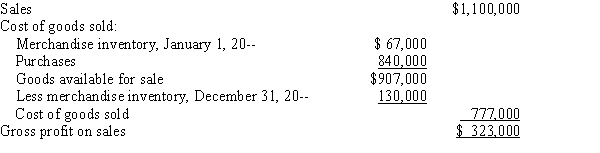
Investigation revealed that employees of the company had not taken an actual physical count of the inventory on December 31, 20--. Instead, they had merely estimated the inventory.
Required:
Under the gross profit method of inventory estimation, determine the following items to check the accuracy of the employees' estimates.

Investigation revealed that employees of the company had not taken an actual physical count of the inventory on December 31, 20--. Instead, they had merely estimated the inventory.
Required:
Under the gross profit method of inventory estimation, determine the following items to check the accuracy of the employees' estimates. (Essay)
5.0/5 (76)
(76) Match the terms with the definitions.
-Under this system, the ending inventory and cost of goods sold are determined at the end of the accounting period, when a physical inventory is taken.
(Multiple Choice)
4.9/5 (75)
(75) Match the terms with the definitions.
-Goods that are in the process of being shipped between the seller and the buyer.
(Multiple Choice)
4.8/5 (91)
(91) 
Filters
- Essay(0)
- Multiple Choice(0)
- Short Answer(0)
- True False(0)
- Matching(0)