



 Chat with AI
Exam 16: Accounting for Accounts Receivable

Exam 1: Introduction to Accounting50 Questions
Exam 2: Analyzing Transactions: the Accounting Equation57 Questions
Exam 3: The Double-Entry Framework78 Questions
Exam 4: Journalizing and Posting Transactions94 Questions
Exam 5: Adjusting Entries and the Work Sheet101 Questions
Exam 6: Financial Statements and the Closing Process92 Questions
Exam 7: Accounting for Cash93 Questions
Exam 8: Payroll Accounting: Employee Earnings and Deductions85 Questions
Exam 9: Payroll Accounting: Employer Taxes and Reports79 Questions
Exam 10: Accounting for Sales and Cash Receipts66 Questions
Exam 11: Accounting for Purchases and Cash Payments79 Questions
Exam 12: Special Journals56 Questions
Exam 13: Accounting for Merchandise Inventory87 Questions
Exam 14: Adjustments and the Work Sheet for a Merchandising Business70 Questions
Exam 15: Financial Statements and Year-End Accounting for a Merchandising Business96 Questions
Exam 16: Accounting for Accounts Receivable77 Questions
Exam 17: Accounting for Notes and Interest97 Questions
Exam 18: Accounting for Long-Term Assets103 Questions
Exam 19: Accounting for Partnerships77 Questions
Exam 20: Corporations: Organization and Capital Stocks105 Questions
Exam 21: Corporations: Earnings, Taxes, Distributions, and the Retained Earnings Statement92 Questions
Exam 22: Corporations: Bonds98 Questions
Exam 23: Statement of Cash Flows102 Questions
Exam 24: Analysis of Financial Statements101 Questions
Exam 25: Departmental Accounting72 Questions
Exam 26: Manufacturing Accounting: The Job Order Cost System97 Questions
Exam 27: Manufacturing Accounting: The Work Sheet and Financial Statements66 Questions
Select questions type


Supreme Carpet Care estimates the amount of uncollectible accounts using the percentage of receivables method. After aging the accounts, it is estimated that $7,225 will not be collecteD.
Required:
Give the end-of-period adjusting entry at December 31 in general journal form to enter the estimate for bad debt expense assuming the allowance for bad debts account has a debit balance of $420 before adjustment.

Free
(Essay)
4.9/5  (87)
(87) Correct Answer: Verified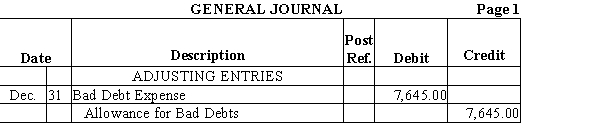
Match the terms with the definitions.
-A method in which the current year's uncollectible accounts are estimated based on the relationship between the amount of accounts receivable and the amount of uncollectible accounts in prior years.
Free
(Multiple Choice)
4.8/5 (85)
(85) Correct Answer:Verified
VerifiedG
Dude Ranch Circle estimates its uncollectible accounts at 1.5% of its credit sales of $825,000. When adjusting for estimated losses from uncollectible accounts, the debit to Bad Debt Expense is
Free
(Multiple Choice)
4.7/5 (75)
(75) Correct Answer:Verified
VerifiedC
Some businesses and individuals who "charge it" are unwilling or unable to "pay for it."
(True/False)
4.7/5 (82)
(82) If after taking a percentage of sales on account, it is estimated that $1,000 will not be collected and the allowance account has an existing credit balance of $200, the adjusting entry would be for the amount of $1,200.
(True/False)
4.8/5 (81)
(81) There are three methods of accounting for uncollectible accounts⎯the direct write-off method, the allowance method, and the reserve method.
(True/False)
4.8/5 (82)
(82) Under the percentage of receivables method, the adjusting entry at the end of the period for bad debt expense is not affected by the current balance in the allowance for bad debts account.
(True/False)
4.8/5 (91)
(91) If actual write-offs are significantly higher or lower than estimated uncollectible accounts over a number of periods, a large debit or credit balance will accumulate in the allowance for bad debts account.
(True/False)
4.9/5 (85)
(85) Most people tend to buy more if they can "charge it" rather than pay cash.
(True/False)
4.9/5 (74)
(74) After aging the accounts receivable, it is estimated that $420 will not be collected and the allowance account has an existing debit balance of $100. If accounts receivable is $145,000, the net receivables would be
(Multiple Choice)
4.9/5 (83)
(83) Which of the following is an advantage of using the direct write-off method?
(Multiple Choice)
4.9/5 (81)
(81) The credit portion of an adjusting entry to enter the estimate for uncollectible accounts can be made directly to a specific receivable account.
(True/False)
4.8/5 (87)
(87) The matching concept states that expenses incurred to produce particular revenues should be matched with those revenues.
(True/False)
4.9/5 (74)
(74) Match the terms with the definitions.
-A method in which the bad debt expense is not recognized until it has been determined that an account is uncollectible.
(Multiple Choice)
4.9/5 (82)
(82) Under the percentage of sales method, the adjusting entry at the end of the period for bad debt expense is affected by the current balance in the allowance for bad debts account.
(True/False)
4.8/5 (82)
(82) After aging the accounts receivable, it is estimated that $790 will not be collected and the allowance account has an existing debit balance of $230. The adjusting entry under the aging approach would be for the amount of
(Multiple Choice)
4.8/5 (71)
(71) The allowance for bad debts account may have a credit balance prior to adjustment.
(True/False)
4.8/5 (80)
(80) Under the direct write-off method, when an account receivable is written off in one accounting period and is collected in the following accounting period, which of the following would be included in the journal entry?
(Multiple Choice)
4.9/5 (67)
(67) When a large balance accumulates in the allowance for bad debts account, the percentage of sales used to estimate uncollectibles should be modified.
(True/False)
4.9/5 (93)
(93) 
Filters
- Essay(0)
- Multiple Choice(0)
- Short Answer(0)
- True False(0)
- Matching(0)