Exam 4: Matrices

arrow
  • Select Tags
search iconSearch Question
flashcardsStudy Flashcards
  • Select Tags

Find x, y, z and w. ​ Find x, y, z and w. ​   ​ ​

(Multiple Choice)
4.7/5
(73)

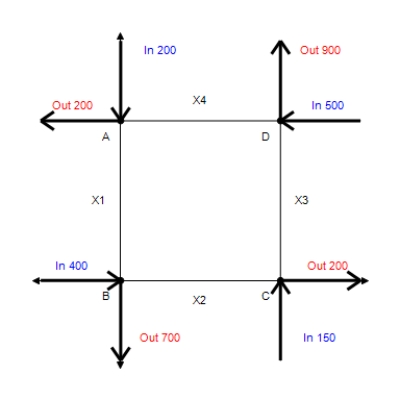
In the analysis of traffic flow, a certain city estimates the following situation for the "square" of its downtown district. In the following figure, the arrows indicate the flow of traffic. If In the analysis of traffic flow, a certain city estimates the following situation for the square of its downtown district. In the following figure, the arrows indicate the flow of traffic. If   represents the number of cars traveling between intersections A and B,   represents the number of cars traveling between B and C,   the number between C and D, and   the number between D and A, we can formulate equations based on the principle that the number of vehicles entering an intersection equals the number leaving it. That is, for intersection A we obtain   Formulate equations for the traffic at B, C, and D. ​   ​ represents the number of cars traveling between intersections A and B, In the analysis of traffic flow, a certain city estimates the following situation for the square of its downtown district. In the following figure, the arrows indicate the flow of traffic. If   represents the number of cars traveling between intersections A and B,   represents the number of cars traveling between B and C,   the number between C and D, and   the number between D and A, we can formulate equations based on the principle that the number of vehicles entering an intersection equals the number leaving it. That is, for intersection A we obtain   Formulate equations for the traffic at B, C, and D. ​   ​ represents the number of cars traveling between B and C, In the analysis of traffic flow, a certain city estimates the following situation for the square of its downtown district. In the following figure, the arrows indicate the flow of traffic. If   represents the number of cars traveling between intersections A and B,   represents the number of cars traveling between B and C,   the number between C and D, and   the number between D and A, we can formulate equations based on the principle that the number of vehicles entering an intersection equals the number leaving it. That is, for intersection A we obtain   Formulate equations for the traffic at B, C, and D. ​   ​ the number between C and D, and In the analysis of traffic flow, a certain city estimates the following situation for the square of its downtown district. In the following figure, the arrows indicate the flow of traffic. If   represents the number of cars traveling between intersections A and B,   represents the number of cars traveling between B and C,   the number between C and D, and   the number between D and A, we can formulate equations based on the principle that the number of vehicles entering an intersection equals the number leaving it. That is, for intersection A we obtain   Formulate equations for the traffic at B, C, and D. ​   ​ the number between D and A, we can formulate equations based on the principle that the number of vehicles entering an intersection equals the number leaving it. That is, for intersection A we obtain In the analysis of traffic flow, a certain city estimates the following situation for the square of its downtown district. In the following figure, the arrows indicate the flow of traffic. If   represents the number of cars traveling between intersections A and B,   represents the number of cars traveling between B and C,   the number between C and D, and   the number between D and A, we can formulate equations based on the principle that the number of vehicles entering an intersection equals the number leaving it. That is, for intersection A we obtain   Formulate equations for the traffic at B, C, and D. ​   ​ Formulate equations for the traffic at B, C, and D. ​ In the analysis of traffic flow, a certain city estimates the following situation for the square of its downtown district. In the following figure, the arrows indicate the flow of traffic. If   represents the number of cars traveling between intersections A and B,   represents the number of cars traveling between B and C,   the number between C and D, and   the number between D and A, we can formulate equations based on the principle that the number of vehicles entering an intersection equals the number leaving it. That is, for intersection A we obtain   Formulate equations for the traffic at B, C, and D. ​   ​ ​

(Multiple Choice)
4.9/5
(82)

Use a computer spreadsheet to find the average efficiency for each work center over the first five workers. Which work center is the most efficient? ​ Use a computer spreadsheet to find the average efficiency for each work center over the first five workers. Which work center is the most efficient? ​   ​ ​

(Multiple Choice)
4.8/5
(86)

Find the inverse of matrix A and check it by calculating Find the inverse of matrix A and check it by calculating   .  . Find the inverse of matrix A and check it by calculating   .

(Multiple Choice)
4.8/5
(62)

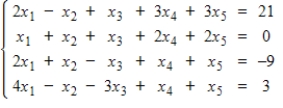
Use technology to solve the system of equations, if a solution exists. Use technology to solve the system of equations, if a solution exists.
(Multiple Choice)
4.9/5
(64)

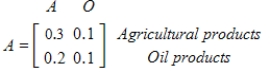
Suppose the economy of an underdeveloped country has an agricultural industry and an oil industry, with technology matrix A. ​ Suppose the economy of an underdeveloped country has an agricultural industry and an oil industry, with technology matrix A. ​   ​ If surpluses of 0 units of agricultural products and 610 units of oil products are desired, find the gross production of each industry to the nearest unit. ​ ​ If surpluses of 0 units of agricultural products and 610 units of oil products are desired, find the gross production of each industry to the nearest unit. ​
(Multiple Choice)
4.8/5
(73)

Use the following matrices to perform the indicated matrix operations, if possible. ​ Use the following matrices to perform the indicated matrix operations, if possible. ​   ​   ​ ​ Use the following matrices to perform the indicated matrix operations, if possible. ​   ​   ​ ​

(Multiple Choice)
4.9/5
(78)

Multiply the matrices. Multiply the matrices.   ​ ​

(Multiple Choice)
4.7/5
(79)

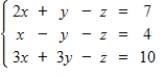
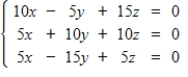
A system of equations may have a unique solution, an infinite number of solutions, or no solution. Use matrices to find the general solution of the following system. A system of equations may have a unique solution, an infinite number of solutions, or no solution. Use matrices to find the general solution of the following system.
(Multiple Choice)
4.8/5
(71)

The tables below give the numbers of some species of threatened and endangered wildlife in the United States and in foreign countries in 2003. Find a matrix with the total number of these species. Assume that U.S. and foreign species are different. ​ United States The tables below give the numbers of some species of threatened and endangered wildlife in the United States and in foreign countries in 2003. Find a matrix with the total number of these species. Assume that U.S. and foreign species are different. ​ United States   Foreign   ​ Foreign The tables below give the numbers of some species of threatened and endangered wildlife in the United States and in foreign countries in 2003. Find a matrix with the total number of these species. Assume that U.S. and foreign species are different. ​ United States   Foreign   ​ ​

(Multiple Choice)
4.9/5
(74)

When a firm buys another company, the company frequently has some outstanding debt that the purchaser must pay. Consider three companies, A, B, and C, that are purchased by Maxx Industries. The following table gives the amount of each company's debt, classified by the number of days remaining until the debt must be paid. What payment plan did Maxx Industries use if the outstanding debt is given by the following matrix? ​ When a firm buys another company, the company frequently has some outstanding debt that the purchaser must pay. Consider three companies, A, B, and C, that are purchased by Maxx Industries. The following table gives the amount of each company's debt, classified by the number of days remaining until the debt must be paid. What payment plan did Maxx Industries use if the outstanding debt is given by the following matrix? ​     ​ When a firm buys another company, the company frequently has some outstanding debt that the purchaser must pay. Consider three companies, A, B, and C, that are purchased by Maxx Industries. The following table gives the amount of each company's debt, classified by the number of days remaining until the debt must be paid. What payment plan did Maxx Industries use if the outstanding debt is given by the following matrix? ​     ​ ​

(Multiple Choice)
4.8/5
(82)

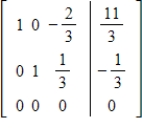
A system of linear equations and a reduced matrix for the system are given. Use the reduced matrix to find the general solution of the ​ System, if one exists. A system of linear equations and a reduced matrix for the system are given. Use the reduced matrix to find the general solution of the ​ System, if one exists.     ​ A system of linear equations and a reduced matrix for the system are given. Use the reduced matrix to find the general solution of the ​ System, if one exists.     ​ ​

(Multiple Choice)
4.9/5
(82)

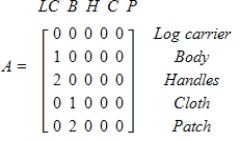
A log carrier has a body made from a 4-ft length of reinforced cloth having a patch on each side and a dowel slid through each end to act as handles. The parts-listing matrix for the log carrier is given by ​ A log carrier has a body made from a 4-ft length of reinforced cloth having a patch on each side and a dowel slid through each end to act as handles. The parts-listing matrix for the log carrier is given by ​   ​ How many of each primary assembly items are required to fill an order for 500 log carriers and 30 handles? ​ ​ How many of each primary assembly items are required to fill an order for 500 log carriers and 30 handles? ​
(Multiple Choice)
4.8/5
(62)

Three different bacteria are cultured in one dish and feed on three nutrients. Each individual of species I consumes 1 unit of each of the first and second nutrients and 2 units of the third nutrient. Each individual of species II consumes 2 units of the first nutrient and 2 units of the third nutrient. Each individual of species III consumes 2 units of the first nutrient, 3 units of the second nutrient, and 5 units of the third nutrient. Let x1, x2 and x3 represent species I, II and III respectively. If the culture is given Three different bacteria are cultured in one dish and feed on three nutrients. Each individual of species I consumes 1 unit of each of the first and second nutrients and 2 units of the third nutrient. Each individual of species II consumes 2 units of the first nutrient and 2 units of the third nutrient. Each individual of species III consumes 2 units of the first nutrient, 3 units of the second nutrient, and 5 units of the third nutrient. Let x<sub>1</sub>, x<sub>2</sub> and x<sub>3</sub> represent species I, II and III respectively. If the culture is given   units of the first nutrient,   units of the second nutrient, and   units of the third nutrient, how many of each species can be supported such that all of the nutrients are consumed? ​ units of the first nutrient, Three different bacteria are cultured in one dish and feed on three nutrients. Each individual of species I consumes 1 unit of each of the first and second nutrients and 2 units of the third nutrient. Each individual of species II consumes 2 units of the first nutrient and 2 units of the third nutrient. Each individual of species III consumes 2 units of the first nutrient, 3 units of the second nutrient, and 5 units of the third nutrient. Let x<sub>1</sub>, x<sub>2</sub> and x<sub>3</sub> represent species I, II and III respectively. If the culture is given   units of the first nutrient,   units of the second nutrient, and   units of the third nutrient, how many of each species can be supported such that all of the nutrients are consumed? ​ units of the second nutrient, and Three different bacteria are cultured in one dish and feed on three nutrients. Each individual of species I consumes 1 unit of each of the first and second nutrients and 2 units of the third nutrient. Each individual of species II consumes 2 units of the first nutrient and 2 units of the third nutrient. Each individual of species III consumes 2 units of the first nutrient, 3 units of the second nutrient, and 5 units of the third nutrient. Let x<sub>1</sub>, x<sub>2</sub> and x<sub>3</sub> represent species I, II and III respectively. If the culture is given   units of the first nutrient,   units of the second nutrient, and   units of the third nutrient, how many of each species can be supported such that all of the nutrients are consumed? ​ units of the third nutrient, how many of each species can be supported such that all of the nutrients are consumed? ​

(Multiple Choice)
4.9/5
(68)

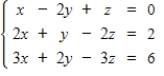
Use inverse matrices to find the solution of the system of equations. ​ Use inverse matrices to find the solution of the system of equations. ​   ​ ​
(Multiple Choice)
4.7/5
(64)

Find the inverse matrix, if one exists. Find the inverse matrix, if one exists.

(Multiple Choice)
4.8/5
(82)

A bank lent A bank lent   million for the development of three new products, with one loan at 6%, one loan at 7%, and the third loan at 8%. The amount lent at 8% was equal to the sum of the amounts lent at the other two rates, and the bank's annual income from the loans was   . How much was lent at each rate? ​ million for the development of three new products, with one loan at 6%, one loan at 7%, and the third loan at 8%. The amount lent at 8% was equal to the sum of the amounts lent at the other two rates, and the bank's annual income from the loans was A bank lent   million for the development of three new products, with one loan at 6%, one loan at 7%, and the third loan at 8%. The amount lent at 8% was equal to the sum of the amounts lent at the other two rates, and the bank's annual income from the loans was   . How much was lent at each rate? ​ . How much was lent at each rate? ​

(Multiple Choice)
4.8/5
(87)

For For   , what size is each product FFT and F<sup>T</sup>F? ​​ , what size is each product FFT and FTF? ​​

(Multiple Choice)
4.8/5
(76)

Use the matrices below. Perform the indicated operations. ​ BA ​ Use the matrices below. Perform the indicated operations. ​ BA ​     ​ ​ Use the matrices below. Perform the indicated operations. ​ BA ​     ​ ​ ​ ​

(Multiple Choice)
4.9/5
(73)

If matrix M has element If matrix M has element   , what is   ? ​   ​ , what is If matrix M has element   , what is   ? ​   ​ ? ​ If matrix M has element   , what is   ? ​   ​ ​

(Multiple Choice)
4.7/5
(80)
Showing 21 - 40 of 227
close modal

Filters

  • Essay(0)
  • Multiple Choice(0)
  • Short Answer(0)
  • True False(0)
  • Matching(0)