



 Chat with AI
Exam 4: Matrices

Exam 1: Algebraic Concepts308 Questions
Exam 2: Linear Equations and Functions243 Questions
Exam 3: Quadratic and Other Special Functions113 Questions
Exam 4: Matrices227 Questions
Exam 5: Inequalities and Linear Programming120 Questions
Exam 6: Exponential and Logarithmic Functions108 Questions
Exam 7: Mathematics of Finance131 Questions
Exam 8: Introduction to Probability178 Questions
Exam 9: Further Topics in Probability; Data Description114 Questions
Exam 10: Derivatives248 Questions
Exam 11: Applications of Derivatives172 Questions
Exam 12: Derivatives Continued139 Questions
Exam 13: Indefinite Integrals120 Questions
Exam 14: Definite Integrals: Techniques of Integration185 Questions
Exam 15: Functions of Two or More Variables119 Questions
Select questions type


Use the following matrices to perform the indicated matrix operations, if possible. 
 ;

; (Multiple Choice)
4.8/5  (68)
(68) Use the following matrices to perform the indicated matrix operations, if possible. 
 ;

; (Multiple Choice)
5.0/5 (83)
(83) Suppose the shipping department of a firm charges 20% of its total monthly costs to the printing department and that the printing department charges 10% of its total monthly costs to the shipping department. If the direct costs of the shipping department are $18,000 and the direct costs of the printing department are $11,000, find the total costs for each department. Round your answer to the nearest hundredths.
(Multiple Choice)
4.7/5 (86)
(86) Each ounce of substance A supplies  of the required nutrition a patient needs. Substance B supplies
 of the required nutrition per ounce and substance C supplies
 of required nutrition per ounce. If digestive restrictions require that substances A and C be given in equal amounts and that the amount of substance B be one-fifth of these other amounts, find the number of ounces of each substance that should be in the meal to provide 100% nutrition.
of the required nutrition a patient needs. Substance B supplies of the required nutrition per ounce and substance C supplies of required nutrition per ounce. If digestive restrictions require that substances A and C be given in equal amounts and that the amount of substance B be one-fifth of these other amounts, find the number of ounces of each substance that should be in the meal to provide 100% nutrition. (Multiple Choice)
4.7/5 (85)
(85) A system of equations may have a unique solution, an infinite number of solutions, or no solution. Use matrices to find the general solution of the following system, if a solution exists. 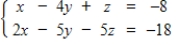
(Multiple Choice)
4.9/5 (86)
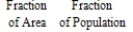
(86) Matrix A below gives the fraction of the Earth's area and the projected fraction of its population for five continents in 2050. Matrix B gives the Earth's area (in square miles) and its projected 2050 population. Find the area and population of each given continent by finding AB.
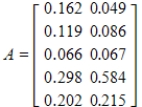 ,
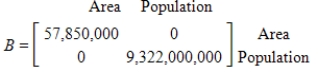
, (Multiple Choice)
4.8/5 (83)
(83) A system of equations may have a unique solution, an infinite number of solutions, or no solution. Use matrices to find the general solution of the following system, if a solution exists. 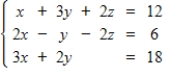
(Multiple Choice)
4.7/5 (63)
(63) 
Set up the system of equations and then solve it by using inverse matrices.
Investment A company offers three mutual fund plans for its employees. Plan I consists of 4 blocks of common stock and 2 municipal bonds. Plan II consists of 8 blocks of common stock, 4 municipal bonds, and 6 blocks of preferred stock. Plan III consists of 14 blocks of common stock, 6 municipal bonds, and 6 blocks of preferred stock. An employee wants to combine these plans so that she has 82 blocks of common stock, 38 municipal bonds, and 36 blocks of preferred stock. How many units of each plan does she need?
(Multiple Choice)
4.9/5 (97)
(97) Find the inverse of matrix A and check it by calculating  .

. (Multiple Choice)
4.8/5 (72)
(72) Using the data in the following tables, Let matrix A represent imports (in billions of dollars) to U.S. from country groupings, and let matrix B represent exports (in billions of dollars) from U.S. to country groupings. Find the U.S. trade balance with each country grouping in each year by finding matrix B - A.
Imports to U.S. from Country Groupings
($billions)  Exports from U.S. to Country Groupings
($billions)

Exports from U.S. to Country Groupings
($billions) (Multiple Choice)
4.9/5 (81)
(81) An underdeveloped country has an agricultural industry and a manufacturing industry, with technology matrix A. 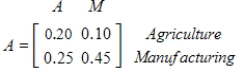
Surpluses of 10 units of agricultural products and 609 units of manufactured products are desired. Find the gross production of each industry.
Surpluses of 10 units of agricultural products and 609 units of manufactured products are desired. Find the gross production of each industry.
(Multiple Choice)
4.9/5 (83)
(83) Solve the following system of equations for y. This gives a formula for solving two equations in two variables for y. 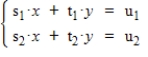
(Multiple Choice)
4.9/5 (69)
(69) Set up the system of equations and then solve it by using inverse matrices.
Nutrition A biologist has a 40% solution and a 10% solution of the same plant nutrient. How many cubic centimeters of each solution should be mixed to obtain 35 cc of a 28% solution?
(Multiple Choice)
4.7/5 (80)
(80) Substitute the given values of x, y, and z into the matrix equation and use matrix multiplication to determine if the values satisfy the equation. 
 ,
 ,

, , (Multiple Choice)
4.9/5 (95)
(95) 


Use the matrices below. Perform the indicated operations.
AZ 

(Multiple Choice)
4.9/5 (92)
(92) Use technology to solve the system of equations, if a solution exists. 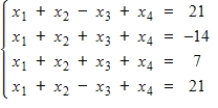
(Multiple Choice)
4.9/5 (92)
(92) An economy has an agricultural industry and a textile industry. Each unit of agricultural output requires 0.4 unit of agricultural input and 0.2 unit of textiles input. Each unit of textiles output requires 0.1 unit of agricultural input and 0.2 unit of textiles input. Write the technology matrix for this economy. (A, agricultural industry; T, textile industry)
(Multiple Choice)
4.8/5 (75)
(75) 
Filters
- Essay(0)
- Multiple Choice(0)
- Short Answer(0)
- True False(0)
- Matching(0)