Exam 4: Matrices

arrow
  • Select Tags
search iconSearch Question
flashcardsStudy Flashcards
  • Select Tags

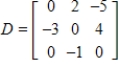
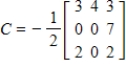
Use the following matrices to perform the indicated matrix operations, if possible. ​ Use the following matrices to perform the indicated matrix operations, if possible. ​   ​   ;   ​ ​ Use the following matrices to perform the indicated matrix operations, if possible. ​   ​   ;   ​ ; Use the following matrices to perform the indicated matrix operations, if possible. ​   ​   ;   ​ ​

(Multiple Choice)
4.9/5
(91)

​In order to rank the five members of its chess team for play against another school, the coach draws the following diagram. An arrow from 1 to 2 means player 1 has defeated player 2. ​ 1 ​In order to rank the five members of its chess team for play against another school, the coach draws the following diagram. An arrow from 1 to 2 means player 1 has defeated player 2. ​ 1   2       5       3   4 ​Construct matrix B with elements   . ​ 2 ​In order to rank the five members of its chess team for play against another school, the coach draws the following diagram. An arrow from 1 to 2 means player 1 has defeated player 2. ​ 1   2       5       3   4 ​Construct matrix B with elements   . ​ ​In order to rank the five members of its chess team for play against another school, the coach draws the following diagram. An arrow from 1 to 2 means player 1 has defeated player 2. ​ 1   2       5       3   4 ​Construct matrix B with elements   . ​ ​In order to rank the five members of its chess team for play against another school, the coach draws the following diagram. An arrow from 1 to 2 means player 1 has defeated player 2. ​ 1   2       5       3   4 ​Construct matrix B with elements   . ​ 5 ​In order to rank the five members of its chess team for play against another school, the coach draws the following diagram. An arrow from 1 to 2 means player 1 has defeated player 2. ​ 1   2       5       3   4 ​Construct matrix B with elements   . ​ ​In order to rank the five members of its chess team for play against another school, the coach draws the following diagram. An arrow from 1 to 2 means player 1 has defeated player 2. ​ 1   2       5       3   4 ​Construct matrix B with elements   . ​ ​In order to rank the five members of its chess team for play against another school, the coach draws the following diagram. An arrow from 1 to 2 means player 1 has defeated player 2. ​ 1   2       5       3   4 ​Construct matrix B with elements   . ​ 3 ​In order to rank the five members of its chess team for play against another school, the coach draws the following diagram. An arrow from 1 to 2 means player 1 has defeated player 2. ​ 1   2       5       3   4 ​Construct matrix B with elements   . ​ 4 ​Construct matrix B with elements ​In order to rank the five members of its chess team for play against another school, the coach draws the following diagram. An arrow from 1 to 2 means player 1 has defeated player 2. ​ 1   2       5       3   4 ​Construct matrix B with elements   . ​ . ​

(Multiple Choice)
4.8/5
(94)

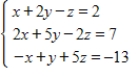
Use row operations on the augmented matrix to solve the given system of linear equations. ​ Use row operations on the augmented matrix to solve the given system of linear equations. ​   ​ ​
(Multiple Choice)
4.7/5
(74)

If If   and   , does   ? and If   and   , does   ? , does If   and   , does   ? ?

(Multiple Choice)
4.8/5
(83)

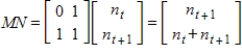
Set up the system of equations and then solve it by using inverse matrices. ​ Bee ancestry Because a female bee comes from a fertilized egg and a male bee comes from an unfertilized egg, the number Set up the system of equations and then solve it by using inverse matrices. ​ Bee ancestry Because a female bee comes from a fertilized egg and a male bee comes from an unfertilized egg, the number   of ancestors of a male t + 2 bee generations before the present generation is the sum of the number of ancestors t and t + 1 generations   before the present. If the numbers of ancestors of a male bee in a given generation t and in the previous generation are given by   , then there is a matrix M such that the numbers of ancestors in the two generations preceding generation t are given by   . ​ For a given male bee, the numbers of ancestors 5 and 6 generations back are given by   . ​ Find the numbers of ancestors 4 and 5 generations back by multiplying both sides of   by the inverse of M. ​ of ancestors of a male t + 2 bee generations before the present generation is the sum of the number of ancestors t and t + 1 generations Set up the system of equations and then solve it by using inverse matrices. ​ Bee ancestry Because a female bee comes from a fertilized egg and a male bee comes from an unfertilized egg, the number   of ancestors of a male t + 2 bee generations before the present generation is the sum of the number of ancestors t and t + 1 generations   before the present. If the numbers of ancestors of a male bee in a given generation t and in the previous generation are given by   , then there is a matrix M such that the numbers of ancestors in the two generations preceding generation t are given by   . ​ For a given male bee, the numbers of ancestors 5 and 6 generations back are given by   . ​ Find the numbers of ancestors 4 and 5 generations back by multiplying both sides of   by the inverse of M. ​ before the present. If the numbers of ancestors of a male bee in a given generation t and in the previous generation are given by Set up the system of equations and then solve it by using inverse matrices. ​ Bee ancestry Because a female bee comes from a fertilized egg and a male bee comes from an unfertilized egg, the number   of ancestors of a male t + 2 bee generations before the present generation is the sum of the number of ancestors t and t + 1 generations   before the present. If the numbers of ancestors of a male bee in a given generation t and in the previous generation are given by   , then there is a matrix M such that the numbers of ancestors in the two generations preceding generation t are given by   . ​ For a given male bee, the numbers of ancestors 5 and 6 generations back are given by   . ​ Find the numbers of ancestors 4 and 5 generations back by multiplying both sides of   by the inverse of M. ​ , then there is a matrix M such that the numbers of ancestors in the two generations preceding generation t are given by Set up the system of equations and then solve it by using inverse matrices. ​ Bee ancestry Because a female bee comes from a fertilized egg and a male bee comes from an unfertilized egg, the number   of ancestors of a male t + 2 bee generations before the present generation is the sum of the number of ancestors t and t + 1 generations   before the present. If the numbers of ancestors of a male bee in a given generation t and in the previous generation are given by   , then there is a matrix M such that the numbers of ancestors in the two generations preceding generation t are given by   . ​ For a given male bee, the numbers of ancestors 5 and 6 generations back are given by   . ​ Find the numbers of ancestors 4 and 5 generations back by multiplying both sides of   by the inverse of M. ​ . ​ For a given male bee, the numbers of ancestors 5 and 6 generations back are given by Set up the system of equations and then solve it by using inverse matrices. ​ Bee ancestry Because a female bee comes from a fertilized egg and a male bee comes from an unfertilized egg, the number   of ancestors of a male t + 2 bee generations before the present generation is the sum of the number of ancestors t and t + 1 generations   before the present. If the numbers of ancestors of a male bee in a given generation t and in the previous generation are given by   , then there is a matrix M such that the numbers of ancestors in the two generations preceding generation t are given by   . ​ For a given male bee, the numbers of ancestors 5 and 6 generations back are given by   . ​ Find the numbers of ancestors 4 and 5 generations back by multiplying both sides of   by the inverse of M. ​ . ​ Find the numbers of ancestors 4 and 5 generations back by multiplying both sides of Set up the system of equations and then solve it by using inverse matrices. ​ Bee ancestry Because a female bee comes from a fertilized egg and a male bee comes from an unfertilized egg, the number   of ancestors of a male t + 2 bee generations before the present generation is the sum of the number of ancestors t and t + 1 generations   before the present. If the numbers of ancestors of a male bee in a given generation t and in the previous generation are given by   , then there is a matrix M such that the numbers of ancestors in the two generations preceding generation t are given by   . ​ For a given male bee, the numbers of ancestors 5 and 6 generations back are given by   . ​ Find the numbers of ancestors 4 and 5 generations back by multiplying both sides of   by the inverse of M. ​ by the inverse of M. ​
(Multiple Choice)
4.8/5
(85)

We have encoded messages by assigning the letters of the alphabet the numbers 1-26, with a blank assigned the number 27, and by using an encoding matrix A that converts the numbers to the coded message. To decode any message encoded by A, we must find the inverse of A, denoted by A-1, and multiply A-1 times the coded message. Use this code and the given encoding matrix A to find the matrix that can be used to decode the given message. ​ Code matrix is ​ We have encoded messages by assigning the letters of the alphabet the numbers 1-26, with a blank assigned the number 27, and by using an encoding matrix A that converts the numbers to the coded message. To decode any message encoded by A, we must find the inverse of A, denoted by A<sup>-1</sup>, and multiply A<sup>-1</sup> times the coded message. Use this code and the given encoding matrix A to find the matrix that can be used to decode the given message. ​ Code matrix is ​   The message is ​ 138, 59, 72, 29, 143, 58, 57, 24, 101, 44 ​ The message is ​ 138, 59, 72, 29, 143, 58, 57, 24, 101, 44 ​

(Multiple Choice)
4.9/5
(77)

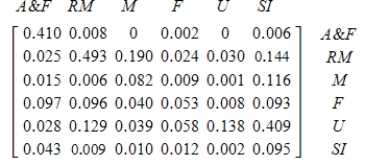
The following technology matrix describes the relationship of certain industries within the economy to each other. (A&F, agriculture and food; RM, raw materials; M, manufacturing; F, fuels industry; U, utilities; SI, service industries) ​ The following technology matrix describes the relationship of certain industries within the economy to each other. (A&F, agriculture and food; RM, raw materials; M, manufacturing; F, fuels industry; U, utilities; SI, service industries) ​   ​ For each 1,000 units of raw materials produced, how many units of service were required? ​ ​ For each 1,000 units of raw materials produced, how many units of service were required? ​
(Multiple Choice)
4.9/5
(76)
Showing 221 - 227 of 227
close modal

Filters

  • Essay(0)
  • Multiple Choice(0)
  • Short Answer(0)
  • True False(0)
  • Matching(0)