



 Chat with AI
Exam 45: Hormones and the Endocrine System

Exam 1: Evolution, the Themes of Biology, and Scientific Inquiry51 Questions
Exam 2: The Chemical Context of Life61 Questions
Exam 3: Water and Life55 Questions
Exam 4: Carbon and the Molecular Diversity of Life58 Questions
Exam 5: The Structure and Function of Large Biological Molecules70 Questions
Exam 6: A Tour of the Cell66 Questions
Exam 7: Membrane Structure and Function68 Questions
Exam 8: An Introduction to Metabolism67 Questions
Exam 9: Cellular Respiration and Fermentation68 Questions
Exam 10: Photosynthesis65 Questions
Exam 11: Cell Communication65 Questions
Exam 12: The Cell Cycle66 Questions
Exam 13: Meiosis and Sexual Life Cycles64 Questions
Exam 14: Mendel and the Gene Idea62 Questions
Exam 15: The Chromosomal Basis of Inheritance58 Questions
Exam 16: The Molecular Basis of Inheritance65 Questions
Exam 17: Gene Expression: From Gene to Protein67 Questions
Exam 18: Regulation of Gene Expression66 Questions
Exam 19: Viruses54 Questions
Exam 20: DNA Tools and Biotechnology57 Questions
Exam 21: Genomes and Their Evolution44 Questions
Exam 22: Descent with Modification: A Darwinian View of Life60 Questions
Exam 23: The Evolution of Populations64 Questions
Exam 24: The Origin of Species67 Questions
Exam 25: The History of Life on Earth59 Questions
Exam 26: Phylogeny and the Tree of Life75 Questions
Exam 27: Bacteria and Archaea75 Questions
Exam 28: Protists79 Questions
Exam 29: Plant Diversity I: How Plants Colonized Land82 Questions
Exam 30: Plant Diversity II: The Evolution of Seed Plants80 Questions
Exam 31: Fungi75 Questions
Exam 32: An Overview of Animal Diversity67 Questions
Exam 33: An Introduction to Invertebrates83 Questions
Exam 34: The Origin and Evolution of Vertebrates82 Questions
Exam 35: Vascular Plant Structure, Growth, and Development65 Questions
Exam 36: Resource Acquisition and Transport in Vascular Plants74 Questions
Exam 37: Soil and Plant Nutrition52 Questions
Exam 38: Angiosperm Reproduction and Biotechnology60 Questions
Exam 39: Plant Responses to Internal and External Signals61 Questions
Exam 40: Basic Principles of Animal Form and Function68 Questions
Exam 41: Animal Nutrition64 Questions
Exam 42: Circulation and Gas Exchange67 Questions
Exam 43: The Immune System69 Questions
Exam 44: Osmoregulation and Excretion64 Questions
Exam 45: Hormones and the Endocrine System66 Questions
Exam 46: Animal Reproduction68 Questions
Exam 47: Animal Development70 Questions
Exam 48: Neurons, Synapses, and Signaling68 Questions
Exam 49: Nervous Systems65 Questions
Exam 50: Sensory and Motor Mechanisms67 Questions
Exam 51: Animal Behavior69 Questions
Exam 52: An Introduction to Ecology and the Biosphere68 Questions
Exam 53: Population Ecology69 Questions
Exam 54: Community Ecology71 Questions
Exam 55: Ecosystems and Restoration Ecology68 Questions
Exam 56: Conservation Biology and Global Change69 Questions
Select questions type


An example of antagonistic hormones controlling homeostasis is ________.
(Multiple Choice)
4.8/5  (80)
(80) When a person drinks alcohol, the rate of urination increases. Which of the following best accounts for the increase in urination above normal rates?
(Multiple Choice)
4.8/5 (86)
(86) Fight-or-flight reactions include activation of the ________.
(Multiple Choice)
4.9/5 (73)
(73) In a lactating mammal, the two hormones that promote milk synthesis and milk release, respectively, are ________.
(Multiple Choice)
4.8/5 (80)
(80) The relationship between the insect hormones ecdysteroid and PTTH is an example of ________.
(Multiple Choice)
4.9/5 (84)
(84) In response to stress, the adrenal gland promotes the synthesis of glucose from noncarbohydrate substrates via the action of the steroid hormone ________.
(Multiple Choice)
4.8/5 (70)
(70) Use the figure to answer the following question.
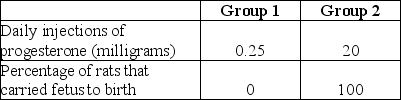 In an experiment, rats' ovaries were removed immediately after impregnation, and then the rats were divided into two groups. Treatments and results are summarized in the table. The results most likely occurred because progesterone exerts an effect on the ________.
 (Multiple Choice)
4.9/5 (82)
(82) Portal blood vessels connect two capillary beds found in the ________.
(Multiple Choice)
4.7/5 (69)
(69) Oxytocin and antidiuretic hormone (ADH) are synthesized in the ________ but released from the ________.
(Multiple Choice)
4.9/5 (75)
(75) Use the bar graph to answer the following question.
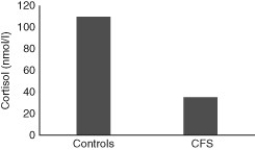 People who suffer from chronic fatigue syndrome (CFS) experience ongoing, debilitating fatigue. In one study, cortisol levels in the saliva during the first hour after waking were measured and compared between CFS patients and people without CFS (controls). The data is summarized in the graph. What can you infer from the data?
 (Multiple Choice)
4.9/5 (72)
(72) The steroid hormone aldosterone affects only a small number of cells in the body because ________.
(Multiple Choice)
4.8/5 (81)
(81) When a steroid hormone and a polypeptide hormone exert similar effects on a population of target cells, then ________.
(Multiple Choice)
4.9/5 (81)
(81) Removing which of the following glands would have the most wide-reaching effect on bodily functions of an adult human?
(Multiple Choice)
4.8/5 (69)
(69) You are dissecting a fish in your biology laboratory section. Your teaching assistant points out a long oval structure and tells you it is an endocrine gland. Which of the following would you then know is a true statement about this structure?
(Multiple Choice)
4.8/5 (82)
(82) A cell with membrane-bound proteins that selectively bind a specific hormone is called that hormone's ________.
(Multiple Choice)
4.8/5 (87)
(87) Injury localized to the hypothalamus would most likely disrupt ________.
(Multiple Choice)
4.8/5 (91)
(91) 
Filters
- Essay(0)
- Multiple Choice(0)
- Short Answer(0)
- True False(0)
- Matching(0)