



 Chat with AI
Exam 39: Plant Responses to Internal and External Signals

Exam 1: Evolution, the Themes of Biology, and Scientific Inquiry51 Questions
Exam 2: The Chemical Context of Life61 Questions
Exam 3: Water and Life55 Questions
Exam 4: Carbon and the Molecular Diversity of Life58 Questions
Exam 5: The Structure and Function of Large Biological Molecules70 Questions
Exam 6: A Tour of the Cell66 Questions
Exam 7: Membrane Structure and Function68 Questions
Exam 8: An Introduction to Metabolism67 Questions
Exam 9: Cellular Respiration and Fermentation68 Questions
Exam 10: Photosynthesis65 Questions
Exam 11: Cell Communication65 Questions
Exam 12: The Cell Cycle66 Questions
Exam 13: Meiosis and Sexual Life Cycles64 Questions
Exam 14: Mendel and the Gene Idea62 Questions
Exam 15: The Chromosomal Basis of Inheritance58 Questions
Exam 16: The Molecular Basis of Inheritance65 Questions
Exam 17: Gene Expression: From Gene to Protein67 Questions
Exam 18: Regulation of Gene Expression66 Questions
Exam 19: Viruses54 Questions
Exam 20: DNA Tools and Biotechnology57 Questions
Exam 21: Genomes and Their Evolution44 Questions
Exam 22: Descent with Modification: A Darwinian View of Life60 Questions
Exam 23: The Evolution of Populations64 Questions
Exam 24: The Origin of Species67 Questions
Exam 25: The History of Life on Earth59 Questions
Exam 26: Phylogeny and the Tree of Life75 Questions
Exam 27: Bacteria and Archaea75 Questions
Exam 28: Protists79 Questions
Exam 29: Plant Diversity I: How Plants Colonized Land82 Questions
Exam 30: Plant Diversity II: The Evolution of Seed Plants80 Questions
Exam 31: Fungi75 Questions
Exam 32: An Overview of Animal Diversity67 Questions
Exam 33: An Introduction to Invertebrates83 Questions
Exam 34: The Origin and Evolution of Vertebrates82 Questions
Exam 35: Vascular Plant Structure, Growth, and Development65 Questions
Exam 36: Resource Acquisition and Transport in Vascular Plants74 Questions
Exam 37: Soil and Plant Nutrition52 Questions
Exam 38: Angiosperm Reproduction and Biotechnology60 Questions
Exam 39: Plant Responses to Internal and External Signals61 Questions
Exam 40: Basic Principles of Animal Form and Function68 Questions
Exam 41: Animal Nutrition64 Questions
Exam 42: Circulation and Gas Exchange67 Questions
Exam 43: The Immune System69 Questions
Exam 44: Osmoregulation and Excretion64 Questions
Exam 45: Hormones and the Endocrine System66 Questions
Exam 46: Animal Reproduction68 Questions
Exam 47: Animal Development70 Questions
Exam 48: Neurons, Synapses, and Signaling68 Questions
Exam 49: Nervous Systems65 Questions
Exam 50: Sensory and Motor Mechanisms67 Questions
Exam 51: Animal Behavior69 Questions
Exam 52: An Introduction to Ecology and the Biosphere68 Questions
Exam 53: Population Ecology69 Questions
Exam 54: Community Ecology71 Questions
Exam 55: Ecosystems and Restoration Ecology68 Questions
Exam 56: Conservation Biology and Global Change69 Questions
Select questions type


Which of the following can function in signal transduction in plants?
I.calcium ions
II.nonrandom mutations
III.receptor proteins
IV.autochrome
V.secondary messengers
(Multiple Choice)
4.9/5  (75)
(75) You may have observed plants rotate towards a light source, thereby increasing the plant's ability to intercept light energy and increase photosynthesis. You, however, are given the task of preventing grass seedlings from rotating toward the light. Using your knowledge of phototropism, which of the following experimental procedures would you use to complete your task?
(Multiple Choice)
4.9/5 (78)
(78) Use the figure to answer the following question.
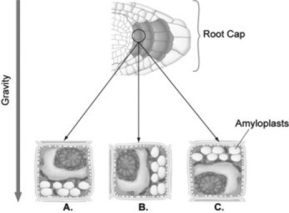 Suppose you laid a seedling on its side so that the root was parallel to the ground as shown in the figure. Several hours after the change in position, where in the root cells, position A, B, or C in the figure, would you find the amyloplasts?
 (Multiple Choice)
4.9/5 (72)
(72) Which of the following statements best summarizes the acid growth hypothesis in an actively growing shoot?
(Multiple Choice)
4.7/5 (92)
(92) Which one of the following hormones regulates cell division in plants?
(Multiple Choice)
4.9/5 (80)
(80) You have a small tree in your yard that is the height that you want it, but does not have as many branches as you want. How can you prune it to trigger it to increase the number of branches?
(Multiple Choice)
4.7/5 (82)
(82) A population of plants experiences several years of severe drought. Much of the population dies due to lack of water, but a few individuals survive. You set out to discover the physiological basis for their adaptation to such an extreme environmental change. You hypothesize that the survivors have the ability to synthesize higher levels of ________ than their siblings do.
(Multiple Choice)
4.9/5 (72)
(72) Upon exposure to blue light, plants not only begin to grow toward the light, but move their chloroplasts to the sunny side of each cell. The adaptive advantage of moving chloroplasts to the sunny side of each cell ________.
(Multiple Choice)
4.9/5 (68)
(68) Experiments on the positive phototropic response of plants indicate that ________.
(Multiple Choice)
4.7/5 (83)
(83) If a farmer wanted more loosely packed clusters of grapes, he would most likely spray the immature bunches with ________.
(Multiple Choice)
4.9/5 (84)
(84) When an arborist prunes a limb off a valuable tree, he or she may paint the cut surface. The primary purpose of the paint is to ________.
(Multiple Choice)
4.9/5 (90)
(90) Which of the following mechanisms is in the correct sequence of steps (I-IV as listed below) that takes place during the formation of de-etiolation (greening) response proteins in plants?
I.Detection of light signal
II.Activation of phytochrome
III.Activation of specific protein kinase1
IV.Formation of de-etiolation response protein
(Multiple Choice)
4.8/5 (83)
(83) Which of the following environmental factors can be sensed by plants?
I.gravity
II.pathogens
III.wind
IV.light
(Multiple Choice)
4.8/5 (75)
(75) The biological clock controlling circadian rhythms must ultimately ________.
(Multiple Choice)
4.8/5 (85)
(85) Seed packets give a recommended planting depth for the enclosed seeds. The most likely reason some seeds are to be covered with only 1/4 inch of soil is that the ________.
(Multiple Choice)
4.8/5 (86)
(86) Which one of the following hormones stimulates stem elongation and pollen tube growth?
(Multiple Choice)
4.9/5 (79)
(79) A gardener in Canada wants to surprise his mother on her birthday and make her favorite hibiscus bush flower in May instead of at the end of June. The bush is growing in the greenhouse. Which of the following might make the hibiscus bush flower early?
(Multiple Choice)
4.7/5 (76)
(76) In the fall, the leaves of some trees change color. This happens because chlorophyll breaks down and the accessory pigments become visible. What hormone is responsible for this?
(Multiple Choice)
4.9/5 (91)
(91) 
Filters
- Essay(0)
- Multiple Choice(0)
- Short Answer(0)
- True False(0)
- Matching(0)