



 Chat with AI
Exam 31: Fungi

Exam 1: Evolution, the Themes of Biology, and Scientific Inquiry51 Questions
Exam 2: The Chemical Context of Life61 Questions
Exam 3: Water and Life55 Questions
Exam 4: Carbon and the Molecular Diversity of Life58 Questions
Exam 5: The Structure and Function of Large Biological Molecules70 Questions
Exam 6: A Tour of the Cell66 Questions
Exam 7: Membrane Structure and Function68 Questions
Exam 8: An Introduction to Metabolism67 Questions
Exam 9: Cellular Respiration and Fermentation68 Questions
Exam 10: Photosynthesis65 Questions
Exam 11: Cell Communication65 Questions
Exam 12: The Cell Cycle66 Questions
Exam 13: Meiosis and Sexual Life Cycles64 Questions
Exam 14: Mendel and the Gene Idea62 Questions
Exam 15: The Chromosomal Basis of Inheritance58 Questions
Exam 16: The Molecular Basis of Inheritance65 Questions
Exam 17: Gene Expression: From Gene to Protein67 Questions
Exam 18: Regulation of Gene Expression66 Questions
Exam 19: Viruses54 Questions
Exam 20: DNA Tools and Biotechnology57 Questions
Exam 21: Genomes and Their Evolution44 Questions
Exam 22: Descent with Modification: A Darwinian View of Life60 Questions
Exam 23: The Evolution of Populations64 Questions
Exam 24: The Origin of Species67 Questions
Exam 25: The History of Life on Earth59 Questions
Exam 26: Phylogeny and the Tree of Life75 Questions
Exam 27: Bacteria and Archaea75 Questions
Exam 28: Protists79 Questions
Exam 29: Plant Diversity I: How Plants Colonized Land82 Questions
Exam 30: Plant Diversity II: The Evolution of Seed Plants80 Questions
Exam 31: Fungi75 Questions
Exam 32: An Overview of Animal Diversity67 Questions
Exam 33: An Introduction to Invertebrates83 Questions
Exam 34: The Origin and Evolution of Vertebrates82 Questions
Exam 35: Vascular Plant Structure, Growth, and Development65 Questions
Exam 36: Resource Acquisition and Transport in Vascular Plants74 Questions
Exam 37: Soil and Plant Nutrition52 Questions
Exam 38: Angiosperm Reproduction and Biotechnology60 Questions
Exam 39: Plant Responses to Internal and External Signals61 Questions
Exam 40: Basic Principles of Animal Form and Function68 Questions
Exam 41: Animal Nutrition64 Questions
Exam 42: Circulation and Gas Exchange67 Questions
Exam 43: The Immune System69 Questions
Exam 44: Osmoregulation and Excretion64 Questions
Exam 45: Hormones and the Endocrine System66 Questions
Exam 46: Animal Reproduction68 Questions
Exam 47: Animal Development70 Questions
Exam 48: Neurons, Synapses, and Signaling68 Questions
Exam 49: Nervous Systems65 Questions
Exam 50: Sensory and Motor Mechanisms67 Questions
Exam 51: Animal Behavior69 Questions
Exam 52: An Introduction to Ecology and the Biosphere68 Questions
Exam 53: Population Ecology69 Questions
Exam 54: Community Ecology71 Questions
Exam 55: Ecosystems and Restoration Ecology68 Questions
Exam 56: Conservation Biology and Global Change69 Questions
Select questions type


Use the following information to answer the question.
For several decades now, amphibian species worldwide have been in decline. A significant proportion of the decline seems to be due to the spread of the chytrid fungus, Batrachochytrium dendrobatidis (Bd). Chytrid sporangia reside within the epidermal cells of infected animals, animals that consequently show areas of sloughed skin. They can also be lethargic, which is expressed through failure to hide and failure to flee. The infection cycle typically takes four to five days, at the end of which zoospores are released from sporangia into the environment. In some amphibian species, mortality rates approach 100%; other species seem able to survive the infection.
Sexual reproduction has not been observed in Bd. If its morphology and genetics did not identify it as a chytridiomycete, then to which fungal group would Bd be assigned?
(Multiple Choice)
4.7/5  (80)
(80) Use the following information to answer the question.
Suzanne Simard and colleagues knew that the same mycorrhizal fungal species could colonize multiple types of trees. They wondered if the same fungal individual would colonize different trees, forming an underground network that potentially could transport carbon and nutrients from one tree to another (S. Simard et al. 1997. Net transfer of carbon between mycorrhizal tree species in the field. Nature 388:579-82).
Pots containing seedlings of three different tree species were set up and grown under natural conditions for three years (Fig.A). Two of the three species (Douglas fir, birch) could form ectomycorrhizal connections with the same fungal species, but the third species (cedar) could not form an ectomycorrhizal connection with the fungal species. In some of the pots, the researchers placed airtight bags over the Douglas fir and birch seedlings and injected carbon dioxide made from carbon-13 into the bags with the Douglas fir and carbon dioxide made from carbon-14 into the bags with the birch. (¹³C and ¹⁴C are different isotopes of carbon that can be detected and measured by researchers.) As the seedlings photosynthesized, the carbon dioxide was converted into sugars that could be tracked and measured by the researchers. The researchers measured whether the sugars in each plant contained only the carbon isotope that was in the air of their plastic bag or also the carbon isotope from the air around the other plant.
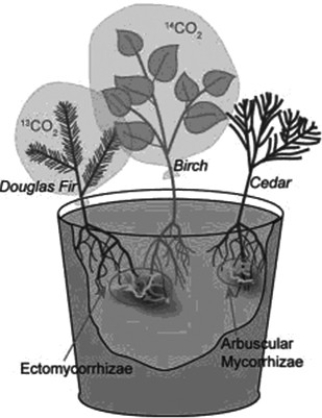 Figure A
Referring to Simard et al. (1997), what is the result that would most strongly refute their hypothesis? [Hypothesis: Sugars made by one plant during photosynthesis can travel through a mycorrhizal fungus and be incorporated into the tissues of another plant.]
Figure A
Referring to Simard et al. (1997), what is the result that would most strongly refute their hypothesis? [Hypothesis: Sugars made by one plant during photosynthesis can travel through a mycorrhizal fungus and be incorporated into the tissues of another plant.] (Multiple Choice)
4.9/5 (82)
(82) Use the following information to answer the question.
Suzanne Simard and colleagues knew that the same mycorrhizal fungal species could colonize multiple types of trees. They wondered if the same fungal individual would colonize different trees, forming an underground network that potentially could transport carbon and nutrients from one tree to another (S. Simard et al. 1997. Net transfer of carbon between mycorrhizal tree species in the field. Nature 388:579-82).
Pots containing seedlings of three different tree species were set up and grown under natural conditions for three years (Fig.A). Two of the three species (Douglas fir, birch) could form ectomycorrhizal connections with the same fungal species, but the third species (cedar) could not form an ectomycorrhizal connection with the fungal species. In some of the pots, the researchers placed airtight bags over the Douglas fir and birch seedlings and injected carbon dioxide made from carbon-13 into the bags with the Douglas fir and carbon dioxide made from carbon-14 into the bags with the birch. (¹³C and ¹⁴C are different isotopes of carbon that can be detected and measured by researchers.) As the seedlings photosynthesized, the carbon dioxide was converted into sugars that could be tracked and measured by the researchers. The researchers measured whether the sugars in each plant contained only the carbon isotope that was in the air of their plastic bag or also the carbon isotope from the air around the other plant.
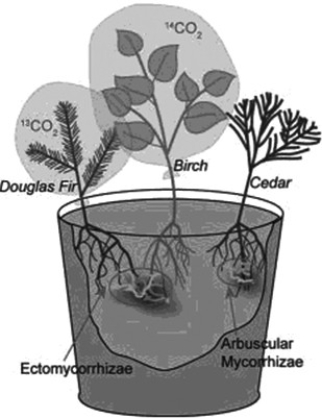 Figure A
Referring to Simard et al. (1997), which design element is the control in this experiment and why?
Figure A
Referring to Simard et al. (1997), which design element is the control in this experiment and why? (Multiple Choice)
5.0/5 (74)
(74) Use the information to answer the following question.
The figure depicts the outline of a large fairy ring that has appeared overnight in an open meadow, as viewed from above. The fairy ring represents the furthest advance of this mycelium through the soil. Locations A-D are all 0.5 meters below the soil surface.
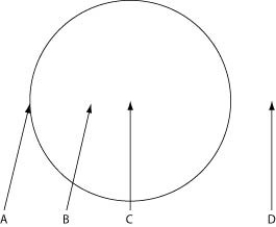 Assume that all four locations are 0.5 meters above the surface. On a breezy day with prevailing winds blowing from left to right, where should one expect to find the highest concentration of free basidiospores in an air sample?
 (Multiple Choice)
4.7/5 (79)
(79) Some fungal species live in plants and can kill herbivores that feed on the plant. What type of relationship does this fungus have with its host?
(Multiple Choice)
4.7/5 (82)
(82) Use the following information to answer the question.
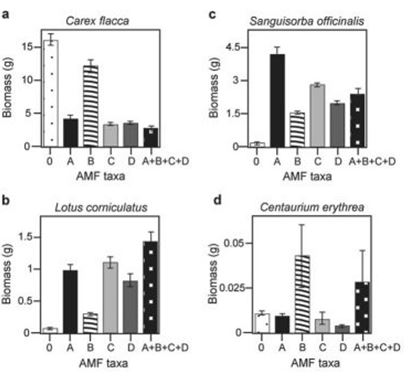
There is much discussion in the media about protecting biodiversity. But does biodiversity really matter? Canadian and Swiss researchers wanted to know if the diversity of arbuscular mycorrhizal fungi (AMF) was important to the productivity of grasslands (M.G.A. van der Heijden, J. N. Klironomos, M. Ursic, P. Moutoglis, R. Streitwolf-Engel, T. Boler, A. Wiemken, and I. R. Sanders. 1998. Mycorrhizal fungal diversity determines plant biodiversity, ecosystem variability, and productivity. Nature 396:69-72). Specifically, they wanted to know if it mattered which specific AMF species were present, or just that some type of AMF was present. They grew various plants in combination with one of four AMF species (A, B, C, and D), no AMF species (O), or all four AMF species together (A + B + C + D); and they measured plant growth under each set of conditions. All plant species were grown in each plot, so they always competed with each other, with the only difference being which AMF species were present.
On the graphs, the x-axis labels indicate the number and identity of AMF species (bar 0 = no fungi; bars A - D = individual AMF species; bar A + B + C + D = all AMF species together). The y-axis indicates the amount (grams) of plant biomass for the species shown in italics above each graph.
(Multiple Choice)
4.8/5 (85)
(85) If all fungi in an environment that perform decomposition were to suddenly die, then which group of organisms should benefit most, due to the fact that their fungal competitors have been removed?
(Multiple Choice)
4.9/5 (78)
(78) After cytokinesis occurs in budding yeasts, the daughter cell has a ________.
(Multiple Choice)
5.0/5 (70)
(70) Use the following information to answer the question.
In the United States and Canada, bats use one of two strategies to survive winter. They either migrate south, or they hibernate. Recently, those that hibernate seem to have come under attack by a fungus, Geomyces destructans (Gd), an attack that is occurring from Missouri to New England, Canada, and even the state of Washington. Many infected bats have a delicate, white filamentous mat on their muzzles, which is referred to as white-nose syndrome (WNS). The fungus invades the bat tissues, causes discomfort, and awakens the bat from its hibernation. The bat fidgets and wastes calories, using up its stored fat. The bat then behaves abnormally, leaving its cave during daytime in winter to search for food. Their food, primarily insects, is scarce during the winter, and the bats ultimately starve to death. Since 2006, it is estimated that over six million bats have perished from WNS.
The Gd mat on the fur of the bats should be expected to consist of ________.
(Multiple Choice)
4.7/5 (69)
(69) Use the following information to answer the question.
Rose-picker's disease is caused by the yeast Sporothrix schenkii (S. schenkii). The yeast grows on the exteriors of rose-bush thorns. If a human gets pricked by such a thorn, the yeasts can be introduced under the skin. The yeasts then assume a hyphal morphology and grow along the interiors of lymphatic vessels until they reach a lymph node. This often results in the accumulation of pus in the lymph node, which subsequently ulcerates through the skin surface and then drains.
Humans have immune systems in which lymph nodes are important, because many white blood cells (phagocytes and lymphocytes) reside there. Given that a successful infection by S. schenkii damages lymph nodes themselves, which of the following is most probable?
(Multiple Choice)
4.9/5 (85)
(85) Use the information to answer the following question.
The figure depicts the outline of a large fairy ring that has appeared overnight in an open meadow, as viewed from above. The fairy ring represents the furthest advance of this mycelium through the soil. Locations A-D are all 0.5 meters below the soil surface.
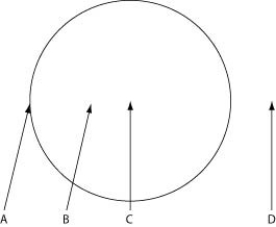 At which location is the mycelium currently absorbing the most nutrients per unit surface area, per unit time?
 (Multiple Choice)
4.8/5 (76)
(76) Which of the following characteristics would be most helpful in distinguishing among different species of fungi?
(Multiple Choice)
4.8/5 (83)
(83) Use the following information to answer the question.
Suzanne Simard and colleagues knew that the same mycorrhizal fungal species could colonize multiple types of trees. They wondered if the same fungal individual would colonize different trees, forming an underground network that potentially could transport carbon and nutrients from one tree to another (S. Simard et al. 1997. Net transfer of carbon between mycorrhizal tree species in the field. Nature 388:579-82).
Pots containing seedlings of three different tree species were set up and grown under natural conditions for three years (Fig.A). Two of the three species (Douglas fir, birch) could form ectomycorrhizal connections with the same fungal species, but the third species (cedar) could not form an ectomycorrhizal connection with the fungal species. In some of the pots, the researchers placed airtight bags over the Douglas fir and birch seedlings and injected carbon dioxide made from carbon-13 into the bags with the Douglas fir and carbon dioxide made from carbon-14 into the bags with the birch. (¹³C and ¹⁴C are different isotopes of carbon that can be detected and measured by researchers.) As the seedlings photosynthesized, the carbon dioxide was converted into sugars that could be tracked and measured by the researchers. The researchers measured whether the sugars in each plant contained only the carbon isotope that was in the air of their plastic bag or also the carbon isotope from the air around the other plant.
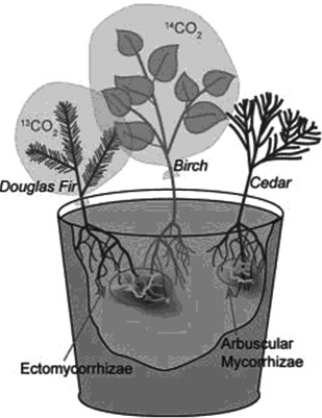 Figure A
Based on the idea that fungi have pores between their cell walls that allow cytoplasm to move from one end of the mycelium to the other, which of the following hypotheses is the most plausible?
Figure A
Based on the idea that fungi have pores between their cell walls that allow cytoplasm to move from one end of the mycelium to the other, which of the following hypotheses is the most plausible? (Multiple Choice)
4.9/5 (84)
(84) If haustoria from the fungal partner were to appear within the photosynthetic partner of a lichen, and if the growth rate of the photosynthetic partner consequently slowed substantially, then this would support the claim that ________.
(Multiple Choice)
4.9/5 (92)
(92) 
Filters
- Essay(0)
- Multiple Choice(0)
- Short Answer(0)
- True False(0)
- Matching(0)