



 Chat with AI
Exam 29: Plant Diversity I: How Plants Colonized Land

Exam 1: Evolution, the Themes of Biology, and Scientific Inquiry51 Questions
Exam 2: The Chemical Context of Life61 Questions
Exam 3: Water and Life55 Questions
Exam 4: Carbon and the Molecular Diversity of Life58 Questions
Exam 5: The Structure and Function of Large Biological Molecules70 Questions
Exam 6: A Tour of the Cell66 Questions
Exam 7: Membrane Structure and Function68 Questions
Exam 8: An Introduction to Metabolism67 Questions
Exam 9: Cellular Respiration and Fermentation68 Questions
Exam 10: Photosynthesis65 Questions
Exam 11: Cell Communication65 Questions
Exam 12: The Cell Cycle66 Questions
Exam 13: Meiosis and Sexual Life Cycles64 Questions
Exam 14: Mendel and the Gene Idea62 Questions
Exam 15: The Chromosomal Basis of Inheritance58 Questions
Exam 16: The Molecular Basis of Inheritance65 Questions
Exam 17: Gene Expression: From Gene to Protein67 Questions
Exam 18: Regulation of Gene Expression66 Questions
Exam 19: Viruses54 Questions
Exam 20: DNA Tools and Biotechnology57 Questions
Exam 21: Genomes and Their Evolution44 Questions
Exam 22: Descent with Modification: A Darwinian View of Life60 Questions
Exam 23: The Evolution of Populations64 Questions
Exam 24: The Origin of Species67 Questions
Exam 25: The History of Life on Earth59 Questions
Exam 26: Phylogeny and the Tree of Life75 Questions
Exam 27: Bacteria and Archaea75 Questions
Exam 28: Protists79 Questions
Exam 29: Plant Diversity I: How Plants Colonized Land82 Questions
Exam 30: Plant Diversity II: The Evolution of Seed Plants80 Questions
Exam 31: Fungi75 Questions
Exam 32: An Overview of Animal Diversity67 Questions
Exam 33: An Introduction to Invertebrates83 Questions
Exam 34: The Origin and Evolution of Vertebrates82 Questions
Exam 35: Vascular Plant Structure, Growth, and Development65 Questions
Exam 36: Resource Acquisition and Transport in Vascular Plants74 Questions
Exam 37: Soil and Plant Nutrition52 Questions
Exam 38: Angiosperm Reproduction and Biotechnology60 Questions
Exam 39: Plant Responses to Internal and External Signals61 Questions
Exam 40: Basic Principles of Animal Form and Function68 Questions
Exam 41: Animal Nutrition64 Questions
Exam 42: Circulation and Gas Exchange67 Questions
Exam 43: The Immune System69 Questions
Exam 44: Osmoregulation and Excretion64 Questions
Exam 45: Hormones and the Endocrine System66 Questions
Exam 46: Animal Reproduction68 Questions
Exam 47: Animal Development70 Questions
Exam 48: Neurons, Synapses, and Signaling68 Questions
Exam 49: Nervous Systems65 Questions
Exam 50: Sensory and Motor Mechanisms67 Questions
Exam 51: Animal Behavior69 Questions
Exam 52: An Introduction to Ecology and the Biosphere68 Questions
Exam 53: Population Ecology69 Questions
Exam 54: Community Ecology71 Questions
Exam 55: Ecosystems and Restoration Ecology68 Questions
Exam 56: Conservation Biology and Global Change69 Questions
Select questions type


If bryophytes do not have vascular tissue, how can some mosses reach 60 centimeters tall?
(Multiple Choice)
4.9/5  (95)
(95) Which of the following statements about the transition from ocean to land by plants is most likely to be accurate?
(Multiple Choice)
4.8/5 (86)
(86) Use the following information to answer the question.
Big Bend National Park in Texas is mostly Chihuahuan desert, where rainfall averages about 25 centimeters per year. Yet, it is not uncommon when hiking in this extremely arid zone to encounter mosses and ferns. One such plant is called "flower of stone." It is not a flowering plant, nor does it produce seeds. Under arid conditions, its leaflike structures curl up. However, when it rains, it unfurls its leaves, which form a bright green rosette on the desert floor. Consequently, it is sometimes called the "resurrection plant." At first glance, it could be a fern, a true moss, or a spike moss.
What feature of both true mosses and ferns makes it most surprising that they can survive for many generations in dry deserts?
(Multiple Choice)
4.8/5 (81)
(81) The 1-meter height attainable by Dawsonia moss is at the upper end of the size range reached by mosses. What accounts for the relative tallness of Dawsonia?
(Multiple Choice)
4.9/5 (75)
(75) The fact that both charophytes and green plants contain chlorophylls a and b demonstrates which of the following?
(Multiple Choice)
4.9/5 (86)
(86) According to our current knowledge of plant evolution, which group of organisms should feature cell division most similar to that of land plants?
(Multiple Choice)
4.7/5 (76)
(76) Three of the following are evidence that charophytes are the closest algal relatives of plants. Select the exception.
(Multiple Choice)
4.8/5 (83)
(83) The structural integrity of bacteria is to peptidoglycan as the structural integrity of plant spores is to ________.
(Multiple Choice)
4.8/5 (81)
(81) Use the following information to answer the question.
Big Bend National Park in Texas is mostly Chihuahuan desert, where rainfall averages about 25 centimeters per year. Yet, it is not uncommon when hiking in this extremely arid zone to encounter mosses and ferns. One such plant is called "flower of stone." It is not a flowering plant, nor does it produce seeds. Under arid conditions, its leaflike structures curl up. However, when it rains, it unfurls its leaves, which form a bright green rosette on the desert floor. Consequently, it is sometimes called the "resurrection plant." At first glance, it could be a fern, a true moss, or a spike moss.
Which of the following characteristics is (are) possessed in common by true mosses, ferns, and spike mosses, and therefore becomes useless at helping to determine to which of these groups "flower of stone" belongs?
(Multiple Choice)
4.7/5 (99)
(99) Breeuwer et al. (2008) measured the effect of different temperature regimes on the growth of different Sphagnum species. The growth of S. fuscum at four temperatures is shown. Use the information in the graph to answer the following question.
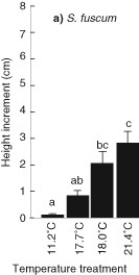 What would you expect to happen to the geographic range of S. fuscum as the temperature of Earth warms?
 (Multiple Choice)
4.9/5 (72)
(72) Which of these events, based on plant fossils, came last (most recently)?
(Multiple Choice)
4.9/5 (67)
(67) You are hiking in a forest and come upon a mysterious plant, which you determine is either a lycophyte sporophyte or a monilophyte sporophyte. Which of the following would be most helpful in determining the correct classification of the plant?
(Multiple Choice)
4.7/5 (80)
(80) The following question refers to the generalized life cycle for land plants shown in the figure. Each number within a circle or square represents a specific plant or plant part, and each number over an arrow represents meiosis, mitosis, or fertilization.
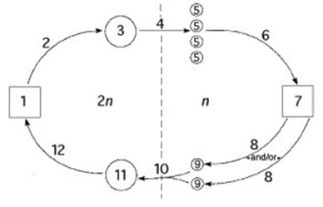 In the figure, which number represents an embryo?
 (Multiple Choice)
4.9/5 (71)
(71) In general, liverworts have a cuticle and pores. However, some species do not have pores. What would you predict concerning the cuticle of these species and why?
(Multiple Choice)
4.8/5 (73)
(73) Which of the following environmental factors probably helped early plants to successfully colonize land?
(Multiple Choice)
4.7/5 (75)
(75) If you were asked to design a bryophyte that could be successful in a bare, moist area, which of the following possible adaptations would you include?
(Multiple Choice)
4.9/5 (86)
(86) Use the following description to answer the question.
A biology student hiking in a forest happens upon an erect, 15-centimeter-tall plant that bears microphylls and a strobilus at its tallest point. When disturbed, the cone emits a dense cloud of brownish dust. A pocket magnifying glass reveals the dust to be composed of tiny spheres with a high oil content.
Besides oil, what other chemical should be detected in substantial amounts upon chemical analysis of these small spheres?
(Multiple Choice)
4.8/5 (87)
(87) Increasing the number of stomata per unit surface area of a leaf when atmospheric carbon dioxide levels decline is most analogous to a human ________.
(Multiple Choice)
4.9/5 (71)
(71) 
Filters
- Essay(0)
- Multiple Choice(0)
- Short Answer(0)
- True False(0)
- Matching(0)