



 Chat with AI
Exam 28: Protists

Exam 1: Evolution, the Themes of Biology, and Scientific Inquiry51 Questions
Exam 2: The Chemical Context of Life61 Questions
Exam 3: Water and Life55 Questions
Exam 4: Carbon and the Molecular Diversity of Life58 Questions
Exam 5: The Structure and Function of Large Biological Molecules70 Questions
Exam 6: A Tour of the Cell66 Questions
Exam 7: Membrane Structure and Function68 Questions
Exam 8: An Introduction to Metabolism67 Questions
Exam 9: Cellular Respiration and Fermentation68 Questions
Exam 10: Photosynthesis65 Questions
Exam 11: Cell Communication65 Questions
Exam 12: The Cell Cycle66 Questions
Exam 13: Meiosis and Sexual Life Cycles64 Questions
Exam 14: Mendel and the Gene Idea62 Questions
Exam 15: The Chromosomal Basis of Inheritance58 Questions
Exam 16: The Molecular Basis of Inheritance65 Questions
Exam 17: Gene Expression: From Gene to Protein67 Questions
Exam 18: Regulation of Gene Expression66 Questions
Exam 19: Viruses54 Questions
Exam 20: DNA Tools and Biotechnology57 Questions
Exam 21: Genomes and Their Evolution44 Questions
Exam 22: Descent with Modification: A Darwinian View of Life60 Questions
Exam 23: The Evolution of Populations64 Questions
Exam 24: The Origin of Species67 Questions
Exam 25: The History of Life on Earth59 Questions
Exam 26: Phylogeny and the Tree of Life75 Questions
Exam 27: Bacteria and Archaea75 Questions
Exam 28: Protists79 Questions
Exam 29: Plant Diversity I: How Plants Colonized Land82 Questions
Exam 30: Plant Diversity II: The Evolution of Seed Plants80 Questions
Exam 31: Fungi75 Questions
Exam 32: An Overview of Animal Diversity67 Questions
Exam 33: An Introduction to Invertebrates83 Questions
Exam 34: The Origin and Evolution of Vertebrates82 Questions
Exam 35: Vascular Plant Structure, Growth, and Development65 Questions
Exam 36: Resource Acquisition and Transport in Vascular Plants74 Questions
Exam 37: Soil and Plant Nutrition52 Questions
Exam 38: Angiosperm Reproduction and Biotechnology60 Questions
Exam 39: Plant Responses to Internal and External Signals61 Questions
Exam 40: Basic Principles of Animal Form and Function68 Questions
Exam 41: Animal Nutrition64 Questions
Exam 42: Circulation and Gas Exchange67 Questions
Exam 43: The Immune System69 Questions
Exam 44: Osmoregulation and Excretion64 Questions
Exam 45: Hormones and the Endocrine System66 Questions
Exam 46: Animal Reproduction68 Questions
Exam 47: Animal Development70 Questions
Exam 48: Neurons, Synapses, and Signaling68 Questions
Exam 49: Nervous Systems65 Questions
Exam 50: Sensory and Motor Mechanisms67 Questions
Exam 51: Animal Behavior69 Questions
Exam 52: An Introduction to Ecology and the Biosphere68 Questions
Exam 53: Population Ecology69 Questions
Exam 54: Community Ecology71 Questions
Exam 55: Ecosystems and Restoration Ecology68 Questions
Exam 56: Conservation Biology and Global Change69 Questions
Select questions type


Super cells characteristic of plasmodial slime molds result when which one of the following common cellular processes does not occur?
(Multiple Choice)
4.8/5  (78)
(78) The chloroplasts of land plants are thought to have been derived according to which evolutionary sequence?
(Multiple Choice)
4.9/5 (70)
(70) You are given an unknown organism to identify. It is unicellular and heterotrophic. It is motile, using many short extensions of the cytoplasm, each featuring the 9 + 2 filament pattern. It has well-developed organelles and two nuclei, one large and one small. This organism is most likely to be a ________.
(Multiple Choice)
4.8/5 (80)
(80) In order to determine the "root" of the eukaryote phylogenetic tree, scientists should ________.
(Multiple Choice)
4.8/5 (78)
(78) Green algae differ from land plants in that many green algae ________.
(Multiple Choice)
4.9/5 (68)
(68) Use the following figure to answer the question.
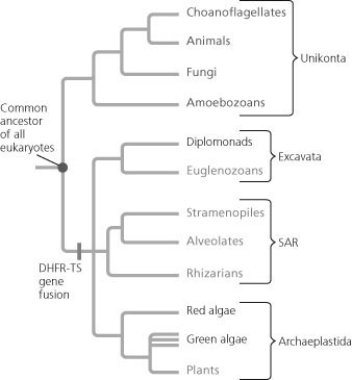 "Rare events" can help us understand evolutionary events, as shown in the figure. Which of the following statements explains the logic of this approach?
 (Multiple Choice)
4.7/5 (83)
(83) You are given four test tubes, each containing an unknown protist, and your task is to read the following description and match these four protists to the correct test tube.
When light, especially red and blue light, is shone on the tubes, oxygen bubbles accumulate on the inside of test tubes 1 and 2. Chemical analysis of test tube 1 indicates the presence of a chemical that is toxic to fish and humans. Chemical analysis of test tube 2 indicates the presence of substantial amounts of silica. Microscopic analysis of organisms in test tubes 1, 3, and 4 reveals the presence of permanent, membrane-bounded sacs just under the plasma membrane. Microscopic analysis of organisms in test tube 3 reveals the presence of an apicoplast in each. Microscopic analysis of the contents in test tube 4 reveals the presence of one large nucleus and one small nucleus in each organism.
Test tube 4 contains ________.
(Multiple Choice)
4.8/5 (85)
(85) Use the following description and table to answer the question.
Diatoms are encased in petri-plate-like cases (valves) made of translucent hydrated silica whose thickness can be varied. The material used to store excess calories can also be varied. At certain times, diatoms store excess calories in the form of the liquid polysaccharide, laminarin, and at other times as oil. The following are data concerning the density (specific gravity) of various components of diatoms, and of their environment.
Specific Gravities of Materials Relevant to Diatoms
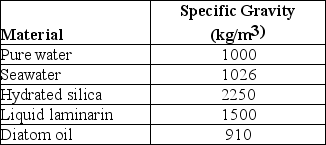 Water's density and, consequently, its buoyancy decrease at warmer temperatures. Based on this consideration, and using data from the table above, at which time of year should one expect diatoms to be storing excess calories mostly as oil?
 (Multiple Choice)
4.9/5 (83)
(83) Trypanosome infections evade attacks by host immune systems through which of the following mechanisms?
(Multiple Choice)
4.9/5 (72)
(72) According to the phylogeny presented in this chapter, which protists are in the same eukaryotic supergroup as plants?
(Multiple Choice)
4.7/5 (79)
(79) You are given four test tubes, each containing an unknown protist, and your task is to read the following description and match these four protists to the correct test tube.
When light, especially red and blue light, is shone on the tubes, oxygen bubbles accumulate on the inside of test tubes 1 and 2. Chemical analysis of test tube 1 indicates the presence of a chemical that is toxic to fish and humans. Chemical analysis of test tube 2 indicates the presence of substantial amounts of silica. Microscopic analysis of organisms in test tubes 1, 3, and 4 reveals the presence of permanent, membrane-bounded sacs just under the plasma membrane. Microscopic analysis of organisms in test tube 3 reveals the presence of an apicoplast in each. Microscopic analysis of the contents in test tube 4 reveals the presence of one large nucleus and one small nucleus in each organism.
Test tube 1 contains ________.
(Multiple Choice)
4.8/5 (77)
(77) Use the following description and table to answer the question.
Diatoms are encased in petri-plate-like cases (valves) made of translucent hydrated silica whose thickness can be varied. The material used to store excess calories can also be varied. At certain times, diatoms store excess calories in the form of the liquid polysaccharide, laminarin, and at other times as oil. The following are data concerning the density (specific gravity) of various components of diatoms, and of their environment.
Specific Gravities of Materials Relevant to Diatoms
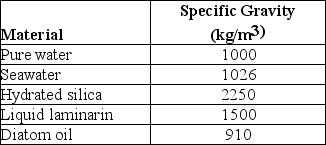 Water's density and, consequently, its buoyancy decrease at warmer temperatures. Considering the impact of temperature, and the table above, in which environment should diatoms sinking be slowest?
 (Multiple Choice)
4.8/5 (74)
(74) Consider the following data:
(a) Most ancient eukaryotes are unicellular.
(b) All eukaryotes alive today have a nucleus and cytoskeleton.
(c) Most ancient eukaryotes lack a cell wall. Which of the following conclusions could reasonably follow the data presented? The first eukaryote may have been ________.
(Multiple Choice)
4.8/5 (94)
(94) SAR is a group defined by DNA similarities. This grouping represents ________.
(Multiple Choice)
4.7/5 (76)
(76) A P. bursaria cell that has lost its zoochlorellae is aposymbiotic. If aposymbiotic cells have population growth rates the same as those of healthy, zoochlorella-containing P. bursaria in well-lit environments with plenty of prey items, then such an observation would be consistent with which type of relationship?
(Multiple Choice)
4.7/5 (77)
(77) Which of the following groups is matched with a correct anatomical feature?
(Multiple Choice)
4.9/5 (88)
(88) Which of the following pairs of protists and their ecological roles are correctly matched?
(Multiple Choice)
4.8/5 (77)
(77) 
Filters
- Essay(0)
- Multiple Choice(0)
- Short Answer(0)
- True False(0)
- Matching(0)