



 Chat with AI
Exam 26: Phylogeny and the Tree of Life

Exam 1: Evolution, the Themes of Biology, and Scientific Inquiry51 Questions
Exam 2: The Chemical Context of Life61 Questions
Exam 3: Water and Life55 Questions
Exam 4: Carbon and the Molecular Diversity of Life58 Questions
Exam 5: The Structure and Function of Large Biological Molecules70 Questions
Exam 6: A Tour of the Cell66 Questions
Exam 7: Membrane Structure and Function68 Questions
Exam 8: An Introduction to Metabolism67 Questions
Exam 9: Cellular Respiration and Fermentation68 Questions
Exam 10: Photosynthesis65 Questions
Exam 11: Cell Communication65 Questions
Exam 12: The Cell Cycle66 Questions
Exam 13: Meiosis and Sexual Life Cycles64 Questions
Exam 14: Mendel and the Gene Idea62 Questions
Exam 15: The Chromosomal Basis of Inheritance58 Questions
Exam 16: The Molecular Basis of Inheritance65 Questions
Exam 17: Gene Expression: From Gene to Protein67 Questions
Exam 18: Regulation of Gene Expression66 Questions
Exam 19: Viruses54 Questions
Exam 20: DNA Tools and Biotechnology57 Questions
Exam 21: Genomes and Their Evolution44 Questions
Exam 22: Descent with Modification: A Darwinian View of Life60 Questions
Exam 23: The Evolution of Populations64 Questions
Exam 24: The Origin of Species67 Questions
Exam 25: The History of Life on Earth59 Questions
Exam 26: Phylogeny and the Tree of Life75 Questions
Exam 27: Bacteria and Archaea75 Questions
Exam 28: Protists79 Questions
Exam 29: Plant Diversity I: How Plants Colonized Land82 Questions
Exam 30: Plant Diversity II: The Evolution of Seed Plants80 Questions
Exam 31: Fungi75 Questions
Exam 32: An Overview of Animal Diversity67 Questions
Exam 33: An Introduction to Invertebrates83 Questions
Exam 34: The Origin and Evolution of Vertebrates82 Questions
Exam 35: Vascular Plant Structure, Growth, and Development65 Questions
Exam 36: Resource Acquisition and Transport in Vascular Plants74 Questions
Exam 37: Soil and Plant Nutrition52 Questions
Exam 38: Angiosperm Reproduction and Biotechnology60 Questions
Exam 39: Plant Responses to Internal and External Signals61 Questions
Exam 40: Basic Principles of Animal Form and Function68 Questions
Exam 41: Animal Nutrition64 Questions
Exam 42: Circulation and Gas Exchange67 Questions
Exam 43: The Immune System69 Questions
Exam 44: Osmoregulation and Excretion64 Questions
Exam 45: Hormones and the Endocrine System66 Questions
Exam 46: Animal Reproduction68 Questions
Exam 47: Animal Development70 Questions
Exam 48: Neurons, Synapses, and Signaling68 Questions
Exam 49: Nervous Systems65 Questions
Exam 50: Sensory and Motor Mechanisms67 Questions
Exam 51: Animal Behavior69 Questions
Exam 52: An Introduction to Ecology and the Biosphere68 Questions
Exam 53: Population Ecology69 Questions
Exam 54: Community Ecology71 Questions
Exam 55: Ecosystems and Restoration Ecology68 Questions
Exam 56: Conservation Biology and Global Change69 Questions
Select questions type


Carolus Linnaeus believed that species remained fixed in the form in which they had been created. Linnaeus would have been uncomfortable with ________.
(Multiple Choice)
4.9/5  (73)
(73) The question refers to the following table, which compares the percent sequence homology of four different parts (two introns and two exons) of a gene that is found in five different eukaryotic species. Each part is numbered to indicate its distance from the promoter (for example, Intron I is the one closest to the promoter). The data reported for species A were obtained by comparing DNA from one member of species A to another member of species A.
% Sequence Homology
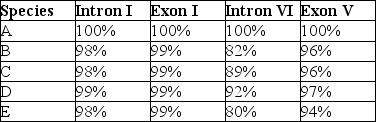 Regarding these sequence homology data, the principle of maximum parsimony would be applicable in ________.
 (Multiple Choice)
4.8/5 (89)
(89) 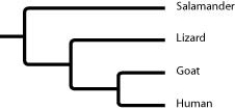
Your professor wants you to construct a phylogenetic tree of orchids. She gives you tissue from seven orchid species and one lily. What is the most likely reason she gave you the lily?
(Multiple Choice)
4.9/5 (80)
(80) Which of the following would, if it had acted upon a gene, prevent this gene from acting as a reliable molecular clock?
(Multiple Choice)
4.9/5 (76)
(76) Use the figure to answer the following question.
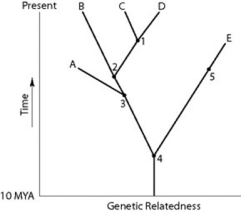 If the figure is an accurate depiction of relatedness, then which of the following should be an accurate statement?
 (Multiple Choice)
4.9/5 (83)
(83) To apply the principle of maximum parsimony to construction of a phylogenetic tree, ________.
(Multiple Choice)
4.8/5 (92)
(92) If additional DNA sequence evidence shows that yeast genes for synthesizing proteins are more similar to protein-synthesizing genes in bacteria than those in archaea, a modern systematist would ________.
(Multiple Choice)
5.0/5 (87)
(87) Use the following information to answer the question.
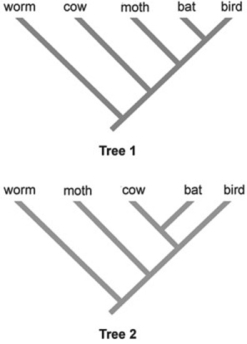 Applying the principle of parsimony to the trait "ability to fly," which of the two phylogenetic trees is better?
 (Multiple Choice)
4.9/5 (82)
(82) Some beetles and flies have antler-like structures on their heads, much like male deer. The existence of antlers in beetle, fly, and deer species with strong male-male competition is an example of ________.
(Multiple Choice)
4.8/5 (86)
(86) The following question refers to this phylogenetic tree, depicting the origins of life and the three domains. Horizontal lines indicate instances of gene or genome transfer.
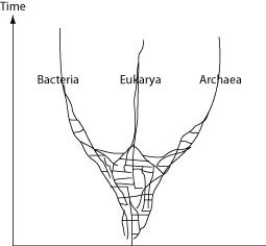 A possible phylogenetic tree for the three domains of life.
Which of these processes can be included among those responsible for the horizontal components of the figure?
A possible phylogenetic tree for the three domains of life.
Which of these processes can be included among those responsible for the horizontal components of the figure? (Multiple Choice)
4.9/5 (77)
(77) The most important feature that permits a gene to act as a molecular clock is ________.
(Multiple Choice)
4.9/5 (93)
(93) Which of the following pairs are the best examples of homologous structures?
(Multiple Choice)
4.7/5 (79)
(79) The common ancestors of birds and mammals were very early (stem) reptiles, which almost certainly possessed three-chambered hearts (two atria, one ventricle). Birds and mammals, however, are alike in having four-chambered hearts (two atria, two ventricles). The four-chambered hearts of birds and mammals are best described as ________.
(Multiple Choice)
4.9/5 (70)
(70) The importance of computers and of computer software to modern systematics s is most closely linked to advances in ________.
(Multiple Choice)
4.9/5 (83)
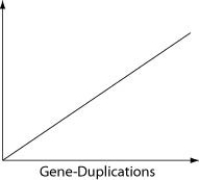
(83) Which of the following items is most likely to form a simple linear relationship with the number of gene-duplication events, when placed as the label on the vertical axis of the following graph?
(Multiple Choice)
4.8/5 (77)
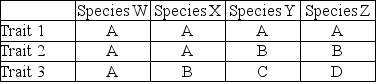
(77) Given that phylogenies are based on shared derived characteristics, which of the following traits is useful in generating a phylogeny of species W, X, Y, and Z?
(Multiple Choice)
4.9/5 (69)
(69) The following question refers to the following phylogenetic trees.
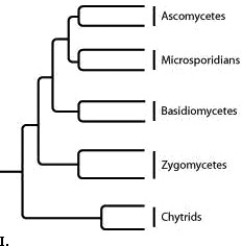
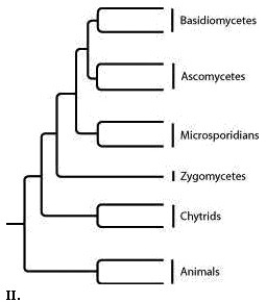
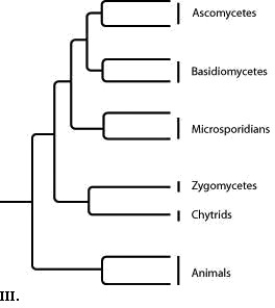
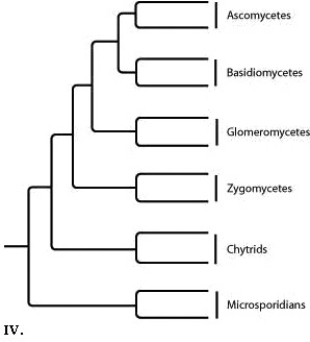 Which tree depicts the microsporidians as a sister group of the ascomycetes?
 (Multiple Choice)
4.8/5 (80)
(80) Which statement represents the best explanation for the observation that the nuclear DNA of wolves and domestic dogs has a very high degree of sequence homology? Dogs and wolves ________.
(Multiple Choice)
4.7/5 (74)
(74) The term convergent evolution is most applicable to which of the following features?
(Multiple Choice)
4.8/5 (87)
(87) 
Filters
- Essay(0)
- Multiple Choice(0)
- Short Answer(0)
- True False(0)
- Matching(0)