



 Chat with AI
Exam 19: Viruses

Exam 1: Evolution, the Themes of Biology, and Scientific Inquiry51 Questions
Exam 2: The Chemical Context of Life61 Questions
Exam 3: Water and Life55 Questions
Exam 4: Carbon and the Molecular Diversity of Life58 Questions
Exam 5: The Structure and Function of Large Biological Molecules70 Questions
Exam 6: A Tour of the Cell66 Questions
Exam 7: Membrane Structure and Function68 Questions
Exam 8: An Introduction to Metabolism67 Questions
Exam 9: Cellular Respiration and Fermentation68 Questions
Exam 10: Photosynthesis65 Questions
Exam 11: Cell Communication65 Questions
Exam 12: The Cell Cycle66 Questions
Exam 13: Meiosis and Sexual Life Cycles64 Questions
Exam 14: Mendel and the Gene Idea62 Questions
Exam 15: The Chromosomal Basis of Inheritance58 Questions
Exam 16: The Molecular Basis of Inheritance65 Questions
Exam 17: Gene Expression: From Gene to Protein67 Questions
Exam 18: Regulation of Gene Expression66 Questions
Exam 19: Viruses54 Questions
Exam 20: DNA Tools and Biotechnology57 Questions
Exam 21: Genomes and Their Evolution44 Questions
Exam 22: Descent with Modification: A Darwinian View of Life60 Questions
Exam 23: The Evolution of Populations64 Questions
Exam 24: The Origin of Species67 Questions
Exam 25: The History of Life on Earth59 Questions
Exam 26: Phylogeny and the Tree of Life75 Questions
Exam 27: Bacteria and Archaea75 Questions
Exam 28: Protists79 Questions
Exam 29: Plant Diversity I: How Plants Colonized Land82 Questions
Exam 30: Plant Diversity II: The Evolution of Seed Plants80 Questions
Exam 31: Fungi75 Questions
Exam 32: An Overview of Animal Diversity67 Questions
Exam 33: An Introduction to Invertebrates83 Questions
Exam 34: The Origin and Evolution of Vertebrates82 Questions
Exam 35: Vascular Plant Structure, Growth, and Development65 Questions
Exam 36: Resource Acquisition and Transport in Vascular Plants74 Questions
Exam 37: Soil and Plant Nutrition52 Questions
Exam 38: Angiosperm Reproduction and Biotechnology60 Questions
Exam 39: Plant Responses to Internal and External Signals61 Questions
Exam 40: Basic Principles of Animal Form and Function68 Questions
Exam 41: Animal Nutrition64 Questions
Exam 42: Circulation and Gas Exchange67 Questions
Exam 43: The Immune System69 Questions
Exam 44: Osmoregulation and Excretion64 Questions
Exam 45: Hormones and the Endocrine System66 Questions
Exam 46: Animal Reproduction68 Questions
Exam 47: Animal Development70 Questions
Exam 48: Neurons, Synapses, and Signaling68 Questions
Exam 49: Nervous Systems65 Questions
Exam 50: Sensory and Motor Mechanisms67 Questions
Exam 51: Animal Behavior69 Questions
Exam 52: An Introduction to Ecology and the Biosphere68 Questions
Exam 53: Population Ecology69 Questions
Exam 54: Community Ecology71 Questions
Exam 55: Ecosystems and Restoration Ecology68 Questions
Exam 56: Conservation Biology and Global Change69 Questions
Select questions type


Which of the following characteristics, structures, or processes is common to both bacteria and viruses?
(Multiple Choice)
4.9/5  (78)
(78) What is the function of reverse transcriptase in retroviruses?
(Multiple Choice)
4.9/5 (88)
(88) Which of the following characteristics is typical of the lytic cycle of a bacteriophage?
(Multiple Choice)
4.8/5 (91)
(91) Which of the following characteristics correctly describes retroviruses?
(Multiple Choice)
5.0/5 (81)
(81) Use the following figure and information to answer the question(s) below.
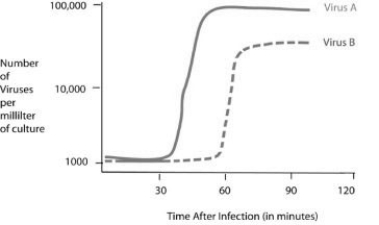 Cells were infected with approximately 1,000 copies of either virus A or virus B at the 0 time point. At five-minute intervals, a sample of the virus and cell mixture was removed. The intact cells were removed from the sample, and the number of viruses per milliliter of culture was determined.
Using the data in the figure, how long does it take for virus A to go through one lytic cycle?
Cells were infected with approximately 1,000 copies of either virus A or virus B at the 0 time point. At five-minute intervals, a sample of the virus and cell mixture was removed. The intact cells were removed from the sample, and the number of viruses per milliliter of culture was determined.
Using the data in the figure, how long does it take for virus A to go through one lytic cycle? (Multiple Choice)
4.9/5 (80)
(80) Refer to the treatments listed to answer the question.
You isolate an infectious substance capable of causing disease in plants, but you do not know whether the infectious agent is a bacterium, virus, or prion. You have four methods at your disposal to analyze the substance and determine the nature of the infectious agent.
I.Treat the substance with enzymes that destroy all nucleic acids, and then determine whether the substance is still infectious.
II.Filter the substance to remove all elements smaller than what can be easily seen under a light microscope.
III.Culture the substance on nutritive medium, away from any plant cells.
IV.Treat the sample with proteases that digest all proteins, and then determine whether the substance is still infectious.
If you already know that the infectious agent was either a virus or a prion, which method(s) listed above would allow you to distinguish between these two possibilities?
(Multiple Choice)
4.8/5 (77)
(77) Which of the following types of viral genomes could be transcribed using reverse transcriptase?
(Multiple Choice)
4.9/5 (86)
(86) In 2009, a flu pandemic was believed to have originated when viral transmission occurred from pig to human, thereby earning the designation "swine flu." Although pigs are thought to have been the breeding ground for the 2009 virus, sequences from bird, pig, and human viruses were all found within this newly identified virus. What is the most likely explanation of why this virus contained sequences from bird, pig, and human viruses?
(Multiple Choice)
5.0/5 (82)
(82) Which of the following statements correctly describes vaccines and how they help prevent viral infection?
(Multiple Choice)
4.8/5 (79)
(79) A person is most likely to recover from a cold due to viral infection if the infected cells are able to perform which of the following processes?
(Multiple Choice)
4.9/5 (78)
(78) Which of the following viruses would most likely have reverse transcriptase inside them?
(Multiple Choice)
4.8/5 (77)
(77) Which of the following descriptions correctly identifies the main structural differences between viruses with envelopes and viruses without envelopes?
(Multiple Choice)
4.8/5 (69)
(69) Which of the following statements best reflects what we know about how the flu virus moves between species?
(Multiple Choice)
5.0/5 (81)
(81) 
Filters
- Essay(0)
- Multiple Choice(0)
- Short Answer(0)
- True False(0)
- Matching(0)