



 Chat with AI
Exam 7: Membrane Structure and Function

Exam 1: Evolution, the Themes of Biology, and Scientific Inquiry51 Questions
Exam 2: The Chemical Context of Life61 Questions
Exam 3: Water and Life55 Questions
Exam 4: Carbon and the Molecular Diversity of Life58 Questions
Exam 5: The Structure and Function of Large Biological Molecules70 Questions
Exam 6: A Tour of the Cell66 Questions
Exam 7: Membrane Structure and Function68 Questions
Exam 8: An Introduction to Metabolism67 Questions
Exam 9: Cellular Respiration and Fermentation68 Questions
Exam 10: Photosynthesis65 Questions
Exam 11: Cell Communication65 Questions
Exam 12: The Cell Cycle66 Questions
Exam 13: Meiosis and Sexual Life Cycles64 Questions
Exam 14: Mendel and the Gene Idea62 Questions
Exam 15: The Chromosomal Basis of Inheritance58 Questions
Exam 16: The Molecular Basis of Inheritance65 Questions
Exam 17: Gene Expression: From Gene to Protein67 Questions
Exam 18: Regulation of Gene Expression66 Questions
Exam 19: Viruses54 Questions
Exam 20: DNA Tools and Biotechnology57 Questions
Exam 21: Genomes and Their Evolution44 Questions
Exam 22: Descent with Modification: A Darwinian View of Life60 Questions
Exam 23: The Evolution of Populations64 Questions
Exam 24: The Origin of Species67 Questions
Exam 25: The History of Life on Earth59 Questions
Exam 26: Phylogeny and the Tree of Life75 Questions
Exam 27: Bacteria and Archaea75 Questions
Exam 28: Protists79 Questions
Exam 29: Plant Diversity I: How Plants Colonized Land82 Questions
Exam 30: Plant Diversity II: The Evolution of Seed Plants80 Questions
Exam 31: Fungi75 Questions
Exam 32: An Overview of Animal Diversity67 Questions
Exam 33: An Introduction to Invertebrates83 Questions
Exam 34: The Origin and Evolution of Vertebrates82 Questions
Exam 35: Vascular Plant Structure, Growth, and Development65 Questions
Exam 36: Resource Acquisition and Transport in Vascular Plants74 Questions
Exam 37: Soil and Plant Nutrition52 Questions
Exam 38: Angiosperm Reproduction and Biotechnology60 Questions
Exam 39: Plant Responses to Internal and External Signals61 Questions
Exam 40: Basic Principles of Animal Form and Function68 Questions
Exam 41: Animal Nutrition64 Questions
Exam 42: Circulation and Gas Exchange67 Questions
Exam 43: The Immune System69 Questions
Exam 44: Osmoregulation and Excretion64 Questions
Exam 45: Hormones and the Endocrine System66 Questions
Exam 46: Animal Reproduction68 Questions
Exam 47: Animal Development70 Questions
Exam 48: Neurons, Synapses, and Signaling68 Questions
Exam 49: Nervous Systems65 Questions
Exam 50: Sensory and Motor Mechanisms67 Questions
Exam 51: Animal Behavior69 Questions
Exam 52: An Introduction to Ecology and the Biosphere68 Questions
Exam 53: Population Ecology69 Questions
Exam 54: Community Ecology71 Questions
Exam 55: Ecosystems and Restoration Ecology68 Questions
Exam 56: Conservation Biology and Global Change69 Questions
Select questions type


According to the fluid mosaic model of cell membranes, phospholipids ________.
(Multiple Choice)
4.9/5  (77)
(77) For the following questions, match the labeled component of the cell membrane in the figure with its description.
-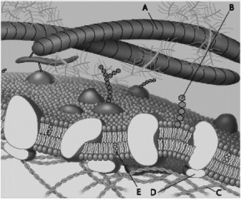 Which component in the accompanying figure plays a critical role in cell-cell recognition?
A) A
B) B
C) C
D) E
Which component in the accompanying figure plays a critical role in cell-cell recognition?
A) A
B) B
C) C
D) E (Essay)
4.9/5 (82)
(82) A bacterium engulfed by a white blood cell through phagocytosis will be digested by enzymes contained in ________.
(Multiple Choice)
4.8/5 (70)
(70) In receptor-mediated endocytosis, receptor molecules initially project to the outside of the cell. Where do they end up after endocytosis?
(Multiple Choice)
4.8/5 (77)
(77) For the following questions, match the labeled component of the cell membrane in the figure with its description.
-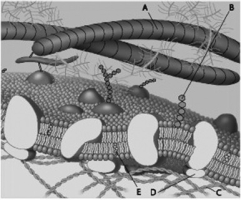 Which component in the accompanying figure is hydrophilic?
A) A
B) B
C) C
D) D
Which component in the accompanying figure is hydrophilic?
A) A
B) B
C) C
D) D (Essay)
4.8/5 (87)
(87) When a plant cell, such as one from a tulip leaf, is submerged in a hypertonic solution, what is likely to occur?
(Multiple Choice)
4.7/5 (85)
(85) Which of the following types of molecules lack hydrophilic domains?
(Multiple Choice)
4.9/5 (75)
(75) Which of the following statements correctly describes osmosis?
(Multiple Choice)
4.9/5 (80)
(80) Which of the following statements correctly describes the normal tonicity conditions for typical plant and animal cells? The animal cell is in ________.
(Multiple Choice)
4.9/5 (91)
(91) Which of the following types of molecules are hydrophilic and therefore excluded from the hydrophobic portion of the phospholipid bilayer?
(Multiple Choice)
4.7/5 (84)
(84) Use the paragraph and accompanying figure to answer the following questions.
Human immunodeficiency virus (HIV) infects cells that have both CD4 and CCR5 cell surface molecules. The viral nucleic acid molecules are enclosed in a protein capsid, and the protein capsid is itself contained inside an envelope consisting of a lipid bilayer membrane and viral glycoproteins. One hypothesis for viral entry into cells is that binding of HIV membrane glycoproteins to CD4 and CCR5 initiates fusion of the HIV membrane with the plasma membrane, releasing the viral capsid into the cytoplasm. An alternative hypothesis is that HIV gains entry into the cell via receptor-mediated endocytosis, and membrane fusion occurs in the endocytotic vesicle. To test these alternative hypotheses for HIV entry, researchers labeled the lipids on the HIV membrane with a red fluorescent dye.
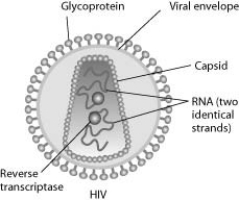 -In an HIV-infected cell producing HIV virus particles, the viral glycoprotein is expressed on the plasma membrane. How do the viral glycoproteins get to the plasma membrane? They are synthesized ________.
 (Multiple Choice)
4.9/5 (76)
(76) Which of the following factors would tend to increase membrane fluidity?
(Multiple Choice)
4.8/5 (77)
(77) Use the paragraph and accompanying figure to answer the following questions.
Human immunodeficiency virus (HIV) infects cells that have both CD4 and CCR5 cell surface molecules. The viral nucleic acid molecules are enclosed in a protein capsid, and the protein capsid is itself contained inside an envelope consisting of a lipid bilayer membrane and viral glycoproteins. One hypothesis for viral entry into cells is that binding of HIV membrane glycoproteins to CD4 and CCR5 initiates fusion of the HIV membrane with the plasma membrane, releasing the viral capsid into the cytoplasm. An alternative hypothesis is that HIV gains entry into the cell via receptor-mediated endocytosis, and membrane fusion occurs in the endocytotic vesicle. To test these alternative hypotheses for HIV entry, researchers labeled the lipids on the HIV membrane with a red fluorescent dye.
-What would be observed by live-cell fluorescence microscopy immediately after HIV entry if HIV is endocytosed first, and then later fuses with the endocytotic vesicle membrane?
-What would be observed by live-cell fluorescence microscopy immediately after HIV entry if HIV is endocytosed first, and then later fuses with the endocytotic vesicle membrane? (Multiple Choice)
4.9/5 (71)
(71) Three lab groups carried out an experiment to identify the concentration of sucrose in six solutions. Each unknown contained one of the following sucrose concentrations: 0.0 M, 0.2 M, 0.4 M, 0.6 M, 0.8 M, and 1.0 M. Cubes of sweet potato (1 cm³) were soaked for 24 hours in each solution and weighed to determine the change in mass. Each data entry represents the average of three sample replicates expressed as percent change in mass following a 24-hour soak in the unknown solutions.
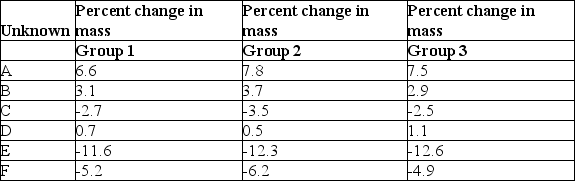 Based on the data provided, the intracellular molarity of dissolved solutes in sweet potato cells is approximately ________.
 (Multiple Choice)
4.8/5 (91)
(91) Which of the following statements describes a characteristic feature of a carrier protein in a plasma membrane?
(Multiple Choice)
4.7/5 (87)
(87) The solutions in the two arms of this U-tube are separated by a membrane that is permeable to water and glucose but not to sucrose. Side A is half-filled with a solution of 2 M sucrose and 1 M glucose. Side B is half-filled with 1 M sucrose and 2 M glucose. Initially, the liquid levels on both sides are equal.
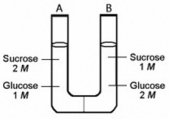 In the U-tube illustrated above, ________.
 (Multiple Choice)
4.9/5 (75)
(75) The membranes of winter wheat are able to remain fluid when it is extremely cold by ________.
(Multiple Choice)
4.8/5 (86)
(86) In which of the following environments would there be the greatest need for osmoregulation?
(Multiple Choice)
5.0/5 (81)
(81) 
Filters
- Essay(0)
- Multiple Choice(0)
- Short Answer(0)
- True False(0)
- Matching(0)