



 Chat with AI
Exam 5: International Trade

Exam 1: First Principles183 Questions
Exam 2: Economic Models: Trade-Offs and Trade341 Questions
Exam 3: Supply and Demand230 Questions
Exam 4: Price Controls and Quotas: Meddling With Markets187 Questions
Exam 5: International Trade224 Questions
Exam 6: Macroeconomics: the Big Picture128 Questions
Exam 7: GDP and the CPI: Tracking the Macroeconomy213 Questions
Exam 8: Unemployment and Inflation300 Questions
Exam 9: Long-Run Economic Growth268 Questions
Exam 10: Savings, Investment Spending, and the Financial Syst355 Questions
Exam 11: Income and Expenditure114 Questions
Exam 12: Aggregate Demand and Aggregate Supply308 Questions
Exam 13: Fiscal Policy120 Questions
Exam 14: Money, Banking, and the Federal Reserve System135 Questions
Exam 15: Monetary Policy316 Questions
Exam 16: Inflation, Disinflation, and Deflation194 Questions
Exam 17: Macroeconomics: Events and Ideas283 Questions
Exam 18: International Macroeconomics411 Questions
Select questions type


Use the following to answer questions: 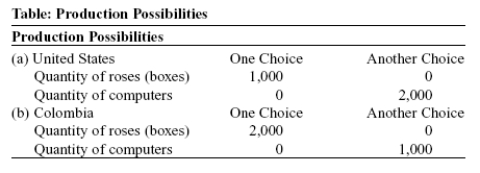 -(Table: Production Possibilities) Use Table: Production Possibilities. The opportunity cost of 1 computer for _____ is _____ box(es) of roses.
 (Multiple Choice)
4.9/5  (71)
(71) Use the following to answer questions:  -(Table: Production Possibilities for Machinery and Petroleum) Use Table: Production Possibilities for Machinery and Petroleum. In the United States the opportunity cost of producing 40 units of machinery is _____ units of petroleum.
 (Multiple Choice)
4.8/5 (69)
(69) Use the following to answer questions:  -(Figure: The Production Possibilities for Two Countries) Use Figure: The Production Possibilities for Two Countries. The opportunity cost of producing 1 microchip in Malaysia is _____ tire(s).
 (Multiple Choice)
4.8/5 (66)
(66) In the case of U.S. trade protection, quota rents for the most important import licenses are earned by:
(Multiple Choice)
4.9/5 (75)
(75) If Japan levies tariffs on U.S. goods entering Japan, this will tend in the short run to _____ U.S. producers and _____ Japanese producers.
(Multiple Choice)
4.8/5 (80)
(80) In a Ricardian model of international trade, the production possibility frontiers are _____, indicating that the opportunity cost of increasing the production of one item relative to another _____.
(Multiple Choice)
4.8/5 (78)
(78) Use the following to answer questions:  -(Table: The Production Possibilities for Tractors and Crude Oil) Use Table: The Production Possibilities for Tractors and Crude Oil. The opportunity cost of _____ is _____ in the United States as/than in Mexico.
 (Multiple Choice)
4.8/5 (74)
(74) If the United States removed the tariffs and quotas on sugar, in the U.S. market for sugar:
(Multiple Choice)
4.7/5 (80)
(80) Assume that the United States imposes an import quota on Scottish wool suits. Relative to the equilibrium price that would prevail in the absence of quotas, the equilibrium price of suits in the United States will most likely _____ and the equilibrium price of suits in Scotland will most likely _____.
(Multiple Choice)
4.9/5 (78)
(78) Use the following to answer questions:  -(Figure: The Production Possibility Frontiers for Jackson and Tahoe) Use Figure: The Production Possibility Frontiers for Jackson and Tahoe. In autarky, Jackson produces and consumes 30 head of cattle and 80 bushels of wheat, while Tahoe produces and consumes 80 head of cattle and 60 bushels of wheat. Each nation specializes completely, based on comparative advantage, and the price of 1 head of cattle equals the price of 2 bushels of wheat. If Jackson exports 120 bushels of wheat to Tahoe, then the new consumption point for Tahoe after trade is _____ bushels of wheat and _____ head of cattle.
 (Multiple Choice)
4.8/5 (78)
(78) Use the following to answer questions:
-(Table: Production Possibilities for Machinery and Petroleum) Use Table: Production Possibilities for Machinery and Petroleum. The opportunity cost in the United States of producing 30 units of petroleum is _____ units of machinery.
-(Table: Production Possibilities for Machinery and Petroleum) Use Table: Production Possibilities for Machinery and Petroleum. The opportunity cost in the United States of producing 30 units of petroleum is _____ units of machinery. (Multiple Choice)
4.9/5 (72)
(72) Use the following to answer questions:  -(Figure: The Market for Oranges in South Africa) Use Figure: The Market for Oranges in South Africa. In autarky, the price of oranges in South Africa is P1. When the economy is opened to trade, the price falls to PW and producer surplus will _____ to area _____.
 (Multiple Choice)
4.8/5 (73)
(73) Mexico produces lettuce but can also import it. If Mexico imports some lettuce:
(Multiple Choice)
4.9/5 (77)
(77) If a nation imports a good when the economy is opened to trade, the domestic price of the good will _____ and domestic consumption will _____.
(Multiple Choice)
4.8/5 (84)
(84) Use the following to answer questions:  -(Figure: The Market for Computers) Use Figure: The Market for Computers. Assume that PA is the autarky price and PW is the world price. Producer surplus without international trade would be area:
 (Multiple Choice)
4.8/5 (90)
(90) Use the following to answer questions:
-(Figure: The Production Possibilities for Two Countries) Use Figure: The Production Possibilities for Two Countries. If Indonesia and Malaysia specialize completely in the production of the good of their comparative advantage, the two nations together will produce _____ tires and _____ microchips.
-(Figure: The Production Possibilities for Two Countries) Use Figure: The Production Possibilities for Two Countries. If Indonesia and Malaysia specialize completely in the production of the good of their comparative advantage, the two nations together will produce _____ tires and _____ microchips. (Multiple Choice)
4.9/5 (78)
(78) Use the following to answer questions:
-(Table: The Production Possibilities for Tractors and Crude Oil) Use Table: The Production Possibilities for Tractors and Crude Oil. The United States has a comparative advantage in _____, and Mexico has a comparative advantage in _____.
-(Table: The Production Possibilities for Tractors and Crude Oil) Use Table: The Production Possibilities for Tractors and Crude Oil. The United States has a comparative advantage in _____, and Mexico has a comparative advantage in _____. (Multiple Choice)
4.8/5 (87)
(87) The United States must give up the production of 500 bicycles to produce 20 additional tractors. The opportunity cost of producing 100 bicycles is _____ tractor(s).
(Multiple Choice)
4.7/5 (80)
(80) Use the following to answer questions:
-(Table: The Production Possibilities for Tractors and Crude Oil) Use Table: The Production Possibilities for Tractors and Crude Oil. Both the United States and Mexico will gain from trade if one tractor trades for _____ barrels of oil.
-(Table: The Production Possibilities for Tractors and Crude Oil) Use Table: The Production Possibilities for Tractors and Crude Oil. Both the United States and Mexico will gain from trade if one tractor trades for _____ barrels of oil. (Multiple Choice)
4.8/5 (82)
(82) Use the following to answer questions:
-(Figure: The Market for Oranges in South Africa) Use Figure: The Market for Oranges in South Africa. In autarky, the price of oranges in South Africa is P1. When the economy is opened to trade, the price falls to PW and consumer surplus will _____ to area _____.
-(Figure: The Market for Oranges in South Africa) Use Figure: The Market for Oranges in South Africa. In autarky, the price of oranges in South Africa is P1. When the economy is opened to trade, the price falls to PW and consumer surplus will _____ to area _____. (Multiple Choice)
4.9/5 (93)
(93) 
Filters
- Essay(0)
- Multiple Choice(0)
- Short Answer(0)
- True False(0)
- Matching(0)