



 Chat with AI
Exam 5: International Trade

Exam 1: First Principles183 Questions
Exam 2: Economic Models: Trade-Offs and Trade341 Questions
Exam 3: Supply and Demand230 Questions
Exam 4: Price Controls and Quotas: Meddling With Markets187 Questions
Exam 5: International Trade224 Questions
Exam 6: Macroeconomics: the Big Picture128 Questions
Exam 7: GDP and the CPI: Tracking the Macroeconomy213 Questions
Exam 8: Unemployment and Inflation300 Questions
Exam 9: Long-Run Economic Growth268 Questions
Exam 10: Savings, Investment Spending, and the Financial Syst355 Questions
Exam 11: Income and Expenditure114 Questions
Exam 12: Aggregate Demand and Aggregate Supply308 Questions
Exam 13: Fiscal Policy120 Questions
Exam 14: Money, Banking, and the Federal Reserve System135 Questions
Exam 15: Monetary Policy316 Questions
Exam 16: Inflation, Disinflation, and Deflation194 Questions
Exam 17: Macroeconomics: Events and Ideas283 Questions
Exam 18: International Macroeconomics411 Questions
Select questions type


Use the following to answer questions:  -(Table: The Production Possibilities for Tractors and Crude Oil) Use Table: The Production Possibilities for Tractors and Crude Oil. In the United States, the opportunity cost of producing 30,000 barrels of crude oil is _____ tractors.
 (Multiple Choice)
4.9/5  (83)
(83) Use the following to answer questions:
-(Table: The Production Possibilities for Tractors and Crude Oil) Use Table: The Production Possibilities for Tractors and Crude Oil. _____ has/have an absolute advantage in producing tractors.
-(Table: The Production Possibilities for Tractors and Crude Oil) Use Table: The Production Possibilities for Tractors and Crude Oil. _____ has/have an absolute advantage in producing tractors. (Multiple Choice)
4.9/5 (68)
(68) Since the United States imports a large quantity of textiles from Asia, the overall wages of U.S. textile workers have _____, while the price of textiles in the United States has _____.
(Multiple Choice)
5.0/5 (83)
(83) If a country has the comparative advantage in producing cloth, in the market for cloth the autarky price would be _____ the world price and the country would _____ cloth.
(Multiple Choice)
4.7/5 (80)
(80) Use the following to answer questions:  -(Figure: The Production Possibility Frontiers for Jackson and Tahoe) Use Figure: The Production Possibility Frontiers for Jackson and Tahoe. Jackson has an absolute advantage in producing:
 (Multiple Choice)
4.9/5 (86)
(86) Use the following to answer questions: 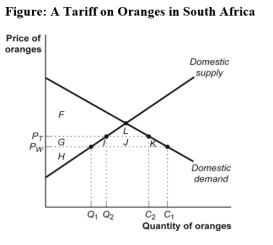 -(Figure: A Tariff on Oranges in South Africa) Use Figure: A Tariff on Oranges in South Africa. When the government imposes a tariff on imported oranges, the price of oranges in South Africa rises from PW to PT and domestic producer surplus _____ to _____.
 (Multiple Choice)
4.8/5 (80)
(80) Use the following to answer questions:
-(Table: The Production Possibilities for Tractors and Crude Oil) Use Table: The Production Possibilities for Tractors and Crude Oil. In the United States, the opportunity cost of producing 40 tractors is _____ barrels of crude oil.
-(Table: The Production Possibilities for Tractors and Crude Oil) Use Table: The Production Possibilities for Tractors and Crude Oil. In the United States, the opportunity cost of producing 40 tractors is _____ barrels of crude oil. (Multiple Choice)
4.9/5 (82)
(82) If the United States can produce 30 computers for every car it produces and Japan can produce 15 computers for every car it produces, _____ has the _____ advantage in car production.
(Multiple Choice)
4.9/5 (82)
(82) Restrictions on free international trade designed to insulate domestic industries from competitive market forces that originate beyond the borders of the country are _____ policies.
(Multiple Choice)
4.7/5 (82)
(82) In a single year, Argentina can raise 100 tons of beef or produce 1,000 boxes of tulips. In the same growing season, Venezuela can raise 50 tons of beef or produce 750 boxes of tulips. When the two countries begin trading beef for tulips, we expect the price of beef in Venezuela:
(Multiple Choice)
4.9/5 (75)
(75) Use the following to answer questions:  -(Figure: The Production Possibilities for Two Countries) Use Figure: The Production Possibilities for Two Countries. If Indonesia specializes completely in the production of the good of its comparative advantage, it will produce:
 (Multiple Choice)
4.8/5 (93)
(93) Assume that the United States imposes an import quota on Columbian coffee. Relative to the equilibrium world price that would prevail in the absence of import quotas, it is likely that the equilibrium price of coffee in the United States will _____ and the equilibrium price of coffee in Columbia will _____.
(Multiple Choice)
4.7/5 (69)
(69) According to the Heckscher-Ohlin model, Brazil will have a comparative advantage in oranges if the factors that are _____ in the production of oranges are _____.
(Multiple Choice)
4.8/5 (85)
(85) The United States can produce 30 computers for every car it produces, and Japan can produce 15 computers for every car it produces. Based on this information, which statement is INCORRECT?
(Multiple Choice)
4.9/5 (80)
(80) Use the following to answer questions: 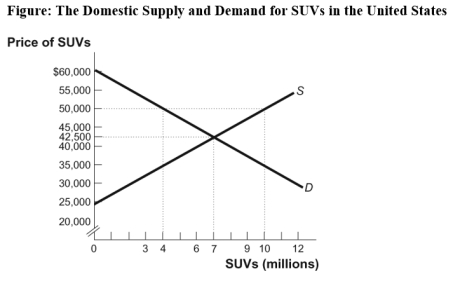 -(Figure: The Domestic Supply and Demand for SUVs in the United States) Use Figure: The Domestic Supply and Demand for SUVs in the United States. Suppose the world price equals $50,000 and there is free trade. In the United States, consumer surplus would _____ and producer surplus would _____.
 (Multiple Choice)
4.8/5 (66)
(66) If a market begins to engage in international trade, we can assume that:
(Multiple Choice)
4.8/5 (76)
(76) The United States must give up the production of 500 bicycles to produce 20 additional tractors. The opportunity cost of producing 5 tractors is _____ bicycles.
(Multiple Choice)
4.9/5 (86)
(86) Use the following to answer questions: 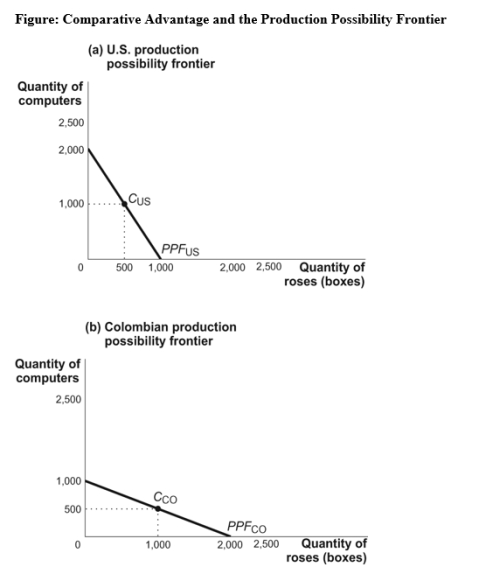 -(Figure: Comparative Advantage and the Production Possibility Frontier) Use Figure: Comparative Advantage and the Production Possibility Frontier. _____ has an absolute advantage in the production of _____ and a comparative advantage in the production of _____.
 (Multiple Choice)
4.9/5 (82)
(82) The _____ model analyzes trade under the assumption that opportunity costs are constant and therefore production possibility frontiers are straight lines.
(Multiple Choice)
4.8/5 (88)
(88) 
Filters
- Essay(0)
- Multiple Choice(0)
- Short Answer(0)
- True False(0)
- Matching(0)