



 Chat with AI
Exam 29: The Working Plant

Exam 1: Learning About Life45 Questions
Exam 2: Essential Chemistry for Biology50 Questions
Exam 3: The Molecules of Life56 Questions
Exam 4: A Tour of the Cell57 Questions
Exam 5: The Working Cell58 Questions
Exam 6: Cellular Respiration: Obtaining Energy From Food53 Questions
Exam 7: Photosynthesis: Using Light to Make Food52 Questions
Exam 8: Cellular Reproduction: Cells From Cells59 Questions
Exam 9: Patterns of Inheritance55 Questions
Exam 10: The Structure and Function of Dna59 Questions
Exam 11: How Genes Are Controlled55 Questions
Exam 12: Dna Technology54 Questions
Exam 13: How Populations Evolve52 Questions
Exam 14: How Biological Diversity Evolves47 Questions
Exam 15: The Evolution of Microbial Life59 Questions
Exam 16: The Evolution of Plants and Fungi56 Questions
Exam 17: The Evolution of Animals60 Questions
Exam 18: An Introduction to Ecology and the Biosphere56 Questions
Exam 19: Population Ecology52 Questions
Exam 20: Communities and Ecosystems63 Questions
Exam 21: Unifying Concepts of Animal Structure and Function57 Questions
Exam 22: Nutrition and Digestion67 Questions
Exam 23: Circulation and Respiration69 Questions
Exam 24: The Bodys Defenses59 Questions
Exam 25: Hormones53 Questions
Exam 26: Reproduction and Development59 Questions
Exam 27: Nervous, Sensory, and Locomotor Systems62 Questions
Exam 28: The Life of a Flowering Plant81 Questions
Exam 29: The Working Plant73 Questions
Select questions type


 -Scientists can now measure phloem pressure directly. Which measurements from a plant, as represented by the figure, would support the pressure flow mechanism of plant transport?
 (Multiple Choice)
5.0/5  (82)
(82) Across the globe, billions of people eat rice. In order to make rice grains (the seed), a rice plant must flower and be pollinated. Rice plants flower only after days become shorter (i.e., summer to autumn). What is the best classification for rice?
(Multiple Choice)
4.8/5 (91)
(91) The figure shows plants grown in the dark, and illustrates ________ in plants. 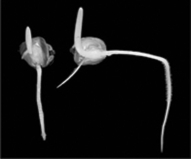
(Multiple Choice)
4.9/5 (79)
(79) The three most important nutrients contained in fertilizers are ________.
(Multiple Choice)
4.7/5 (80)
(80) A farmer applies an organic fertilizer to her apple trees. Does this practice allow her to sell her apples as certified organic?
(Multiple Choice)
4.7/5 (64)
(64) 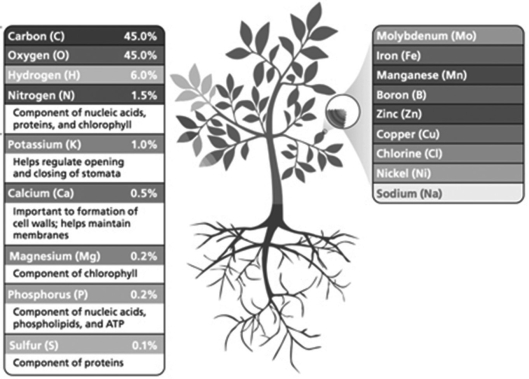 -What plant nutrients are shown in the figure?
In a strawberry plant in the summer, the leaves are ________ and the strawberry fruits are ________.
(Multiple Choice)
4.9/5 (80)
(80) Root nodules in plants such as peas and beans are advantageous because they ________.
(Multiple Choice)
5.0/5 (84)
(84) Examine the figure. Where is the site of carbon dioxide uptake by a plant? 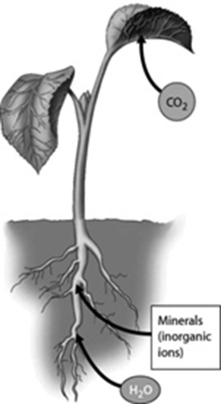
(Multiple Choice)
4.8/5 (87)
(87) What happens in a twig if the auxin produced by its apical meristem is conveyed equally down all sides?
(Multiple Choice)
4.8/5 (87)
(87) The figure shows plants originally grown in the dark, and then a light is added on one side only (arrow). Predict the response of the plants to the addition of the light source. 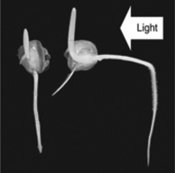
(Multiple Choice)
4.9/5 (71)
(71) What best describes the opening and closing of the stomata in most plants?
(Multiple Choice)
4.7/5 (83)
(83) Scenario
In the late 1800s, Charles Darwin and his son Francis conducted the first experiments on phototropism. Several years later, their work was furthered by Peter Boysen-Jensen, Arpad Paal, and Frits Went. Peter Boysen-Jensen separated the tip of grass shoots from the rest of the plant using either tiny blocks of agar (a gelatin)or a mica wafer (an impervious rock). Like the Darwins, Boysen-Jensen noticed that the grass did not grow toward a light without its tips. However, when he separated the tip from the rest of the plant using agar, the grass would grow toward a light. The grass would not grow toward a light if the tip of the shoot was separated using a mica wafer. Arpad Paal cut off the tips of grass shoots that were growing in the dark. He placed these cut tips back on the shoots, but with only part of the tip covering the cut surface, and found that the plants grew, in the dark, in the opposite direction from the side with the tip covering it. Lastly, Frits Went removed the tips of many grass shoots and placed them on a large block of agar for a few hours. Then, he cut up the agar block, and was able to make grass shoots without any tips at all grow toward a light by putting these agar blocks on the cut surfaces of the shoots (i.e., no tips were placed back on the shoots, only the agar).
-Considering the experiments of the Darwins, Boysen-Jensen, Paal, and Went, what do you conclude about phototropism?
(Multiple Choice)
4.7/5 (69)
(69) In phytoremediation after a nuclear power plant accident, plants are used to remove ________ and ________ from the soil.
(Multiple Choice)
4.9/5 (82)
(82) 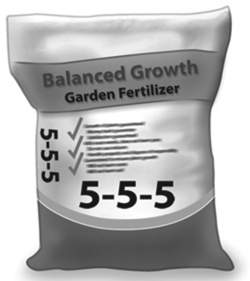 This figure shows a typical label for fertilizer. What fertilizer is contained in this bag?
 (Multiple Choice)
4.9/5 (74)
(74) Scenario
In the late 1800s, Charles Darwin and his son Francis conducted the first experiments on phototropism. Several years later, their work was furthered by Peter Boysen-Jensen, Arpad Paal, and Frits Went. Peter Boysen-Jensen separated the tip of grass shoots from the rest of the plant using either tiny blocks of agar (a gelatin)or a mica wafer (an impervious rock). Like the Darwins, Boysen-Jensen noticed that the grass did not grow toward a light without its tips. However, when he separated the tip from the rest of the plant using agar, the grass would grow toward a light. The grass would not grow toward a light if the tip of the shoot was separated using a mica wafer. Arpad Paal cut off the tips of grass shoots that were growing in the dark. He placed these cut tips back on the shoots, but with only part of the tip covering the cut surface, and found that the plants grew, in the dark, in the opposite direction from the side with the tip covering it. Lastly, Frits Went removed the tips of many grass shoots and placed them on a large block of agar for a few hours. Then, he cut up the agar block, and was able to make grass shoots without any tips at all grow toward a light by putting these agar blocks on the cut surfaces of the shoots (i.e., no tips were placed back on the shoots, only the agar).
-If Paal grew his plants using a light source that was directly overhead, what should he have observed?
(Multiple Choice)
4.9/5 (84)
(84) A location in a plant where sugar is being received for storage or consumption is ________.
(Multiple Choice)
4.9/5 (70)
(70)  -Examine the figure. Why does the shoot bend toward the light?
 (Multiple Choice)
4.9/5 (78)
(78) 
Filters
- Essay(0)
- Multiple Choice(0)
- Short Answer(0)
- True False(0)
- Matching(0)