



 Chat with AI
Exam 29: The Working Plant

Exam 1: Learning About Life45 Questions
Exam 2: Essential Chemistry for Biology50 Questions
Exam 3: The Molecules of Life56 Questions
Exam 4: A Tour of the Cell57 Questions
Exam 5: The Working Cell58 Questions
Exam 6: Cellular Respiration: Obtaining Energy From Food53 Questions
Exam 7: Photosynthesis: Using Light to Make Food52 Questions
Exam 8: Cellular Reproduction: Cells From Cells59 Questions
Exam 9: Patterns of Inheritance55 Questions
Exam 10: The Structure and Function of Dna59 Questions
Exam 11: How Genes Are Controlled55 Questions
Exam 12: Dna Technology54 Questions
Exam 13: How Populations Evolve52 Questions
Exam 14: How Biological Diversity Evolves47 Questions
Exam 15: The Evolution of Microbial Life59 Questions
Exam 16: The Evolution of Plants and Fungi56 Questions
Exam 17: The Evolution of Animals60 Questions
Exam 18: An Introduction to Ecology and the Biosphere56 Questions
Exam 19: Population Ecology52 Questions
Exam 20: Communities and Ecosystems63 Questions
Exam 21: Unifying Concepts of Animal Structure and Function57 Questions
Exam 22: Nutrition and Digestion67 Questions
Exam 23: Circulation and Respiration69 Questions
Exam 24: The Bodys Defenses59 Questions
Exam 25: Hormones53 Questions
Exam 26: Reproduction and Development59 Questions
Exam 27: Nervous, Sensory, and Locomotor Systems62 Questions
Exam 28: The Life of a Flowering Plant81 Questions
Exam 29: The Working Plant73 Questions
Select questions type


A typical plant obtains both water and minerals from ________.
(Multiple Choice)
4.9/5  (73)
(73) 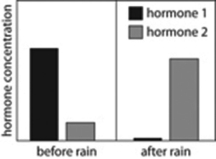 V
-A scientist finds seeds of an unknown plant on top of the soil in a desert. She measures the concentration of two hormones in these seeds. After it rains, she collects more of these seeds, and finds that the concentration of the two hormones has changed. A graph of her results is shown. If the scientist returns to the desert to collect more seeds, a few days later, what should she observe?
V
-A scientist finds seeds of an unknown plant on top of the soil in a desert. She measures the concentration of two hormones in these seeds. After it rains, she collects more of these seeds, and finds that the concentration of the two hormones has changed. A graph of her results is shown. If the scientist returns to the desert to collect more seeds, a few days later, what should she observe? (Multiple Choice)
4.8/5 (101)
(101) Substances that enter a plant through the root system are ________.
(Multiple Choice)
4.7/5 (60)
(60)  -The force that creates the upward pulling of a string of water molecules is found at ________.
 (Multiple Choice)
4.9/5 (93)
(93) What aspect of plant nutrition is not found in animal nutrition?
(Multiple Choice)
4.9/5 (85)
(85) Scenario
Nitrogen shortage is a common nutritional problem for plants. In crops, a nitrogen deficiency can result in stunted growth as well as lower nutritional content. Farmers sometimes apply fertilizers containing nitrogen as well as other essential nutrients, such as phosphorus and potassium. Compost can also be used to fertilize soils. Compost consists of vegetable matter that adds nutrients to soil as it is decomposed by microorganisms, fungi, and animals. Certain plants, including legumes such as peas and beans, house nitrogen-fixing bacteria in swellings called "root nodules." The bacteria have enzymes that help convert atmospheric N2 to ammonium ions that can be readily used by the plants. The plant, in turn, provides the bacteria with other nutrients. When conditions are favorable, root nodule bacteria fix so much nitrogen that the nodules secrete excess ammonia.
-Which approach could an organic farmer use to deal with nitrogen deficiency?
(Multiple Choice)
4.9/5 (92)
(92) What weather conditions would cause transpiration to be most rapid?
(Multiple Choice)
4.8/5 (83)
(83) A typical plant obtains most of the inorganic matter that forms its dry weight from ________.
(Multiple Choice)
4.9/5 (78)
(78) What mechanism best explains how xylem sap moves up against the downward pull of gravity?
(Multiple Choice)
4.7/5 (79)
(79) 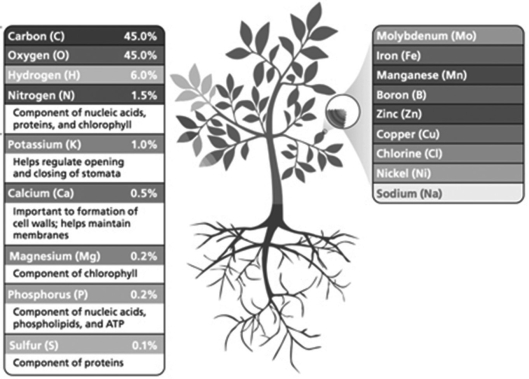 -What correctly describes the plant nutrients shown in the figure?
 (Multiple Choice)
4.8/5 (71)
(71) A farmer decides she wants to grow certified organic corn and sets out to meet all USDA standards to do so. Her crop grows well for the first 3 years; however, she notices during the 4th and 5th years that plants are getting smaller and producing much less corn. She has not altered farming practices and begins to wonder what is happening. She remembers someone mentioning planting peanuts every 3rd year in place of a corn crop, which leads to much healthier corn. Why would a farmer want to change to a different crop, especially something like peanuts?
(Multiple Choice)
4.8/5 (81)
(81) Scenario
In the late 1800s, Charles Darwin and his son Francis conducted the first experiments on phototropism. Several years later, their work was furthered by Peter Boysen-Jensen, Arpad Paal, and Frits Went. Peter Boysen-Jensen separated the tip of grass shoots from the rest of the plant using either tiny blocks of agar (a gelatin)or a mica wafer (an impervious rock). Like the Darwins, Boysen-Jensen noticed that the grass did not grow toward a light without its tips. However, when he separated the tip from the rest of the plant using agar, the grass would grow toward a light. The grass would not grow toward a light if the tip of the shoot was separated using a mica wafer. Arpad Paal cut off the tips of grass shoots that were growing in the dark. He placed these cut tips back on the shoots, but with only part of the tip covering the cut surface, and found that the plants grew, in the dark, in the opposite direction from the side with the tip covering it. Lastly, Frits Went removed the tips of many grass shoots and placed them on a large block of agar for a few hours. Then, he cut up the agar block, and was able to make grass shoots without any tips at all grow toward a light by putting these agar blocks on the cut surfaces of the shoots (i.e., no tips were placed back on the shoots, only the agar).
-Boysen-Jensen also used the mica to separate a tip of a grass shoot only partially, by cutting the tip halfway and inserting a wafer of mica into the cut. If this experiment supported the Darwins' hypothesis, what would Boysen-Jensen have observed?
(Multiple Choice)
4.9/5 (90)
(90) Scenario
Nitrogen shortage is a common nutritional problem for plants. In crops, a nitrogen deficiency can result in stunted growth as well as lower nutritional content. Farmers sometimes apply fertilizers containing nitrogen as well as other essential nutrients, such as phosphorus and potassium. Compost can also be used to fertilize soils. Compost consists of vegetable matter that adds nutrients to soil as it is decomposed by microorganisms, fungi, and animals. Certain plants, including legumes such as peas and beans, house nitrogen-fixing bacteria in swellings called "root nodules." The bacteria have enzymes that help convert atmospheric N2 to ammonium ions that can be readily used by the plants. The plant, in turn, provides the bacteria with other nutrients. When conditions are favorable, root nodule bacteria fix so much nitrogen that the nodules secrete excess ammonia.
-Some farmers practice crop rotation, alternating between planting nonlegumes such as corn or wheat one year and legumes the next year. What is the advantage of crop rotation?
(Multiple Choice)
4.8/5 (79)
(79) 
Filters
- Essay(0)
- Multiple Choice(0)
- Short Answer(0)
- True False(0)
- Matching(0)