



 Chat with AI
Exam 17: The Evolution of Animals

Exam 1: Learning About Life45 Questions
Exam 2: Essential Chemistry for Biology50 Questions
Exam 3: The Molecules of Life56 Questions
Exam 4: A Tour of the Cell57 Questions
Exam 5: The Working Cell58 Questions
Exam 6: Cellular Respiration: Obtaining Energy From Food53 Questions
Exam 7: Photosynthesis: Using Light to Make Food52 Questions
Exam 8: Cellular Reproduction: Cells From Cells59 Questions
Exam 9: Patterns of Inheritance55 Questions
Exam 10: The Structure and Function of Dna59 Questions
Exam 11: How Genes Are Controlled55 Questions
Exam 12: Dna Technology54 Questions
Exam 13: How Populations Evolve52 Questions
Exam 14: How Biological Diversity Evolves47 Questions
Exam 15: The Evolution of Microbial Life59 Questions
Exam 16: The Evolution of Plants and Fungi56 Questions
Exam 17: The Evolution of Animals60 Questions
Exam 18: An Introduction to Ecology and the Biosphere56 Questions
Exam 19: Population Ecology52 Questions
Exam 20: Communities and Ecosystems63 Questions
Exam 21: Unifying Concepts of Animal Structure and Function57 Questions
Exam 22: Nutrition and Digestion67 Questions
Exam 23: Circulation and Respiration69 Questions
Exam 24: The Bodys Defenses59 Questions
Exam 25: Hormones53 Questions
Exam 26: Reproduction and Development59 Questions
Exam 27: Nervous, Sensory, and Locomotor Systems62 Questions
Exam 28: The Life of a Flowering Plant81 Questions
Exam 29: The Working Plant73 Questions
Select questions type


The figure shows a simple worm. Bilateral symmetry and a highly branched gastrovascular cavity all suggest that the worm is a(n)________. 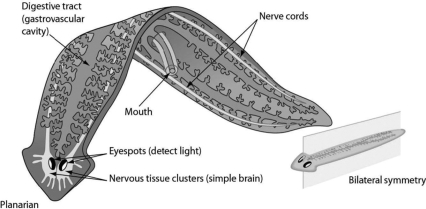

Free
(Multiple Choice)
4.9/5  (66)
(66) Correct Answer: Verified
D
On a hike in the mountains, you find a stream with a rocky bottom. Many of the rocks are covered in algae. Which type of mollusc is most likely to be found living in this environment?
Free
(Multiple Choice)
4.9/5 (71)
(71) Correct Answer:Verified
VerifiedB
The evolutionary tree indicates that ________ anthropoids are most closely related to humans?
(Multiple Choice)
4.7/5 (83)
(83) The stationary stage of the cnidarian life cycle is the ________ stage.
(Multiple Choice)
4.7/5 (80)
(80) In the image, the segmented body of the worm suggests that it is a(n)________. 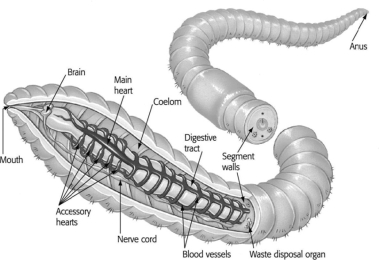
(Multiple Choice)
4.9/5 (80)
(80) All but one of these traits result from evolutionary responses of ancient ancestors to their physical and cultural environment. Choose the EXCEPTION.
(Multiple Choice)
4.9/5 (76)
(76) The process of biological evolution often allows humans to survive consistent environmental stresses that occur across multiple generations. As humans colonized Earth's diverse environments, they encountered hot, dry areas and decided to settle. What trait likely offered an advantage in this environment?
(Multiple Choice)
4.8/5 (80)
(80) Unique features of vertebrates include the presence of a(n)________.
(Multiple Choice)
4.7/5 (69)
(69) The phylogenetic tree indicates that ________ are most closely related to chordates?
(Multiple Choice)
4.8/5 (75)
(75) Among vertebrates, the unique feature of lampreys and hagfish is the ________.
(Multiple Choice)
4.9/5 (81)
(81) The common ancestor of all animals is likely to have been a ________.
(Multiple Choice)
4.9/5 (83)
(83) If researchers are able to determine when HIVs emerged and therefore how transmission of these viruses to humans occurred, how will this help modern medical care?
(Multiple Choice)
4.8/5 (73)
(73) When the crown of thorns starfish hatches, it has a semitransparent, jellylike appearance with a non-defined shape. As it ages, it grows arms and then spikes, giving rise to its name. This dramatic change in its body features describes the starfish's ________.
(Multiple Choice)
4.7/5 (93)
(93) You are given the task of confirming the categorization of a newly discovered animal that has been tagged as a species of annelid. What evidence would convince you that it is an annelid and not a roundworm or flatworm?
(Multiple Choice)
4.8/5 (87)
(87) 
Filters
- Essay(0)
- Multiple Choice(0)
- Short Answer(0)
- True False(0)
- Matching(0)