



 Chat with AI
Exam 17: The Evolution of Animals

Exam 1: Learning About Life45 Questions
Exam 2: Essential Chemistry for Biology50 Questions
Exam 3: The Molecules of Life56 Questions
Exam 4: A Tour of the Cell57 Questions
Exam 5: The Working Cell58 Questions
Exam 6: Cellular Respiration: Obtaining Energy From Food53 Questions
Exam 7: Photosynthesis: Using Light to Make Food52 Questions
Exam 8: Cellular Reproduction: Cells From Cells59 Questions
Exam 9: Patterns of Inheritance55 Questions
Exam 10: The Structure and Function of Dna59 Questions
Exam 11: How Genes Are Controlled55 Questions
Exam 12: Dna Technology54 Questions
Exam 13: How Populations Evolve52 Questions
Exam 14: How Biological Diversity Evolves47 Questions
Exam 15: The Evolution of Microbial Life59 Questions
Exam 16: The Evolution of Plants and Fungi56 Questions
Exam 17: The Evolution of Animals60 Questions
Exam 18: An Introduction to Ecology and the Biosphere56 Questions
Exam 19: Population Ecology52 Questions
Exam 20: Communities and Ecosystems63 Questions
Exam 21: Unifying Concepts of Animal Structure and Function57 Questions
Exam 22: Nutrition and Digestion67 Questions
Exam 23: Circulation and Respiration69 Questions
Exam 24: The Bodys Defenses59 Questions
Exam 25: Hormones53 Questions
Exam 26: Reproduction and Development59 Questions
Exam 27: Nervous, Sensory, and Locomotor Systems62 Questions
Exam 28: The Life of a Flowering Plant81 Questions
Exam 29: The Working Plant73 Questions
Select questions type


At a natural history museum, you see a skeleton with the following characteristics: four long, slender finger bones and a smaller opposable thumb bone, and larger feet with long toes. In what type of environment would you expect this organism to have lived?
(Multiple Choice)
4.9/5  (79)
(79) Scenario
Several studies involving molecular analyses of Comb jellies, also known as sea gooseberries, cast doubt on the theory that sponges are the oldest animal phylum. Reported results of the studies suggested that Comb jellies, more complex animals having muscles and a nervous system, may actually be the true, first phylum of animals that diverged from a metazoan common ancestor. However, in 2015, a team of scientists re-analyzed the genetic data in the Comb jellies research with more specialized methods, and they determined that sponges were indeed the oldest animal phylum.
-Suppose that the re-analysis of the genetic data confirmed that Combjellies are the oldest animal phylum. It is therefore likely that their complex traits, such as organ systems, would probably have been present in the common ancestor as well. Therefore, any organisms that would have diverged from the common ancestor after the comb jellies, such as sponges, should likely have similar organ systems. What is the best hypothesis for why sponges do not have a nervous system?
(Multiple Choice)
5.0/5 (84)
(84) The first hominid species to spread beyond Africa was ________.
(Multiple Choice)
4.8/5 (68)
(68) 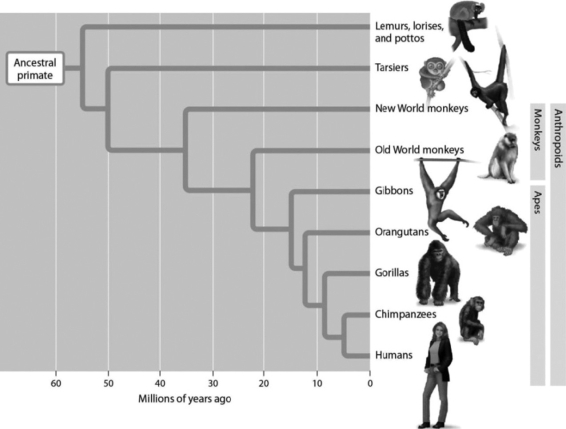 -The evolutionary tree indicates that humans and orangutans shared a common ancestor approximately ________.
 (Multiple Choice)
4.9/5 (79)
(79) ________ are characterized body tissues, radial symmetry, and tentacles with stinging cells.
(Multiple Choice)
4.7/5 (74)
(74) There are more species of ________ than of any other type of animal.
(Multiple Choice)
4.8/5 (71)
(71) All ________ exhibit the arthropod characteristic of multiple pairs of specialized appendages.
(Multiple Choice)
4.9/5 (76)
(76) A characteristic of arthropods that has allowed for their great success is the presence of ________.
(Multiple Choice)
4.8/5 (79)
(79) 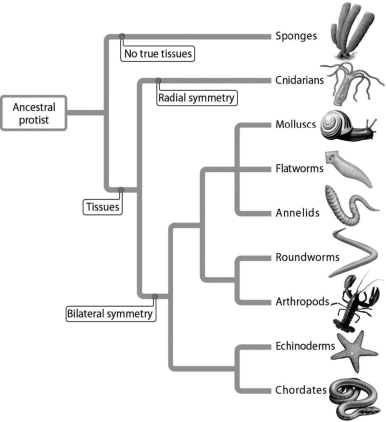 -The phylogenetic tree indicates that annelids are most closely related to ________.
 (Multiple Choice)
4.9/5 (79)
(79)
-The phylogenetic tree indicates that ________ demonstrate the most advanced body plan in reference to the presence of tissues and bilateral symmetry.
-The phylogenetic tree indicates that ________ demonstrate the most advanced body plan in reference to the presence of tissues and bilateral symmetry. (Multiple Choice)
4.8/5 (82)
(82) While on an archaeology expedition, you unearth a skeleton with the following characteristics: four long, slender finger bones and a smaller opposable thumb bone, long arm bones, fingernails, and eye sockets close together on a skull. What type of organism do you suspect you may have found?
(Multiple Choice)
4.9/5 (75)
(75) Which mode of nutrition characteristic distinguishes animals from other eukaryotes?
(Multiple Choice)
4.9/5 (70)
(70) A(n)________ is an example of a chordate that is not a vertebrate.
(Multiple Choice)
4.9/5 (70)
(70) You discover an organism that has scaly skin and is aquatic but returns to the land to reproduce. What else would you expect to find in this organism?
(Multiple Choice)
4.7/5 (77)
(77)
-The evolutionary indicates that if a new anthropoid specimen was discovered and estimated to be approximately 42 million years old, it would be characterized as ________.
-The evolutionary indicates that if a new anthropoid specimen was discovered and estimated to be approximately 42 million years old, it would be characterized as ________. (Multiple Choice)
4.9/5 (79)
(79) 
Filters
- Essay(0)
- Multiple Choice(0)
- Short Answer(0)
- True False(0)
- Matching(0)