



 Chat with AI
Exam 3: The Molecules of Life

Exam 1: Learning About Life45 Questions
Exam 2: Essential Chemistry for Biology50 Questions
Exam 3: The Molecules of Life56 Questions
Exam 4: A Tour of the Cell57 Questions
Exam 5: The Working Cell58 Questions
Exam 6: Cellular Respiration: Obtaining Energy From Food53 Questions
Exam 7: Photosynthesis: Using Light to Make Food52 Questions
Exam 8: Cellular Reproduction: Cells From Cells59 Questions
Exam 9: Patterns of Inheritance55 Questions
Exam 10: The Structure and Function of Dna59 Questions
Exam 11: How Genes Are Controlled55 Questions
Exam 12: Dna Technology54 Questions
Exam 13: How Populations Evolve52 Questions
Exam 14: How Biological Diversity Evolves47 Questions
Exam 15: The Evolution of Microbial Life59 Questions
Exam 16: The Evolution of Plants and Fungi56 Questions
Exam 17: The Evolution of Animals60 Questions
Exam 18: An Introduction to Ecology and the Biosphere56 Questions
Exam 19: Population Ecology52 Questions
Exam 20: Communities and Ecosystems63 Questions
Exam 21: Unifying Concepts of Animal Structure and Function57 Questions
Exam 22: Nutrition and Digestion67 Questions
Exam 23: Circulation and Respiration69 Questions
Exam 24: The Bodys Defenses59 Questions
Exam 25: Hormones53 Questions
Exam 26: Reproduction and Development59 Questions
Exam 27: Nervous, Sensory, and Locomotor Systems62 Questions
Exam 28: The Life of a Flowering Plant81 Questions
Exam 29: The Working Plant73 Questions
Select questions type


The female hormone progesterone (shown below)is involved in the menstrual cycle and pregnancy. Based on its structure, what type of macromolecule is progesterone? 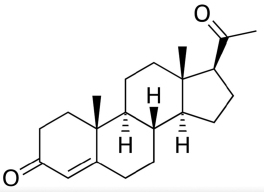
(Multiple Choice)
4.7/5  (82)
(82) What can you conclude about the following reaction?
galactose + glucose → lactose + water
(Multiple Choice)
4.9/5 (75)
(75) Which outcome is a health effect of a diet high in saturated fats?
(Multiple Choice)
4.9/5 (67)
(67) Plants use which molecule as an energy-storing carbohydrate?
(Multiple Choice)
4.8/5 (76)
(76) A single carbon atom can form a maximum of ________ covalent bond(s).
(Multiple Choice)
4.8/5 (90)
(90) In the following reaction, galactose is a ________.
galactose + glucose → lactose + water
(Multiple Choice)
4.9/5 (81)
(81) What is the name given to the reaction that breaks peptide bonds?
(Multiple Choice)
4.7/5 (79)
(79) The molecule CH3-CH2-CH2-CH2-CH2-CH2-CH3 is best described as a(n)________.
(Multiple Choice)
4.7/5 (75)
(75) What name is given to this reaction: galactose + glucose → lactose + water?
(Multiple Choice)
4.9/5 (81)
(81) A specific stretch of DNA that contains information for the amino acid sequence of a polypeptide is a(n)________.
(Multiple Choice)
4.8/5 (76)
(76) A protein's function is dependent on environmental factors such as pH and temperature. What property of the protein itself dictates a protein's function?
(Multiple Choice)
4.8/5 (68)
(68) Oleic acid is a fatty acid that occurs naturally in many animal and vegetable fats and oils. What can you tell about oleic acid just by looking at its structure? 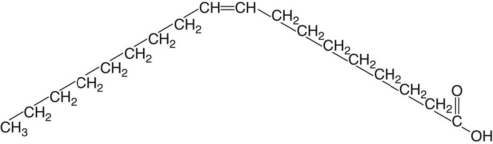
(Multiple Choice)
4.7/5 (69)
(69) A friend of yours appears to have put on a lot of muscle very quickly. At the same time, you notice that your friend seems to have a lot of mood swings and appears depressed. It is reasonable for you to suspect that your friend has begun to take ________.
(Multiple Choice)
4.8/5 (81)
(81) 
Filters
- Essay(0)
- Multiple Choice(0)
- Short Answer(0)
- True False(0)
- Matching(0)