



 Chat with AI
Exam 16: Gaining From International Trade

Exam 1: The Economic Approach225 Questions
Exam 2: Some Tools of the Economist239 Questions
Exam 3: Demand, Supply, and the Market Process408 Questions
Exam 4: Supply and Demand: Applications and Extensions270 Questions
Exam 5: Difficult Cases for the Market, and the Role of Government184 Questions
Exam 6: The Economics of Political Action208 Questions
Exam 7: Consumer Choice and Elasticity229 Questions
Exam 8: Costs and the Supply of Goods222 Questions
Exam 9: Price Takers and the Competitive Process261 Questions
Exam 10: Price-Searcher Markets With Low Entry Barriers232 Questions
Exam 11: Price-Searcher Markets With High Entry Barriers260 Questions
Exam 12: The Supply of and Demand for Productive Resources154 Questions
Exam 13: Earnings, Productivity, and the Job Market91 Questions
Exam 14: Investment, the Capital Market, and the Wealth of Nations106 Questions
Exam 15: Income Inequality and Poverty105 Questions
Exam 16: Gaining From International Trade179 Questions
Select questions type


Measured as a share of the economy, the size of the trade sector (exports plus imports) of the United States has
(Multiple Choice)
4.7/5  (87)
(87) Figure 17-12  -If the country illustrated in Figure 17-12 is initially trading without restrictions at a world price of $1.00, net welfare loss as a result of a tariff of $0.50 per unit is represented by area
 (Multiple Choice)
4.9/5 (77)
(77) Figure 17-9  -Refer to Figure 17-9. Before the tariff is imposed, this country
 (Multiple Choice)
4.8/5 (78)
(78) Figure 17-8  -Refer to Figure 17-8. With trade, this country
 (Multiple Choice)
4.7/5 (79)
(79) A U.S. trade policy that restricts the sale of foreign goods in the U.S. market will
(Multiple Choice)
4.8/5 (87)
(87) Suppose the United States exports cars to France and imports cheese from Switzerland. This situation suggests that
(Multiple Choice)
4.8/5 (82)
(82) When Iceland can generate a product using fewer labor hours and resources than the United States, an economist would say that Iceland had
(Multiple Choice)
4.9/5 (79)
(79) The following table indicates the production possibilities of cars and clothing per worker day in the United States and Japan. 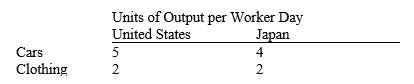 Which of the following is true?
 (Multiple Choice)
4.9/5 (80)
(80) Figure 17-12
-In Figure 17-12, with a tariff of $0.50 per unit and a world price of $1.00,
-In Figure 17-12, with a tariff of $0.50 per unit and a world price of $1.00, (Multiple Choice)
4.8/5 (67)
(67) What is the law of comparative advantage, and why is it important in international trade?
(Essay)
4.9/5 (81)
(81) Figure 17-6
The domestic country is China.  -Refer to Figure 17-6. With trade, China will
 (Multiple Choice)
4.8/5 (64)
(64) The argument that import restrictions save jobs and promote prosperity fails to recognize that
(Multiple Choice)
4.9/5 (88)
(88) Which of the following would be expected if the tariff on foreign-produced automobiles were increased?
(Multiple Choice)
4.9/5 (77)
(77) Relative to a no-trade situation, if the United States imported jeans, the U.S. domestic price of jeans would
(Multiple Choice)
4.8/5 (77)
(77) Figure 17-7
The domestic country is Jamaica.  -Refer to Figure 17-7. With trade, Jamaica
 (Multiple Choice)
4.8/5 (80)
(80) When both exports and imports are considered, the major advantage of international trade is that it allows us to
(Multiple Choice)
4.9/5 (80)
(80) Figure 17-10  -Refer to Figure 17-10. A result of the tariff is that, relative to the free-trade situation, the quantity of saddles imported decreases by
 (Multiple Choice)
4.8/5 (79)
(79) Figure 17-8
-Refer to Figure 17-8. With trade, the price of wagons in this country is
-Refer to Figure 17-8. With trade, the price of wagons in this country is (Multiple Choice)
4.8/5 (81)
(81) 
Filters
- Essay(0)
- Multiple Choice(0)
- Short Answer(0)
- True False(0)
- Matching(0)