



 Chat with AI
Exam 16: Gaining From International Trade

Exam 1: The Economic Approach225 Questions
Exam 2: Some Tools of the Economist239 Questions
Exam 3: Demand, Supply, and the Market Process408 Questions
Exam 4: Supply and Demand: Applications and Extensions270 Questions
Exam 5: Difficult Cases for the Market, and the Role of Government184 Questions
Exam 6: The Economics of Political Action208 Questions
Exam 7: Consumer Choice and Elasticity229 Questions
Exam 8: Costs and the Supply of Goods222 Questions
Exam 9: Price Takers and the Competitive Process261 Questions
Exam 10: Price-Searcher Markets With Low Entry Barriers232 Questions
Exam 11: Price-Searcher Markets With High Entry Barriers260 Questions
Exam 12: The Supply of and Demand for Productive Resources154 Questions
Exam 13: Earnings, Productivity, and the Job Market91 Questions
Exam 14: Investment, the Capital Market, and the Wealth of Nations106 Questions
Exam 15: Income Inequality and Poverty105 Questions
Exam 16: Gaining From International Trade179 Questions
Select questions type


Use the table below to answer the following question. The table outlines the production possibilities of Slavia and Italia for food and clothing. 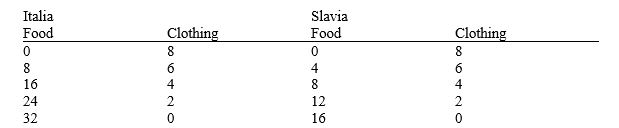 The law of comparative advantage suggests that
 (Multiple Choice)
4.7/5  (68)
(68) The primary source of purchasing power used to buy imported goods is
(Multiple Choice)
4.8/5 (75)
(75) If domestic producers have a comparative advantage in producing a good,
(Multiple Choice)
4.8/5 (86)
(86) If labor-intensive textile products could be produced more cheaply in low-wage countries than in the United States, the United States would gain if it
(Multiple Choice)
4.7/5 (88)
(88) Use the table below to answer the following question. The table outlines the production possibilities for two hypothetical countries. 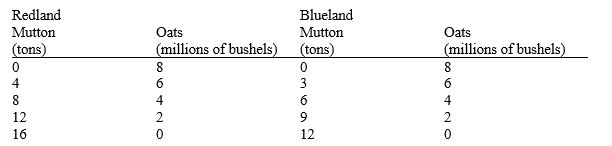 Which of the following statements is true?
 (Multiple Choice)
4.8/5 (75)
(75) Figure 17-10  -Refer to Figure 17-11. The deadweight loss created by the tariff is represented by the area
 (Multiple Choice)
4.9/5 (75)
(75) Suppose that in the absence of trade, the U.S. price for bicycles was higher than the world price for bicycles. Would allowing international trade mean that the United States would import or export bicycles? Who in the United States would benefit and who would lose with a free trade policy, and would the gains be greater than the losses?
(Essay)
4.9/5 (74)
(74) When a country allows trade and becomes an importer of steel,
(Multiple Choice)
4.8/5 (72)
(72) Figure 17-12  -If the country illustrated in Figure 17-12 is initially trading without restrictions at a world price of $1.00, the government revenue from a tariff of $0.50 per unit is represented by area
 (Multiple Choice)
4.8/5 (75)
(75) What are the effects of a tariff, and who benefits and who loses when tariffs are imposed? What are the effects of a quota, and who benefits and who loses when quotas are imposed?
(Essay)
4.8/5 (96)
(96) Which of the following is most likely to increase U.S. exports?
(Multiple Choice)
4.8/5 (70)
(70) Figure 17-8  -Refer to Figure 17-8. If this country allows free trade in wagons,
 (Multiple Choice)
4.9/5 (75)
(75) An import quota on a product protects domestic industries by
(Multiple Choice)
4.8/5 (90)
(90) People living in different countries can benefit from international trade because
(Multiple Choice)
4.9/5 (78)
(78) Countries that impose high tariffs, exchange rate controls, and other barriers that restrict international trade have, on average,
(Multiple Choice)
4.8/5 (73)
(73) If a country allows trade and, for a certain good, the domestic price without trade is higher than the world price,
(Multiple Choice)
5.0/5 (85)
(85) Assume the United States can use a given amount of its resources to produce either 20 airplanes or 8 automobiles and Japan can employ the same amount of its resources to produce either 20 airplanes or 10 automobiles. The U.S. should specialize in
(Multiple Choice)
4.9/5 (86)
(86) 
Filters
- Essay(0)
- Multiple Choice(0)
- Short Answer(0)
- True False(0)
- Matching(0)