



 Chat with AI
Exam 16: Gaining From International Trade

Exam 1: The Economic Approach225 Questions
Exam 2: Some Tools of the Economist239 Questions
Exam 3: Demand, Supply, and the Market Process408 Questions
Exam 4: Supply and Demand: Applications and Extensions270 Questions
Exam 5: Difficult Cases for the Market, and the Role of Government184 Questions
Exam 6: The Economics of Political Action208 Questions
Exam 7: Consumer Choice and Elasticity229 Questions
Exam 8: Costs and the Supply of Goods222 Questions
Exam 9: Price Takers and the Competitive Process261 Questions
Exam 10: Price-Searcher Markets With Low Entry Barriers232 Questions
Exam 11: Price-Searcher Markets With High Entry Barriers260 Questions
Exam 12: The Supply of and Demand for Productive Resources154 Questions
Exam 13: Earnings, Productivity, and the Job Market91 Questions
Exam 14: Investment, the Capital Market, and the Wealth of Nations106 Questions
Exam 15: Income Inequality and Poverty105 Questions
Exam 16: Gaining From International Trade179 Questions
Select questions type


Public choice theory indicates that tariffs, quotas, and other trade restrictions are primarily the result of the
(Multiple Choice)
4.9/5  (85)
(85) In 1993 the negotiations over the North American Free Trade Agreement and the General Agreement on Tariffs and Trade were frequently characterized by comments such as, "Free trade with low-wage countries will cause the wages of U.S. workers to fall." Identify the errors in statements such as this.
(Essay)
4.8/5 (75)
(75) Relative to a no-trade situation, if the United States exported chairs, the domestic price of chairs
(Multiple Choice)
4.8/5 (85)
(85) A decrease in the tariff on foreign-produced automobiles would be most likely to harm
(Multiple Choice)
4.9/5 (83)
(83) Compared to the no-trade situation, if the United States imports video games,
(Multiple Choice)
4.8/5 (86)
(86) Which of the following would be the most likely long-run effect if the United States increased its tariff rates and adopted stricter import quotas?
(Multiple Choice)
4.7/5 (56)
(56) If tariffs are decreased, the long-run effect is most likely to be
(Multiple Choice)
4.7/5 (80)
(80) At one time, it was believed that the way for a nation to prosper was to export as much as possible while importing as little as possible. More money would flow into a country than out of a country. Is this really a sound economic strategy? What is the relationship between exports and imports?
(Essay)
4.9/5 (81)
(81) Figure 17-8 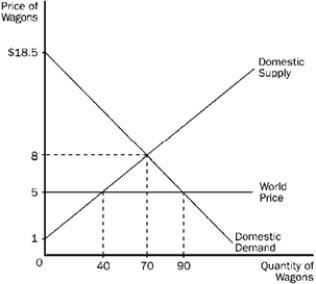 -Refer to Figure 17-8. If this country allows free trade in wagons,
 (Multiple Choice)
4.9/5 (91)
(91) If a country allows trade and, for a certain good, the domestic price without trade is lower than the world price,
(Multiple Choice)
5.0/5 (76)
(76) Figure 17-10 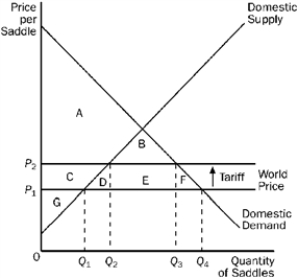 -Refer to Figure 17-10. Consumer surplus with the tariff is
 (Multiple Choice)
4.7/5 (94)
(94) Fixing exchange rates and limiting the convertibility of currency will
(Multiple Choice)
4.8/5 (81)
(81) The law of comparative advantage explains why a nation will benefit from trade when
(Multiple Choice)
4.9/5 (79)
(79) The primary benefits derived from tariffs usually accrue to the
(Multiple Choice)
4.8/5 (84)
(84) An increase in the tariff on foreign-produced automobiles would most likely help
(Multiple Choice)
4.8/5 (86)
(86) According to international trade theory, a country can gain
(Multiple Choice)
5.0/5 (82)
(82) 
Filters
- Essay(0)
- Multiple Choice(0)
- Short Answer(0)
- True False(0)
- Matching(0)