



 Chat with AI
Exam 15: Nutrition: You Are What You Eat

Exam 1: What Is Life55 Questions
Exam 2: Where Do We Come From and Where Do We Fit54 Questions
Exam 3: Everyday Chemistry of Life67 Questions
Exam 4: Cells: Organization and Communication65 Questions
Exam 5: Tissues54 Questions
Exam 6: The Skeletomuscular System107 Questions
Exam 7: The Nervous System78 Questions
Exam 8: The Special Senses53 Questions
Exam 9: Immunity and the Lymphatic System72 Questions
Exam 10: Infectious Disease and Epidemiology55 Questions
Exam 11: The Human Microbiome52 Questions
Exam 12: Cancer59 Questions
Exam 13: The Cardiovascular System63 Questions
Exam 14: The Respiratory System: Movement of Air63 Questions
Exam 15: Nutrition: You Are What You Eat53 Questions
Exam 16: The Digestive System55 Questions
Exam 17: The Urinary System56 Questions
Exam 18: The Endocrine System and Development54 Questions
Exam 19: The Reproductive Systems: Maintaining the Species58 Questions
Exam 20: Pregnancy: Development From Conception to Newborn58 Questions
Exam 21: Inheritance, Genetics, and Molecular Biology54 Questions
Select questions type


ATP is only produced in the electron transport chain.

Free
(True/False)
4.9/5  (76)
(76) Correct Answer: Verified
False
List and describe the five pathogens described in the text that cause food poisoning.
Free
(Essay)
4.7/5 (96)
(96) Correct Answer:Verified
Verified1. Campylobacter found in uncooked poultry causes common bacterial diarrhea.
2. Salmonella found in birds, reptiles and mammals causes food poisoning but can also enter the blood stream and cause septicemia.
3. E. coli is a common bacterium, however one strain 0157:H7 can cause bloody diarrhea. In some cases this infection can lead to hemolytic uremic syndrome.
4. Norwalk type virus causes vomiting.
5. Stomach flu is a virus that also causes vomiting.
Which of the following is the most energy-liberating step? 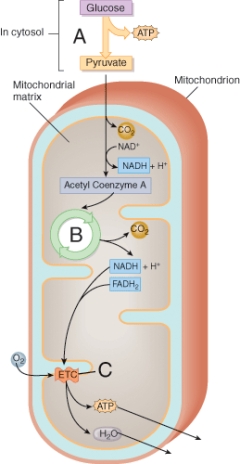
Free
(Multiple Choice)
4.8/5 (74)
(74) Correct Answer:Verified
VerifiedC
_____________ is the bacteria, that usually causes food poisoning symptoms.
(Short Answer)
5.0/5 (68)
(68) Carbohydrates are not lipid soluble and are carried by a protein in the blood.
(True/False)
4.9/5 (66)
(66) High-density lipoproteins (HDLs) are called "good" because they remove cholesterol from the body.
(True/False)
4.9/5 (79)
(79) After eating oysters you develop the symptoms of food poisoning. Which infectious agent might you suspect?
(Multiple Choice)
4.8/5 (72)
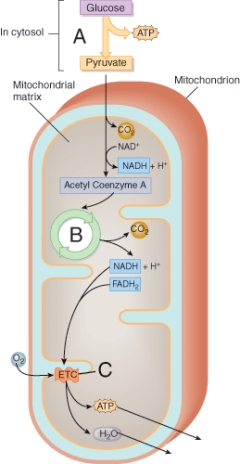
(72) 
Vitamin A is a fat-soluble vitamin that is essential for vision.
(True/False)
4.8/5 (70)
(70) Once our dietary protein requirements have been met, eating more protein won't add more muscle mass.
(True/False)
4.7/5 (71)
(71) More Americans suffer from bulimia nervosa than suffer from obesity.
(True/False)
4.9/5 (90)
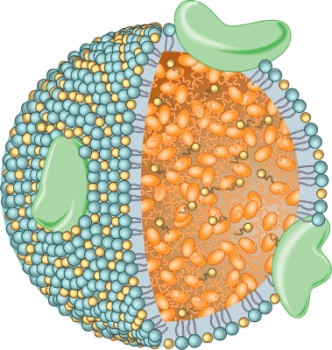
(90) 
Use the body mass index to determine which number would represent the BMI for a person who is at a healthy weight? 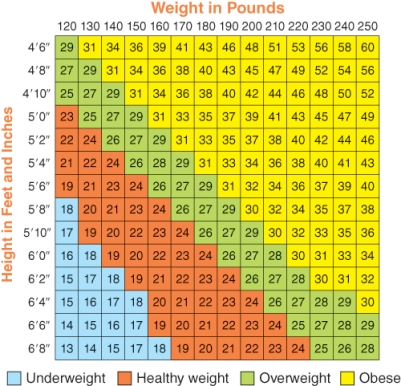
(Multiple Choice)
4.7/5 (77)
(77) In developing nations recently weaned children with bloated bellies are suffering from a deficiency of which nutrient?
(Multiple Choice)
4.9/5 (77)
(77) 
Filters
- Essay(0)
- Multiple Choice(0)
- Short Answer(0)
- True False(0)
- Matching(0)