



 Chat with AI
Exam 4: Cells: Organization and Communication

Exam 1: What Is Life55 Questions
Exam 2: Where Do We Come From and Where Do We Fit54 Questions
Exam 3: Everyday Chemistry of Life67 Questions
Exam 4: Cells: Organization and Communication65 Questions
Exam 5: Tissues54 Questions
Exam 6: The Skeletomuscular System107 Questions
Exam 7: The Nervous System78 Questions
Exam 8: The Special Senses53 Questions
Exam 9: Immunity and the Lymphatic System72 Questions
Exam 10: Infectious Disease and Epidemiology55 Questions
Exam 11: The Human Microbiome52 Questions
Exam 12: Cancer59 Questions
Exam 13: The Cardiovascular System63 Questions
Exam 14: The Respiratory System: Movement of Air63 Questions
Exam 15: Nutrition: You Are What You Eat53 Questions
Exam 16: The Digestive System55 Questions
Exam 17: The Urinary System56 Questions
Exam 18: The Endocrine System and Development54 Questions
Exam 19: The Reproductive Systems: Maintaining the Species58 Questions
Exam 20: Pregnancy: Development From Conception to Newborn58 Questions
Exam 21: Inheritance, Genetics, and Molecular Biology54 Questions
Select questions type


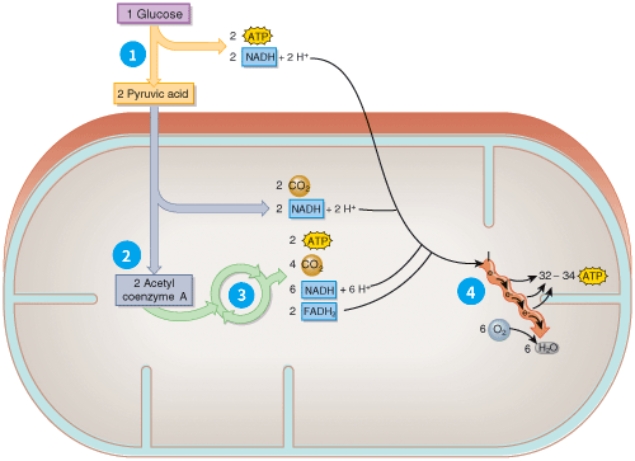
What process is demonstrated here? Give a brief description of the events in each of the four stages of this process. 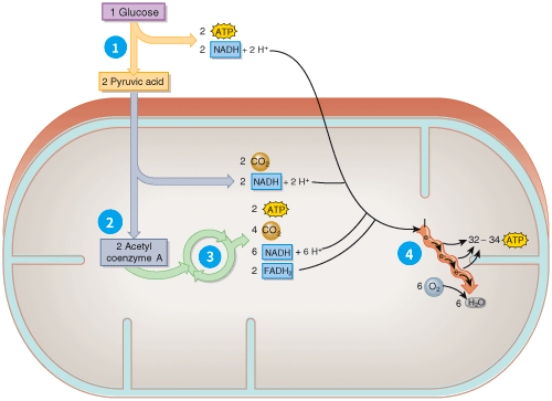

Free
(Essay)
4.9/5  (76)
(76) Correct Answer: Verified
1. Glycolysis in cytosol breaks glucose into pyruvate.
2. Pyruvate enters mitochondria and is converted to Acetyl CoA.
3. Acetyl CoA enters the Krebs Cycle producing ATP, NADH, FADH2, CO2.
4. Electrons and protons from steps 1-3 enter the Electron Transport Chain producing 32-34 ATP, and water. Oxygen is used here as the final electron acceptor.
In the diagram of the cell shown here, what is the function of the structure labeled B? 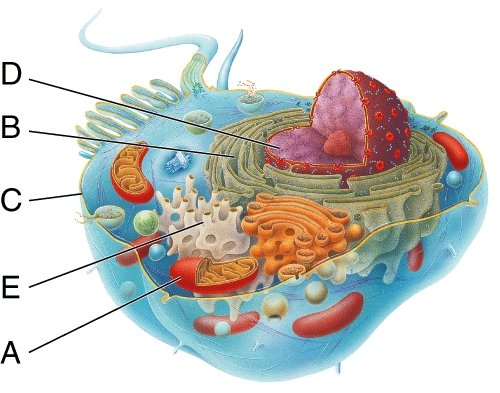
Free
(Multiple Choice)
4.8/5 (85)
(85) Correct Answer:Verified
VerifiedD
What form of transport uses energy and moves molecules against or "up" their concentration gradient?
Free
(Multiple Choice)
4.7/5 (81)
(81) Correct Answer:Verified
VerifiedD
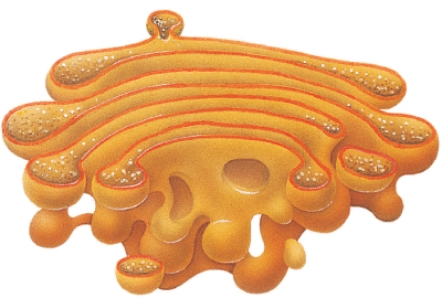
The organelle responsible for the conversion of the pollywog to a frog (the loss of the tadpole's tail) is the:
(Multiple Choice)
4.9/5 (79)
(79) The process of forming RNA copies of nuclear DNA is called _______________.
(Short Answer)
4.9/5 (95)
(95) __________ cells lack a distinct nucleus and organelles.
Answer
(Short Answer)
4.8/5 (71)
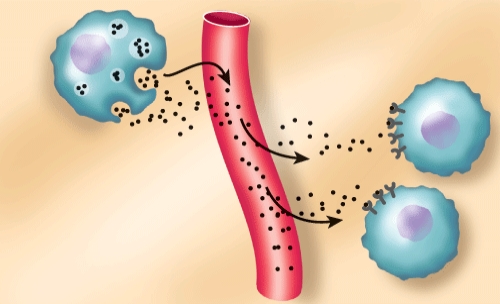
(71) Paracrines, secretions produced in one area of the body, travel to and alter the physiological activity of remote cells.
(True/False)
4.8/5 (73)
(73) 
In the diagram of the cell shown here, the organelle responsible for ATP production is labeled as: 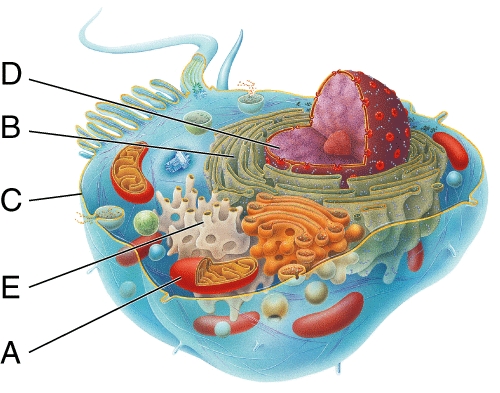
(Multiple Choice)
4.9/5 (85)
(85) The arrow is pointing to the region where the two chromosome arms are held together. This is referred to as the ______. 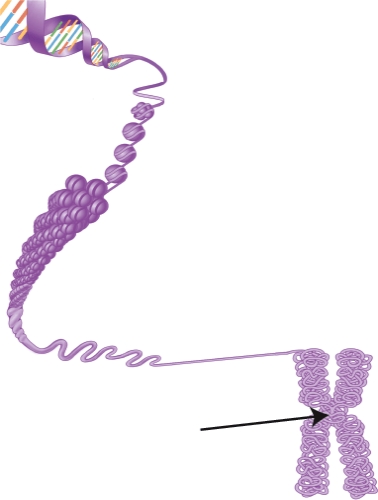
(Multiple Choice)
4.9/5 (71)
(71) The movement of water from an area of high concentration to an area of low concentration is called:
(Multiple Choice)
4.7/5 (80)
(80) Cilia are long whip-like structures that propel the cell forward.
(True/False)
4.7/5 (81)
(81) 

Filters
- Essay(0)
- Multiple Choice(0)
- Short Answer(0)
- True False(0)
- Matching(0)