



 Chat with AI
Exam 18: Gaining From International Trade

Exam 1: The Economic Approach164 Questions
Exam 2: Some Tools of the Economist200 Questions
Exam 3: Demand, Supply, and the Market Process336 Questions
Exam 4: Supply and Demand: Applications and Extensions254 Questions
Exam 5: Difficult Cases for the Market, and the Role of Government130 Questions
Exam 6: The Economics of Political Action154 Questions
Exam 7: Taking the Nations Economic Pulse214 Questions
Exam 8: Economic Fluctuations, Unemployment, and Inflation174 Questions
Exam 9: An Introduction to Basic Macroeconomic Markets219 Questions
Exam 10: Dynamic Change, Economic Fluctuations, and the Ad-As Model189 Questions
Exam 11: Fiscal Policy: the Keynesian View and the Historical Development of Macroeconomics109 Questions
Exam 12: Fiscal Policy, Incentives, and Secondary Effects146 Questions
Exam 13: Money and the Banking System209 Questions
Exam 14: Modern Macroeconomics and Monetary Policy192 Questions
Exam 15: Stabilization Policy, Output, and Employment148 Questions
Exam 16: Creating an Environment for Growth and Prosperity120 Questions
Exam 17: Institutions, Policies, and Cross-Country Differences in Income and Growth111 Questions
Exam 18: Gaining From International Trade170 Questions
Exam 19: International Finance and the Foreign Exchange Market148 Questions
Select questions type


During the last several decades, the size of the trade sector (exports plus imports) of the United States has been
(Multiple Choice)
4.8/5  (82)
(82) According to public choice theory, tariffs, quotas, and other trade restrictions are primarily the result of the
(Multiple Choice)
4.7/5 (80)
(80) Suppose that in the absence of trade, the U.S. price for bicycles was higher than the world price for bicycles. Would allowing international trade mean that the United States would import or export bicycles? Who in the United States would benefit and who would lose with a free trade policy, and would the gains be greater than the losses?
(Essay)
4.9/5 (66)
(66) Figure 17-10 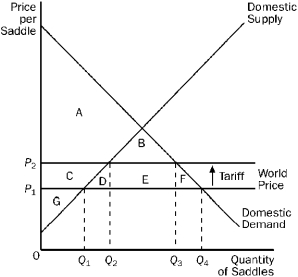 -Refer to Figure 17-10. With trade and without a tariff, the price and domestic quantity demanded are
 (Multiple Choice)
4.9/5 (77)
(77) The primary source of purchasing power used to buy imported goods is
(Multiple Choice)
4.9/5 (74)
(74) A major difference between a tariff and a quota is that a tariff
(Multiple Choice)
4.7/5 (77)
(77) The main problem with using the infant industries argument to justify protecting an industry from foreign competition is that
(Multiple Choice)
4.9/5 (71)
(71) Each trading nation can gain by specializing in producing those things for which it is a low-opportunity cost producer. This statement best describes the implications of the
(Multiple Choice)
4.8/5 (83)
(83) Figure 17-10
-Refer to Figure 17-10. With the tariff, the domestic price and domestic quantity demanded are
-Refer to Figure 17-10. With the tariff, the domestic price and domestic quantity demanded are (Multiple Choice)
5.0/5 (90)
(90) Public choice theory indicates that tariffs, quotas, and other trade restrictions are primarily the result of the
(Multiple Choice)
4.7/5 (70)
(70) Which of the following has resulted from the North American Free Trade Agreement (NAFTA)?
(Multiple Choice)
4.8/5 (85)
(85) Data on trade barriers and the growth of per capita GDP indicate that
(Multiple Choice)
4.9/5 (88)
(88) Which of the following is a partially valid economic argument for restricting free trade?
(Multiple Choice)
4.9/5 (75)
(75) A U.S. trade policy that restricts the sale of foreign goods in the U.S. market will
(Multiple Choice)
4.9/5 (86)
(86) Compared to the no-trade situation, when a country exports a good,
(Multiple Choice)
4.9/5 (67)
(67) Trade restrictions that limit the sale of low-price foreign goods in the U.S. market
(Multiple Choice)
4.8/5 (66)
(66) 
Filters
- Essay(0)
- Multiple Choice(0)
- Short Answer(0)
- True False(0)
- Matching(0)