



 Chat with AI
Exam 18: Gaining From International Trade

Exam 1: The Economic Approach164 Questions
Exam 2: Some Tools of the Economist200 Questions
Exam 3: Demand, Supply, and the Market Process336 Questions
Exam 4: Supply and Demand: Applications and Extensions254 Questions
Exam 5: Difficult Cases for the Market, and the Role of Government130 Questions
Exam 6: The Economics of Political Action154 Questions
Exam 7: Taking the Nations Economic Pulse214 Questions
Exam 8: Economic Fluctuations, Unemployment, and Inflation174 Questions
Exam 9: An Introduction to Basic Macroeconomic Markets219 Questions
Exam 10: Dynamic Change, Economic Fluctuations, and the Ad-As Model189 Questions
Exam 11: Fiscal Policy: the Keynesian View and the Historical Development of Macroeconomics109 Questions
Exam 12: Fiscal Policy, Incentives, and Secondary Effects146 Questions
Exam 13: Money and the Banking System209 Questions
Exam 14: Modern Macroeconomics and Monetary Policy192 Questions
Exam 15: Stabilization Policy, Output, and Employment148 Questions
Exam 16: Creating an Environment for Growth and Prosperity120 Questions
Exam 17: Institutions, Policies, and Cross-Country Differences in Income and Growth111 Questions
Exam 18: Gaining From International Trade170 Questions
Exam 19: International Finance and the Foreign Exchange Market148 Questions
Select questions type


Figure 17-9 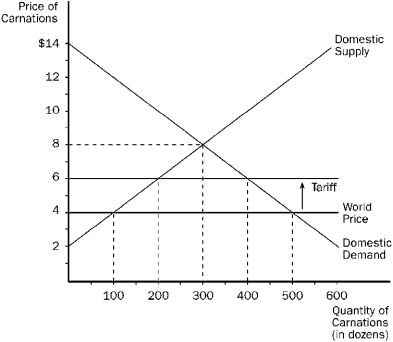 -Refer to Figure 17-9. The amount of revenue collected by the government from the tariff is
 (Multiple Choice)
4.8/5  (70)
(70) When the nation of Venezia allows trade and as a result becomes an exporter of shoes,
(Multiple Choice)
4.8/5 (59)
(59) The United States is the world's leading grain-producing nation. Exporting U.S. grain causes the
(Multiple Choice)
4.9/5 (85)
(85) Which of the following would be expected if the tariff on foreign-produced shoes were decreased?
(Multiple Choice)
4.8/5 (71)
(71) What is the law of comparative advantage, and why is it important in international trade?
(Essay)
4.9/5 (85)
(85) Figure 17-13 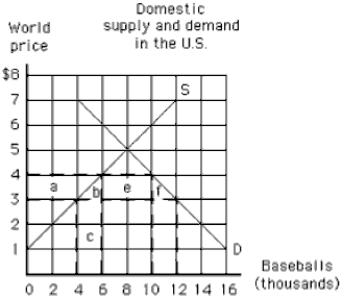 -In Figure 17-13, if the world price of a baseball is $3 and a tariff of $1 per baseball is imposed in the United States, how much tariff revenue will the United States government collect?
 (Multiple Choice)
5.0/5 (78)
(78) When a country fixes the price of foreign exchange (in terms of the domestic currency) below equilibrium, which of the following will result?
(Multiple Choice)
4.7/5 (89)
(89) The argument that import restrictions save jobs and promote prosperity fails to recognize that
(Multiple Choice)
4.7/5 (77)
(77) For each watch Denmark produces, it gives up the opportunity to make 50 pounds of cheese. Germany can produce one watch for every 100 pounds of cheese it produces. Which of the following is true with regard to opportunity costs in the two countries?
(Multiple Choice)
4.9/5 (74)
(74) Assume, for Canada, that the domestic price of steel without international trade is higher than the world price of steel. This suggests that with trade,
(Multiple Choice)
4.7/5 (86)
(86) If labor-intensive textile products could be produced more cheaply in low-wage countries than in the United States, the United States would gain if it
(Multiple Choice)
5.0/5 (85)
(85) When the nation of Roma allows trade and as a result becomes an importer of scooters,
(Multiple Choice)
4.8/5 (79)
(79) Which of the following would be expected if the tariff on foreign-produced automobiles were increased?
(Multiple Choice)
4.7/5 (93)
(93) "Trade restrictions will stop foreign imports, which will increase American employment and protect American jobs." Most economists realize this argument is wrong. Can you explain why?
(Essay)
4.9/5 (72)
(72) International trade is advantageous because trade makes it possible for people in each country to
(Multiple Choice)
4.9/5 (78)
(78) Which of the following is a partially valid economic argument for restricting free trade?
(Multiple Choice)
4.8/5 (82)
(82) 
Filters
- Essay(0)
- Multiple Choice(0)
- Short Answer(0)
- True False(0)
- Matching(0)