



 Chat with AI
Exam 18: Gaining From International Trade

Exam 1: The Economic Approach164 Questions
Exam 2: Some Tools of the Economist200 Questions
Exam 3: Demand, Supply, and the Market Process336 Questions
Exam 4: Supply and Demand: Applications and Extensions254 Questions
Exam 5: Difficult Cases for the Market, and the Role of Government130 Questions
Exam 6: The Economics of Political Action154 Questions
Exam 7: Taking the Nations Economic Pulse214 Questions
Exam 8: Economic Fluctuations, Unemployment, and Inflation174 Questions
Exam 9: An Introduction to Basic Macroeconomic Markets219 Questions
Exam 10: Dynamic Change, Economic Fluctuations, and the Ad-As Model189 Questions
Exam 11: Fiscal Policy: the Keynesian View and the Historical Development of Macroeconomics109 Questions
Exam 12: Fiscal Policy, Incentives, and Secondary Effects146 Questions
Exam 13: Money and the Banking System209 Questions
Exam 14: Modern Macroeconomics and Monetary Policy192 Questions
Exam 15: Stabilization Policy, Output, and Employment148 Questions
Exam 16: Creating an Environment for Growth and Prosperity120 Questions
Exam 17: Institutions, Policies, and Cross-Country Differences in Income and Growth111 Questions
Exam 18: Gaining From International Trade170 Questions
Exam 19: International Finance and the Foreign Exchange Market148 Questions
Select questions type


Figure 17-13 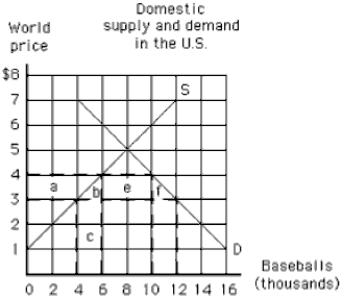 -Figure 17-13 shows domestic supply and demand for baseballs in the United States. The world price of a baseball is $3. With free trade, how many baseballs will be purchased in the United States?
 (Multiple Choice)
4.8/5  (74)
(74) Figure 17-10 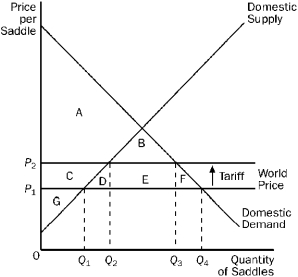 -Refer to Figure 17-10. A result of the tariff is that, relative to the free-trade situation, the quantity of saddles imported decreases by
 (Multiple Choice)
4.7/5 (82)
(82) Which of the following has resulted from the North American Free Trade Agreement (NAFTA)?
(Multiple Choice)
4.7/5 (92)
(92) Suppose the United States exports cars to France and imports cheese from Switzerland. This situation suggests that
(Multiple Choice)
4.8/5 (82)
(82) The law of comparative advantage explains why a nation will benefit from trade when
(Multiple Choice)
4.8/5 (73)
(73) Opening trade between a nation that has "cheap labor" and one that has "expensive labor" will
(Multiple Choice)
4.7/5 (71)
(71) Suppose there are only two goods in the world, corn and shirts. If it is true that with its vast resources the United States could produce both more corn and more shirts than Mexico,
(Multiple Choice)
4.9/5 (84)
(84) Figure 17-10
-Refer to Figure 17-10. With the tariff, the quantity of saddles imported is
-Refer to Figure 17-10. With the tariff, the quantity of saddles imported is (Multiple Choice)
4.8/5 (65)
(65) Imposing a restrictive quota on imported plasma TVs will likely
(Multiple Choice)
4.9/5 (86)
(86) Which of the following provides the foundation of the case for free trade?
(Multiple Choice)
4.9/5 (82)
(82) Use the table below to answer the following question. The table outlines the production possibilities of Slavia and Italia for food and clothing.  Which of the following is true?
 (Multiple Choice)
4.8/5 (89)
(89) Figure 17-5 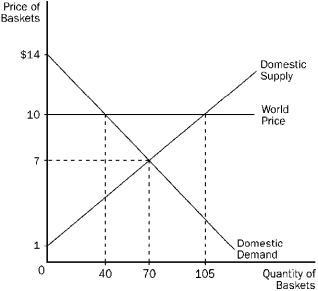 -Refer to Figure 17-5. With free trade, this country will
 (Multiple Choice)
4.8/5 (71)
(71) Figure 17-6
The domestic country is China. 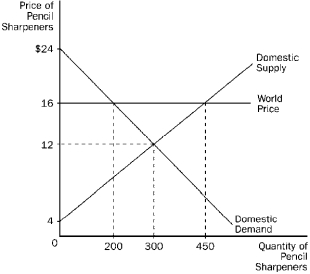 -Refer to Figure 17-6. With trade, China will
 (Multiple Choice)
4.7/5 (86)
(86) Figure 17-9 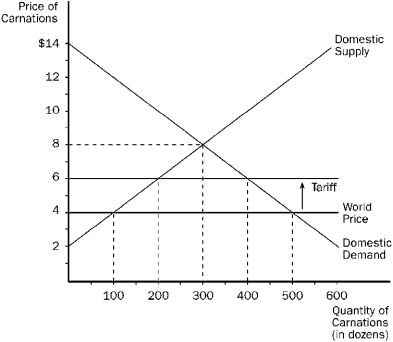 -Refer to Figure 17-9. Without trade, the equilibrium price of carnations is
 (Multiple Choice)
4.9/5 (85)
(85) Which of the following has occurred since the North American Free Trade Agreement (NAFTA) took affect in 1994?
(Multiple Choice)
4.9/5 (78)
(78) "Economists have demonstrated that imports benefit consumers while causing losses to producers, and exports benefit producers while causing losses to consumers. In the balance then, international trade neither benefits nor hurts a nation as a whole." Evaluate this statement.
(Essay)
4.9/5 (84)
(84) 
Filters
- Essay(0)
- Multiple Choice(0)
- Short Answer(0)
- True False(0)
- Matching(0)