



 Chat with AI
Exam 18: Gaining From International Trade

Exam 1: The Economic Approach164 Questions
Exam 2: Some Tools of the Economist200 Questions
Exam 3: Demand, Supply, and the Market Process336 Questions
Exam 4: Supply and Demand: Applications and Extensions254 Questions
Exam 5: Difficult Cases for the Market, and the Role of Government130 Questions
Exam 6: The Economics of Political Action154 Questions
Exam 7: Taking the Nations Economic Pulse214 Questions
Exam 8: Economic Fluctuations, Unemployment, and Inflation174 Questions
Exam 9: An Introduction to Basic Macroeconomic Markets219 Questions
Exam 10: Dynamic Change, Economic Fluctuations, and the Ad-As Model189 Questions
Exam 11: Fiscal Policy: the Keynesian View and the Historical Development of Macroeconomics109 Questions
Exam 12: Fiscal Policy, Incentives, and Secondary Effects146 Questions
Exam 13: Money and the Banking System209 Questions
Exam 14: Modern Macroeconomics and Monetary Policy192 Questions
Exam 15: Stabilization Policy, Output, and Employment148 Questions
Exam 16: Creating an Environment for Growth and Prosperity120 Questions
Exam 17: Institutions, Policies, and Cross-Country Differences in Income and Growth111 Questions
Exam 18: Gaining From International Trade170 Questions
Exam 19: International Finance and the Foreign Exchange Market148 Questions
Select questions type


Assume the United States can use a given amount of its resources to produce either 20 airplanes or 8 automobiles and Japan can employ the same amount of its resources to produce either 20 airplanes or 10 automobiles. The U.S. should specialize in
(Multiple Choice)
4.7/5  (77)
(77) An increase in the tariff on foreign-produced automobiles would most likely help
(Multiple Choice)
4.8/5 (88)
(88) In 1993 the negotiations over the North American Free Trade Agreement and the General Agreement on Tariffs and Trade were frequently characterized by comments such as, "Free trade with low-wage countries will cause the wages of U.S. workers to fall." Identify the errors in statements such as this.
(Essay)
4.9/5 (72)
(72) If tariffs are decreased, the long-run effect is most likely to be
(Multiple Choice)
4.9/5 (84)
(84) If the U.S. put an import quota on clothes dryers, it would
(Multiple Choice)
4.8/5 (82)
(82) Which of the following restricts the volume of international trade?
(Multiple Choice)
4.8/5 (66)
(66) Figure 17-8 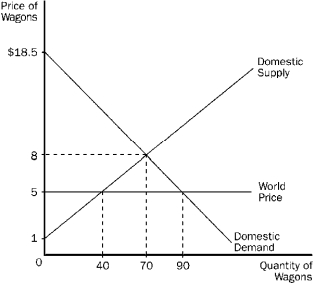 -Refer to Figure 17-8. With trade, the price of wagons in this country is
 (Multiple Choice)
4.7/5 (83)
(83) According to international trade theory, a country can gain if it
(Multiple Choice)
4.7/5 (71)
(71) A decrease in the tariff on foreign-produced automobiles would be most likely to harm
(Multiple Choice)
4.8/5 (74)
(74) The primary benefits derived from tariffs usually accrue to the
(Multiple Choice)
4.9/5 (94)
(94) The primary source of purchasing power used to buy imported goods is the
(Multiple Choice)
4.9/5 (89)
(89) Figure 17-9 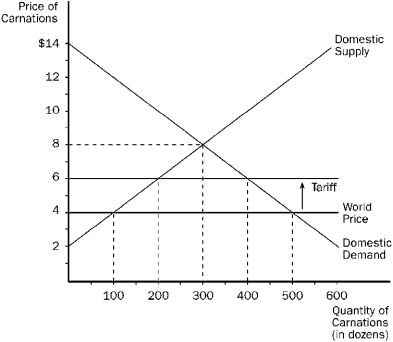 -Refer to Figure 17-9. The imposition of a tariff on carnations
 (Multiple Choice)
4.8/5 (66)
(66) Globalization is becoming more of a worldwide phenomenon because
(Multiple Choice)
4.9/5 (94)
(94) Figure 17-12  -If the country illustrated in Figure 17-12 is initially trading without restrictions at a world price of $1.00, net welfare loss as a result of a tariff of $0.50 per unit is represented by area
 (Multiple Choice)
4.8/5 (79)
(79) When a country allows trade and becomes an exporter of a good,
(Multiple Choice)
4.8/5 (70)
(70) Assume, for the U.S., that the domestic price of beef without international trade is lower than the world price of beef. This suggests that with trade,
(Multiple Choice)
4.9/5 (86)
(86) Figure 17-12
-If the country illustrated in Figure 17-12 is initially trading without restrictions at a world price of $1.00, the loss of consumer surplus as a result of a tariff of $0.50 per unit is represented by area
-If the country illustrated in Figure 17-12 is initially trading without restrictions at a world price of $1.00, the loss of consumer surplus as a result of a tariff of $0.50 per unit is represented by area (Multiple Choice)
4.9/5 (83)
(83) Firms in a high-wage nation such as the U.S. can compete effectively with imports from low-wage nations if
(Multiple Choice)
4.8/5 (70)
(70) 
Filters
- Essay(0)
- Multiple Choice(0)
- Short Answer(0)
- True False(0)
- Matching(0)