



 Chat with AI
Exam 13: Six Sigma Management and Lean Tools

Exam 1: Differing Perspectives on Quality111 Questions
Exam 2: Quality Theory101 Questions
Exam 3: Global Supply Chain Quality and International Quality Standards103 Questions
Exam 4: Strategic Quality Planning104 Questions
Exam 5: The Voice of the Customer100 Questions
Exam 6: The Voice of the Market102 Questions
Exam 7: Quality and Innovation in Product and Process Design101 Questions
Exam 8: Designing Quality Services104 Questions
Exam 9: Managing Supplier Quality in the Supply Chain77 Questions
Exam 10: The Tools of Quality98 Questions
Exam 11: Statistically Based Quality Improvement for Variables99 Questions
Exam 12: Statistically Based Quality Improvement for Attributes100 Questions
Exam 13: Six Sigma Management and Lean Tools101 Questions
Exam 14: Managing Quality Improvement Teams and Projects101 Questions
Exam 15: Implementing and Validating the Quality System96 Questions
Select questions type


A project risk assessment is a method for evaluating a potential project.
(True/False)
4.7/5  (82)
(82) The measure phase involves two major steps, selecting process outcomes and verifying measurements.
(True/False)
4.7/5 (78)
(78) The goal of the ________ step is to use visual and statistical tools to better understand the relationships between dependent and independent variables.
(Multiple Choice)
4.9/5 (84)
(84) ________ get information from a variety of sources such as the voice of the business, the voice of the customer, and the voice of the employee for potential project ideas.
(Multiple Choice)
4.8/5 (82)
(82) The Pitman arm on a car costs $105 to repair. Compute the quality loss function for losses incurred as a result of deviation from a target where a tolerance of 10 plus or minus 0.75 is required and the mean squared deviation (V) from the target is (0.025)2.
(Multiple Choice)
4.9/5 (74)
(74) A Taguchi experiment is to be performed on the effects of lift, bore, stroke, and compression on engine performance with horsepower as the outcome variable. The factors were tested at each of the following levels in hopes of improving engine horsepower.
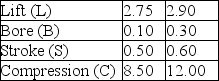 The following experiment was used and the results of all trials are as follows:
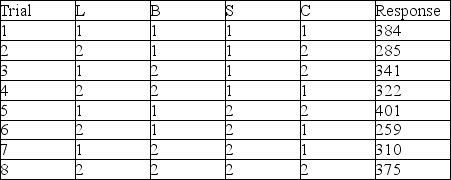 Determine the best levels for each factor and state your conclusions.
The following experiment was used and the results of all trials are as follows:
Determine the best levels for each factor and state your conclusions. (Essay)
4.8/5 (73)
(73) Parameter design refers to the selection of control factors and the determination of optimal levels for each of the factors.
(True/False)
4.7/5 (78)
(78) Hypothesis tests, design of experiments, simulation, and piloting and testing are the tools used in the ________ stage of the DMAIC process.
(Multiple Choice)
4.9/5 (87)
(87) ________ is used to determine if measurements are consistent.
(Multiple Choice)
4.9/5 (102)
(102) The Taguchi constant for flooring materials is known to be $50/cm sq. and the cost to repair them is $300. What is the tolerance interval?
(Multiple Choice)
4.8/5 (68)
(68) The process of developing specification limits is known as ________.
(Multiple Choice)
5.0/5 (87)
(87) Offline experimentation is performed during the ________ phase.
(Multiple Choice)
4.9/5 (78)
(78) The Taguchi constant for flooring materials is known to be $30/cm sq. and the cost to repair them is $325. What is the tolerance interval?
(Multiple Choice)
4.8/5 (60)
(60) A process that meets the statistical notion of Six Sigma produces 3.4 defects per million pieces produced.
(True/False)
4.8/5 (70)
(70) The sigma in Six Sigma refers to the Greek symbol that designates a mean in statistics.
(True/False)
4.9/5 (84)
(84) Which step in the analyze phase of DMAIC involves determining what characteristics of the process need to be changed to achieve improvement?
(Multiple Choice)
4.7/5 (76)
(76) ________ is focused on final engineering design optimization.
(Multiple Choice)
4.9/5 (77)
(77) 
Filters
- Essay(0)
- Multiple Choice(0)
- Short Answer(0)
- True False(0)
- Matching(0)