



 Chat with AI
Exam 13: The Lives of Stars From Birth Through Middle Age

Exam 1: Discovering the Night Sky374 Questions
Exam 2: Gravitation and the Motion of the Planets356 Questions
Exam 3: Light and Telescopes275 Questions
Exam 4: Atomic Physics and Spectra223 Questions
Exam 5: Exoplanets and the Formation of Planetary Systems98 Questions
Exam 6: Formation of the Solar System121 Questions
Exam 7: Earth and the Moon305 Questions
Exam 8: The Other Terrestrial Planets265 Questions
Exam 9: The Outer Planets360 Questions
Exam 10: Vagabonds of the Solar System198 Questions
Exam 11: The Sun: Our Extraordinary Star248 Questions
Exam 12: Characterizing Stars254 Questions
Exam 13: The Lives of Stars From Birth Through Middle Age325 Questions
Exam 14: The Death of Stars235 Questions
Exam 15: Black Holes: Matters of Gravity178 Questions
Exam 16: The Milky Way Galaxy157 Questions
Exam 17: Galaxies207 Questions
Exam 18: Quasars and Other Active Galaxies118 Questions
Exam 19: Cosmology217 Questions
Exam 20: Astrobiology71 Questions
Select questions type


Which of these astronomical objects or systems is likely to be the oldest?
(Multiple Choice)
4.9/5  (85)
(85) How have complex molecules such as formaldehyde (H2CO) been detected in interstellar clouds?
(Multiple Choice)
4.8/5 (86)
(86) What are the main general features that make clusters of stars useful to astronomers?
(Multiple Choice)
4.9/5 (80)
(80) What is the "safety valve" that operates in normal (nondegenerate) stars?
(Multiple Choice)
4.8/5 (102)
(102) Why does the Hertzsprung-Russell diagram of a globular cluster NOT contain any stars with high luminosity and high temperature on the main sequence?
(Multiple Choice)
4.9/5 (87)
(87) The Horsehead Nebula in Orion (see Figure 13-5 in the text) is a distinct dark region surrounded by brighter regions. The Horsehead is an example of 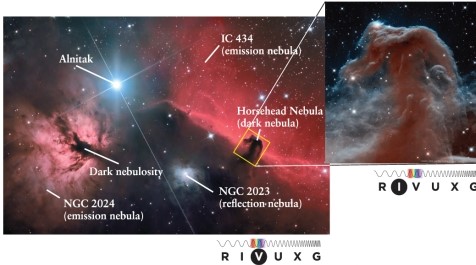
(Multiple Choice)
4.8/5 (69)
(69) If a protostar were able to contract (get smaller) without any change in its surface temperature, what would happen to its luminosity?
(Multiple Choice)
4.9/5 (78)
(78) What particular and very important phenomenon frequently occurs in binary star systems where the stars are very close together?
(Multiple Choice)
4.7/5 (78)
(78) What happens to the luminosity of a low-mass star as it passes through a helium flash?
(Multiple Choice)
4.8/5 (76)
(76) Why is it that the majority of stars in the sky are in the main-sequence phase of their lives?
(Multiple Choice)
4.8/5 (74)
(74) What condition is considered sufficient for an interstellar cloud to collapse and form a star or stars (i.e., if this condition holds then the cloud has to collapse)?
(Multiple Choice)
4.9/5 (93)
(93) What is the MOST important property of a star that governs its evolution and lifetime?
(Multiple Choice)
4.9/5 (91)
(91) The study of stars in clusters has especially helped astronomers to understand
(Multiple Choice)
4.9/5 (85)
(85) At what stage of evolution are the stars with similar luminosities between 50 and 100 times that of the Sun but spread over a range of temperatures?
(Multiple Choice)
4.8/5 (72)
(72) The present estimate of the age of the universe is about 14 billion years. How long will a half-solar-mass star spend on the main sequence, compared with the present age of the universe?
(Multiple Choice)
4.7/5 (73)
(73) The Cygnus Loop Nebula is characterized by having an arched, shell-like appearance. The Cygnus Loop is a
(Multiple Choice)
4.9/5 (70)
(70) When plotted on an H-R diagram, the more massive stars of a particular star cluster are on the main sequence and the less massive stars are above the main sequence. Can the age of this cluster be determined? (In other words, how long is it since these stars condensed from the interstellar medium?)
(Multiple Choice)
4.9/5 (84)
(84) 
Filters
- Essay(0)
- Multiple Choice(0)
- Short Answer(0)
- True False(0)
- Matching(0)